Plate Nº 83 · recorded November 10, 2026
Space & AstronomyReported finding
Proposed ELT Instrument Could Resolve Dark Matter Puzzle of Ghost Galaxies
A proposed ELT spectrograph, NEXUS@SHARP, could test dark matter theory by weighing ultra-diffuse galaxies via their globular clusters out to 230 million light-years.
By Priya Raman4 min read764 words
In brief
- The ELT is scheduled for first light in March 2029, with a 39.3-meter segmented mirror.
- NEXUS@SHARP could survey globular clusters in ultra-diffuse galaxies out to 60–70 Mpc in a few hours of ELT time.
- Ultra-diffuse galaxies are Milky Way-sized but contain thousands of times fewer stars.
- The study by Marco Mirabile et al. appears in New Astronomy (2026), DOI: 10.1016/j.newast.2026.102620.
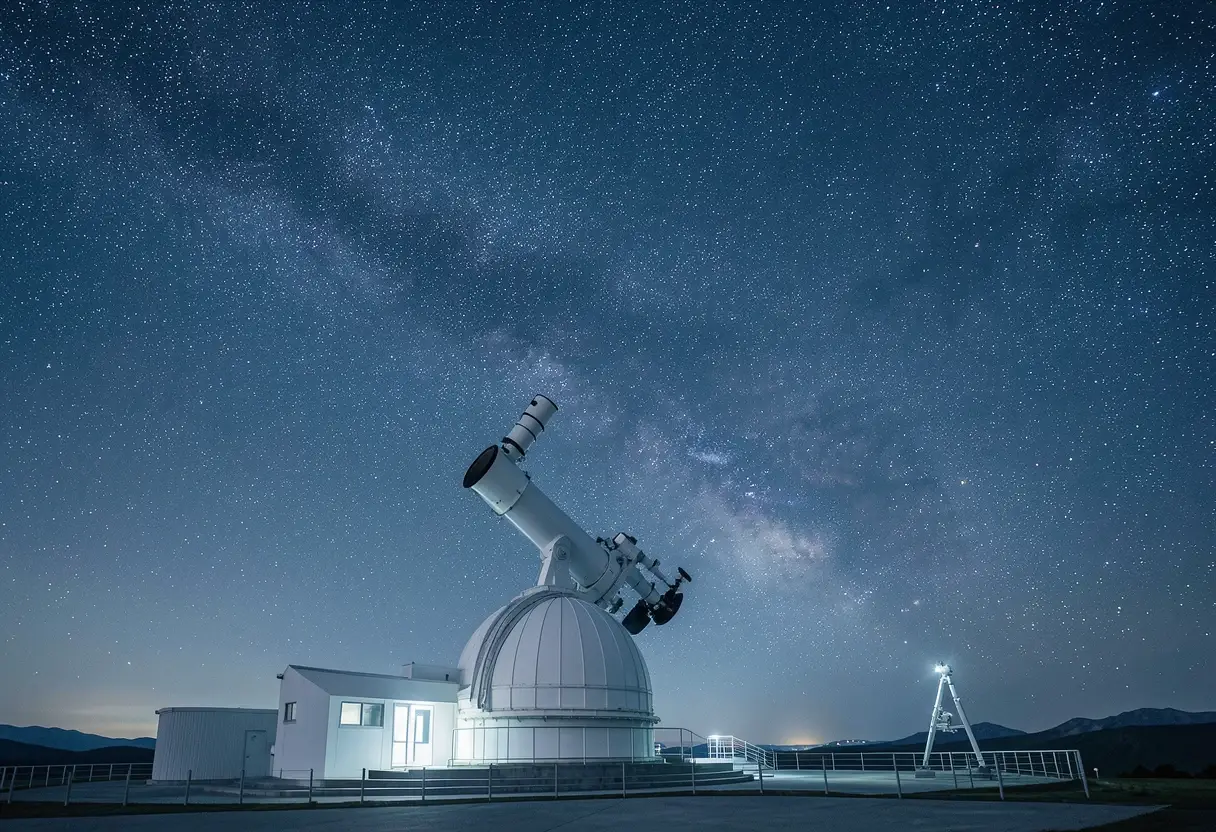
In March 2029, the Extremely Large Telescope is scheduled to open its eye on the sky — and a newly proposed instrument could aim that eye at some of the strangest galaxies known, ones that may either confirm or contradict our standard model of the universe.
A paper published in the journal New Astronomy, led by Marco Mirabile, a Ph.D. student at INAF-Astronomical Observatory of Abruzzo and the Gran Sasso Science Institute in Italy, lays out the case for an instrument called NEXUS@SHARP. NEXUS is a multi-object spectrograph (an instrument that splits light from many targets at once to measure properties such as motion and chemical makeup) designed to work with SHARP, the Spectrograph for High Angular Resolution Physics, on the ELT's 39.3-meter segmented mirror.
The targets are ultra-diffuse galaxies, or UDGs: galaxies about as large as the Milky Way but containing thousands of times fewer stars, spread so thin that they glow dimly. Their existence sits uneasily with the current model of cosmology, Lambda-CDM (the standard Big Bang framework, in which cold dark matter drives structure formation).
"Ultra-diffuse galaxies (UDGs) challenge current galaxy formation models within the ΛCDM framework, particularly regarding their dark matter content and formation histories," Mirabile and colleagues write.
Why do these ghost galaxies matter?
A galaxy's size is shaped by its dark matter halo (the invisible envelope of mass surrounding it, one of the universe's basic structural units). For UDGs, there is an apparent mismatch: the expected halo sizes should not produce galaxies this diffuse. Astronomers do not know what dark matter is — some even doubt it exists — and Lambda-CDM, while still the best fit to much data on dark matter and dark energy, does not explain everything.
The key to testing the mismatch lies in globular clusters: dense, spherical groups of stars that orbit galaxies. They matter for three reasons:
- They are brighter than their faint host galaxies and easier to observe.
- They extend farther outward, tracing the dark matter halo more effectively.
- Their number rises roughly in proportion to halo mass, providing a second, independent mass estimate.
Current spectroscopic facilities cannot reach the depth needed to characterize globular cluster populations beyond the local neighborhood. NEXUS@SHARP could change that.
What makes NEXUS@SHARP different?
Multi-object spectrographs already exist on Keck, the VLT, Gemini and the JWST. NEXUS would combine that capability with the ELT's extraordinary collecting power. "We demonstrate that NEXUS is uniquely positioned to overcome current observational limitations by combining high spatial resolution with efficient multiplexing," the authors write.
The payoff is efficiency. "We show that NEXUS can efficiently help to characterize the GC population in UDGs across diverse environments — out to 60 to 70 Mpc — with a few hours of ELT time," the paper states. Seventy megaparsecs corresponds to roughly 230 million light-years.
What would the measurements show?
Each UDG studied would yield two independent mass measurements: a dynamical mass from the velocity dispersion of its globular clusters (how fast they move, revealing the mass needed to hold them in orbit), and a GC-count mass from their total number.
The combination distinguishes between two competing formation scenarios:
- Failed massive galaxies: quenched early in their history, retaining dwarf-like stellar masses inside massive halos. These would appear "red, old, metal-poor, DM dominated, and host unusually rich globular cluster populations," the authors write.
- Puffed-up dwarfs: genuinely low-mass galaxies that expanded for some reason, expected to be "bluer, exhibit extended star formation histories, and have DM content and GC populations resembling those of typical dwarfs."
If both mass measurements agree and both are high, the galaxy is a failed regular galaxy. If both agree and are low, it is a puffed-up dwarf. A wrinkle appears if the dynamical mass is low but the GC-count mass is high: globular cluster formation was then unusually efficient for some environmental reason.
Spectra of the clusters also reveal their ages and metallicities (chemical compositions), showing how quickly their stars formed and what kind of UDG hosts them.
How firm are these plans?
NEXUS@SHARP remains a concept; the paper argues the case for building it rather than reporting results. "By enabling the systematic spectroscopic survey of GCs in low-surface-brightness systems, NEXUS@SHARP will act as a definitive tool for constraining the formation channels of the most elusive galaxy populations in the local universe," the authors conclude.
If built, it will chip away at the uncertainty surrounding ultra-diffuse galaxies — and, with it, at the standing of dark matter itself.
via phys.org/rss-feed/ (Source)
More from Priya Raman
Show full bio
Senior reporter covering people, launches and day-to-day practice in general science news at SciBeat.
343 articles
Nearby plates
- JWST Detects 104 Magnified Stars in Dragon Galaxy, More Than Doubling Record
- Thousands of Tiny Robots Have a Blind Spot Problem
- Hubble catalogue reveals 30,000 baby stars in N44 superbubble
- AI and the Largest 2D Map of the Universe Uncover 70 New Gravitational Lenses
- Faint Young Stars Suggest Messier 74 Is Nearly Twice as Large as Thought