Plate Nº 76 · recorded November 9, 2026
Space & AstronomyReported finding
Shield Space plans autonomous satellite-defense swarm tests
Shield Space plans a 2027 autonomous rendezvous test, then a 100-cubesat satellite-defense system its CEO estimates could cost less than £100 million to deploy.
By Nathan Brooks5 min read1,048 words
In brief
- Shield Space proposes 100 autonomous cubesats for a protect-and-defend mission costing less than £100 million ($134 million).
- Project Broadsword is planned for Q4 2027 on SpaceX’s Transporter-21, with an 8U cubesat and 3U target craft.
- The demonstration targets a separation of 100 kilometers reduced to 100 meters through four stages of autonomy.
- NASA’s Starling mission launched in 2023 with four small satellites and demonstrated autonomous civilian-science cooperation.
- Shield Space says it is not pursuing kinetic-impact satellite defense, according to an editor’s note updated Nov. 5.
By Nathan Brooks
“We’re talking about deploying 100 cubesats on a protect-and-defend mission for less than £100 million,” said Graeme Ritchie, co-founder and CEO of Shield Space. He said the $134 million total was roughly what one satellite previously cost. The U.K. startup has yet to demonstrate the system, but plans an orbital test in the fourth quarter of 2027.
The proposed drones are low-cost and attritable, meaning they are designed to be expendable. Shield Space aims to apply lessons from drone warfare in Ukraine, where Russia’s invasion has shown the value of swarms.
Why is satellite defense needed?
In May 2026, four Russian military satellites came close to ICEYE-X36, a private synthetic-aperture radar imaging satellite widely believed to be supplying battlefield intelligence for Ukraine. The encounter was an apparently aggressive, risky “grey zone” maneuver that alarmed much of the space industry.
The reported closeness was enough to raise the possibility of jamming or interfering with ICEYE-X36’s signal, blinding it with a laser, firing a metal dart, or forcing it to maneuver and burn fuel. Those were possible actions, not confirmed attacks.
In October 2026, one of the same four satellites passed within 500 meters, or 1,650 feet, of ICEYE-X36. The behavior appeared intimidatory, but the episode did not establish intent, and it has increased Western interest in defensive satellite technology.
What would the drone swarm do?
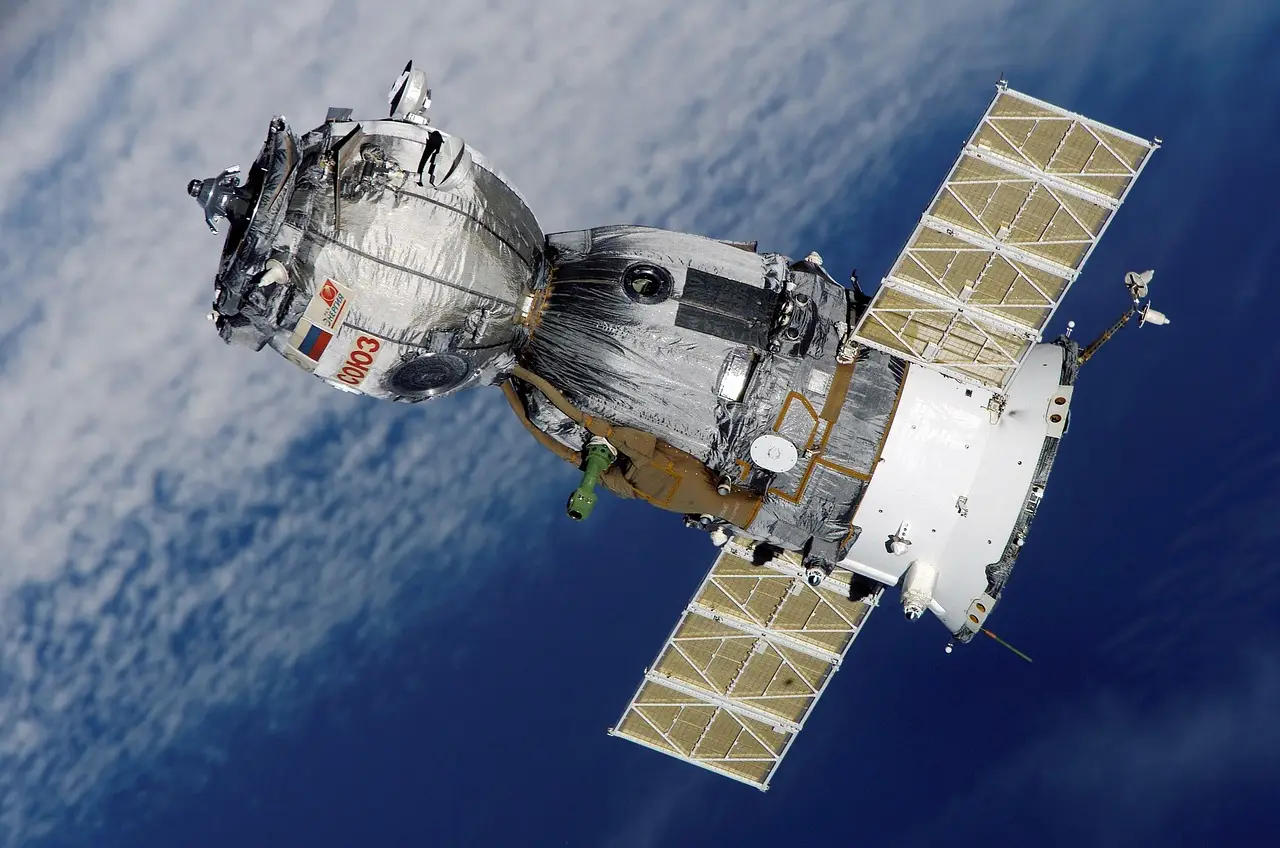
Shield Space plans to release up to 100 very small, drone-like spacecraft from a car-sized carrier in Earth orbit. Each microwave-sized craft would serve as an interceptor, using “effectors,” meaning systems such as lasers or microwaves, to defend a Western satellite. The system would also have to function if controllers lost contact with it.
What exactly will the 2027 test involve?\n
Rendezvous and proximity operations, or RPO, means matching another spacecraft’s position and distance in orbit. On SpaceX’s Transporter-21 rideshare mission, a shared launch, Project Broadsword will send an 8U cubesat and a smaller 3U target craft.
Shield Space plans to maneuver them from 100 kilometers, or 62 miles, apart to within 100 meters, or 330 feet. It will progress through four stages of autonomy, from human-in-the-loop control, where a person approves actions, to “approximately” full autonomy.
A cubesat unit, or U, is a cube measuring 10 centimeters, about 4 inches, on a side. The 8U and 3U names express how many such unit volumes each craft contains.
NASA’s civilian Starling project, launched in 2023, demonstrated that four small satellites could cooperate and operate autonomously during a science mission. The spacecraft relied little on real-time commands from ground control, but Starling did not test combat behavior.
No leading space power has publicly demonstrated swarm combat, though major powers may be reluctant to disclose such capabilities. Shield Space’s 2027 test would address a more demanding application than Starling.
Can the hardware fit inside a cubesat?
Ritchie called size, weight and power the central engineering problem and said the team has only roughly 100 by 100 centimeters to work with. Some mission elements have required new designs from scratch. The aim is to save space or use integrated systems while fitting propulsion, power systems, sensors, AI computing, laser communications and weapons systems within the weight allowance.
Shield Space has commissioned EnduroSat to build the autonomous 8U cubesat, including chemical propulsion and its own imagery-collecting capability. Shield Space will install its software and use the craft for the RPO demonstration.
“The good thing about cubesats is they’re very standardized and they’re very off the shelf,” said Dan Molland, co-founder and chief technology officer. He said cubesats still need some adjustment, but they are more plug-and-play than conventional platforms, which are usually custom-built. Shield Space sees that standardization as a route to cheaper systems than bespoke designs.
Can artificial intelligence control the swarm?
Ritchie said autonomous models need an extraordinary amount of training data, but data comparable to that available from the Ukraine war are not readily accessible for space combat. Synthetic data can help train the system, but he said it is not quite good enough for space.
Molland said Starling mainly asks a guidance system to stay within a specified range of another satellite. Controlling a military swarm raises a more complex set of questions, and its AI must follow rules of engagement, which govern when force may be used.
Both believe the technical hurdles can be overcome, though Ritchie says missions such as Broadsword must generate the missing data. Their schedule includes several sharply different steps between a two-craft maneuver and a distributed defensive network.
What does history say about the idea?
Bleddyn Bowen, an associate professor of astropolitics at Durham University and author of War in Space: Strategy, Spacepower, Geopolitics (Edinburgh University Press, 2020), compared Shield Space’s concept with Brilliant Pebbles. That late-Cold War research program within the Strategic Defense Initiative sought to defend the United States from Soviet intercontinental ballistic missiles with thousands of small autonomous orbiting interceptors that would destroy missiles by collision.
Bowen said enough investment makes a lot feasible, but warned that any such system would require many years of development and testing. The unresolved commercial question, he said, is finding someone to buy it.
What milestones come after the 2027 demonstration?
Shield Space hopes to move quickly through four levels of hardware and scale:
- Late 2027: Project Broadsword’s two-craft RPO demonstration.
- Next: tests involving two full-size 16U cubesats.
- Then: one carrier carrying 10 such cubesats.
- Later: a “super carrier” containing 10 carriers, deployed across multiple orbits.
Only the first milestone has an announced date. Ritchie calls the long-term concept “space-based carrier strike.” In that scenario, responsive launches or pre-positioned carriers could protect entire orbits, but Shield Space has not demonstrated that capability.
An editor’s note, updated at 10:45 a.m. ET on Nov. 5, says the original story suggested Shield Space might be developing kinetic-impact, or collision-based, satellite defense. The company says it is not doing so.
For now, Project Broadsword is the next test. The proposed 100-cubesat fleet remains a long-term vision rather than an operational capability.
via space.com (Source)
More from Nathan Brooks
Show full bio
Market editor covering companies, deals and strategy in general science news at SciBeat.
325 articles
Nearby plates
- NASA Picks Three Firms for Ka-Band Satellite Relay in $1 Billion Awards
- Congress Moves to Cut Basic Defense Science Funding
- 63% of Remote First Nations Homes Lack Working Free-to-Air TV
- Three Days to a Collision: Why Space Junk Is Nearing a Breaking Point
- NASA Seeks Industry Proposals for Commercial Space Stations