Plate Nº 75 · recorded October 10, 2026
Space & AstronomyReported finding
SpaceX Aims for First Starship Orbital Flight on 14th Test
SpaceX will attempt its 14th Starship test flight on Monday, targeting a 275 km orbit at 28,000 km/h and deploying 26 Starlink satellites—a milestone three years in development.
By James Calloway3 min read544 words
In brief
- SpaceX's 14th Starship test flight launches Monday at 7:15 a.m. local time from Texas.
- The mission targets a circular orbit 275 km above Earth at roughly 28,000 km/h.
- Starship will deploy 26 next-generation Starlink satellites if it reaches orbit.
- SpaceX completed a high-profile IPO in June and continues to dominate the global launch market with its Falcon rockets.
- SpaceX plans three more launches the same week, including a crew mission to the International Space Station.
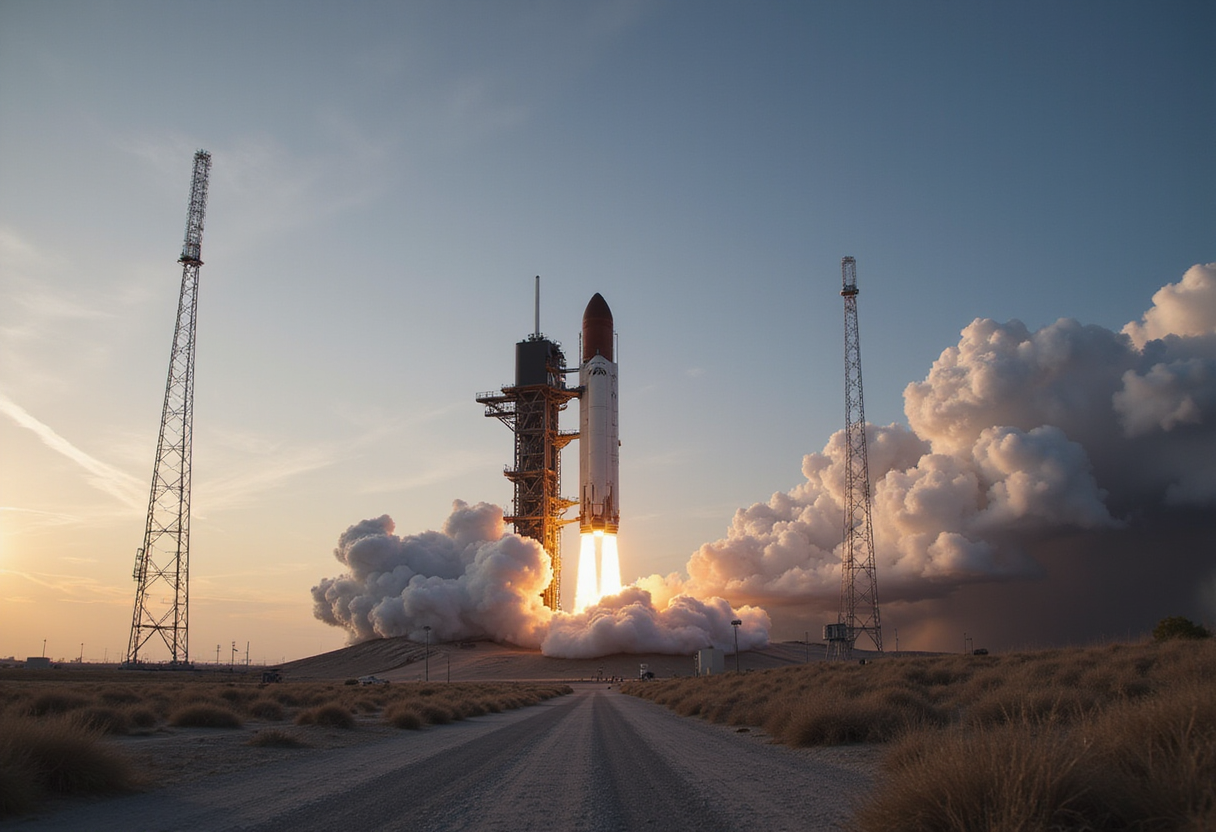
SpaceX will attempt on Monday, in its 14th test flight, to put its massive Starship rocket into Earth orbit for the first time, a milestone three years in the making since the vehicle's first suborbital hop.
The launch is scheduled for 7:15 a.m. local time (12:15 p.m. GMT) from the company's test facilities in Texas. The roughly 10-hour mission will send the upper stage into orbit and, if all systems perform, deploy 26 next-generation Starlink satellites there.
What makes this test different?
Every previous Starship flight followed a suborbital trajectory, which kept the rocket below orbital velocity. SpaceX began flying the vehicle in its full stacked configuration in 2023, and several of those early attempts ended in spectacular explosions.
Now the company wants to push further. SpaceX is targeting a circular orbit roughly 275 km (171 miles) above Earth, which requires a speed near 28,000 km/h (17,400 mph). To get there, the upper stage must perform a second engine burn after separating from its booster.
"That's the hardest part," requiring "more forces and more complex calculations," said Kathleen Curlee, a senior analyst at Georgetown University's Center for Security and Emerging Technology.
To reach the necessary altitude and speed, "the rocket has to do different things when it's experiencing different levels of gravity," she added.
What's the flight plan?
If Starship reaches orbit, it will circle Earth six times before splashing down in the Pacific Ocean. The Super Heavy first-stage booster will drop into the Gulf of Mexico shortly after launch. SpaceX will not try to catch it with the launch tower's mechanical arms this time.
The black-and-silver vehicle stands as the largest and most powerful object ever flown. SpaceX eventually hopes to make it fully reusable, but engineers still face a long list of technical challenges before commercial flights or missions to the moon and Mars can begin.
Why does the test carry so much weight?
From an engineering standpoint, "just achieving flight and getting data" would count as a success, Curlee said. But investors and spectators expect more than that.
"They need to have flashy tests" because anything less would look like a failure, she added.
SpaceX staged a high-profile initial public offering in June, and the company still dominates global launch services with its partially reusable Falcon rockets. Monday's flight could shape how the market reads both Starship's technical promise and the company's financial trajectory.
How does competition factor in?
A Chinese company has recently advanced its own reusable-rocket program, adding competitive pressure. Starship's development has also faced repeated delays along the way.
Curlee noted that SpaceX has turned risk-taking into its operating philosophy, betting that public spectacle and rapid iteration will keep it ahead of rivals.
What comes next?
Whether Monday's attempt succeeds or not, SpaceX plans three additional launches later the same week. One of those missions will carry a crew of astronauts to the International Space Station.
Future Starship tests, according to the company, will include attempts to refuel the vehicle in orbit. That capability is a key building block for any deep-space mission, whether to the moon or to Mars.
via Phys.org Space & Astronomy (Source)
More from James Calloway
Show full bio
Staff writer covering marketplaces and e-commerce at SciBeat.
205 articles
Nearby plates
- Starship Reaches Orbit for the First Time and Deploys 26 Starlink Satellites
- Starship Reaches Orbit for First Time, Delivers 26 Starlink Satellites
- Starship reaches Earth orbit for the first time — with 26 satellites and an engine failure
- Crew-13 Targets Oct. 1 Launch for Sub-9-Hour Trip to ISS
- Starship's 18,000-tile heat shield faces its first orbital test