Plate Nº 40 · recorded November 1, 2026
Space & AstronomyReported finding
Spinning Black Holes Could Split in Two, Theoretical Study Finds
Physicists at the University of Southern Denmark calculated that only black holes rotating near their maximum rate might split into two smaller ones, and no such split has ever been observed.
By Nathan Brooks4 min read739 words
In brief
- The study was published October 22, 2026, in the peer-reviewed journal Physical Review D.
- Only black holes rotating close to their maximum possible rate might be able to split in two.
- For a non-rotating black hole, splitting would decrease total entropy, violating the second law of thermodynamics.
- No black hole split has ever been observed in nature.
- Gamma-ray telescope Fermi-LAT could search for signals from black-hole fragments formed during mergers.
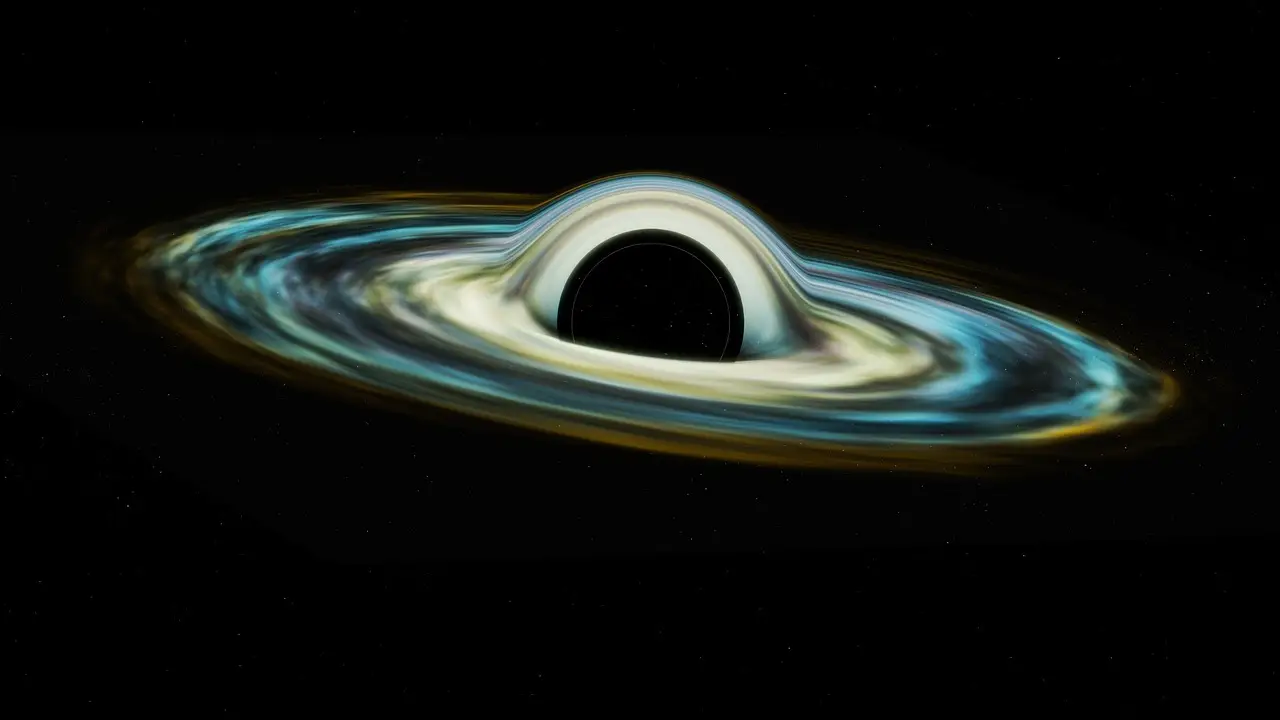
A black hole spinning close to its maximum possible rate might be able to split into two smaller black holes. That's the conclusion of a theoretical study published October 22, 2026, in the peer-reviewed journal Physical Review D, from researchers at the University of Southern Denmark.
The catch is steep. Under most conditions, the team found, splitting simply doesn't work. And so far, astronomers have never observed a single black hole that appears to have split.
"In our study, we investigate which physical laws normally prevent a black hole from splitting into two," said Francesco Sannino, a co-author and professor of physics at the University of Naples Federico II in Italy and the Quantum Field Theory Center at the University of Southern Denmark. "We also investigate if certain circumstances may allow a split to happen."
Why don't black holes normally split?
We usually picture a black hole as a solitary object, drifting through space or lurking at a crowded galactic center. Black holes do collide, and sometimes they merge into a single, more massive hole. But the reverse — one hole breaking into two smaller ones — runs into a fundamental obstacle: entropy.
Entropy, in plain English, is a measure of how many microscopic arrangements can produce the same overall state of a system. It helps physicists judge which changes can happen on their own and which are energetically or thermodynamically unfavorable.
Here's the problem. If a black hole isn't rotating, splitting it into two would reduce the system's total entropy. The second law of thermodynamics forbids that: the total entropy of an isolated system cannot decrease in a spontaneous process. A split would break one of physics' most basic rules.
How could rapid rotation change the answer?
Rotation could reopen the door. A rapidly spinning black hole carries rotational energy, and that energy changes the conditions under which a split might occur. Under the right theoretical setup, one hole could branch into two or more smaller ones.
Physicists describe this shape-shifting with a memorable name: pair-of-pants topology. Picture a pair of pants, with one opening at the top branching into two legs below. The original black hole is the waist; the two daughter holes are the legs.
But there's a second requirement. The two newborn black holes must be able to move apart rather than fall back together. And when the researchers built that into their calculations, the possibilities narrowed sharply.
"When we include this requirement, the window largely closes again, except possibly for black holes rotating close to their maximum possible rate," Sannino said.
What about extra dimensions?
The study also explores more exotic scenarios, at least for now purely theoretical ones. Some theories propose that our universe has extra spatial dimensions beyond the three we experience — up and down, back and front, side to side.
In higher-dimensional models, certain black holes can become unstable and start breaking apart. There, the researchers found, splitting could become much more likely, because the total entropy could increase rather than decrease, making the split thermodynamically favorable.
Plenty of unknowns remain, though. Sannino said: "We cannot yet give a single probability for a black hole to split. It depends on how gravity behaves beyond Einstein's theory, and we are working to quantify this."
The team expects that small primordial black holes — hypothetical miniature black holes theorized to have formed in the first fraction of a second after the Big Bang — would be more prone to splitting than much larger astrophysical black holes.
How could we ever detect a split?
Direct observation is off the table for now. But an indirect signal might be within reach. Gamma-ray telescopes such as Fermi-LAT, Sannino noted, can search for signals from tiny black-hole fragments that might form during mergers.
Black holes with planets, too
Splitting isn't the only strange black hole idea in the news this month. Earlier in October 2026, astrophysicists Bhupendra Mishra and Wladimir Lyra discussed the possibility of black holes hosting their own planets on a SETI livestream.
Their simulations suggested a black hole could indeed have planets — potentially millions of them apiece, some growing larger than Jupiter.
Bottom line: Black holes sometimes collide and merge. A new theoretical study maps the rare conditions — extreme rotation, or extra spatial dimensions — under which one might instead split into two, though no such split has ever been observed.
via journals.aps.org (Original)
More from Nathan Brooks
Show full bio
Market editor covering companies, deals and strategy in general science news at SciBeat.
267 articles
Nearby plates
- Two Supermassive Black Holes Could Collide in Just 100 Years
- Black Holes of All Sizes Fire Jets at the Same 2% Threshold
- Black holes grow normally even in bulgeless galaxies, study finds
- Milky Way's Central Black Hole May Feed Energy to Cosmic Rays
- Millions of Planets Could Orbit Supermassive Black Holes, Simulations Show