Recorded November 22, 2026
Space & AstronomyReported finding
Sun's Death Throes Could Break Up the Solar System Early
Simulations published in the Astrophysical Journal Letters suggest the Sun's pulsed, asymmetric mass loss could disrupt the outer planets, with 90% of model systems breaking apart within three billion years.
By James Calloway4 min read841 words
In brief
- Study published September 21 in the Astrophysical Journal Letters
- 90% of simulations show total solar system disruption within three billion years of the red giant phase
- 77% of runs show an outer planet crossing another's orbit early in the Sun's mass loss
- Each mass-loss pulse ejects about 0.01% of the Sun's material, adding random kicks of a few meters per second
- The Sun becomes a white dwarf with about half its current mass packed into an Earth-sized volume
By James Calloway
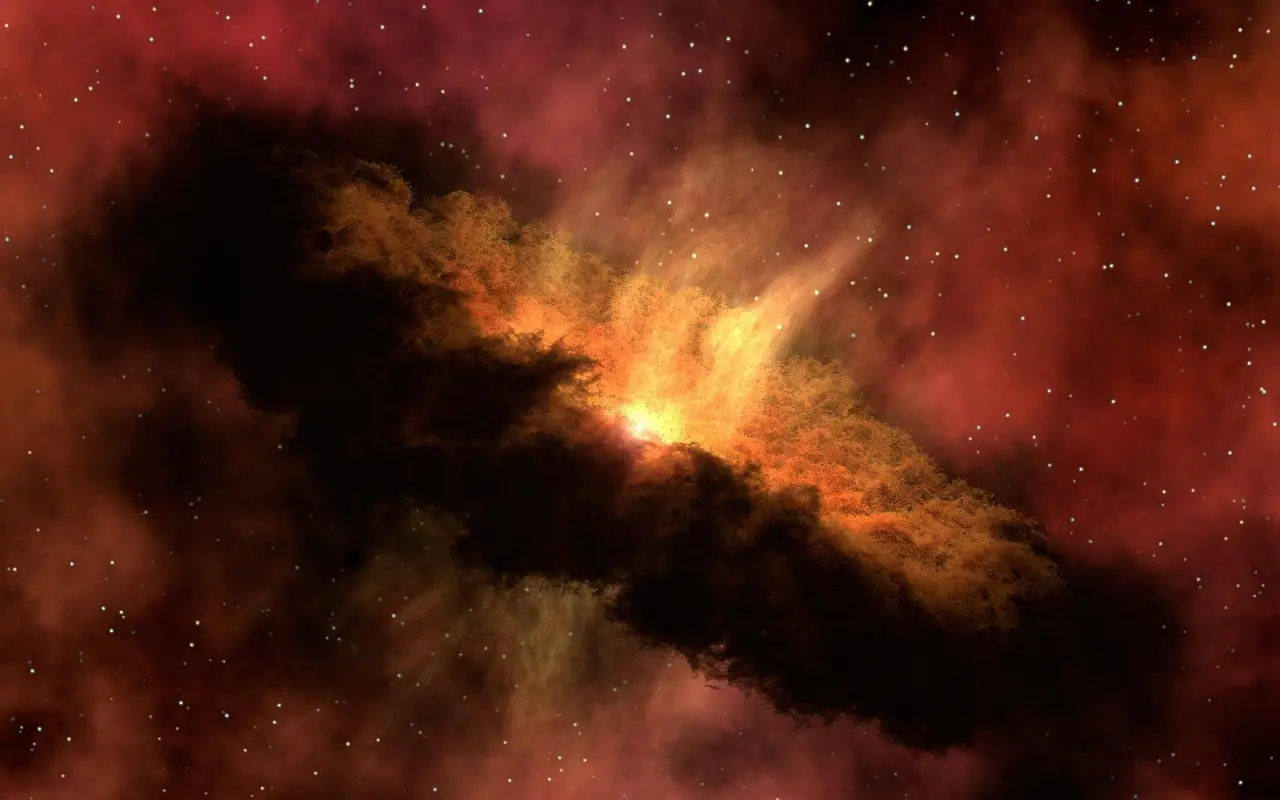
In 90 percent of new simulations, the solar system falls completely apart within three billion years of the Sun becoming a red giant — a far messier death than astronomers had assumed. The study, published September 21 in the Astrophysical Journal Letters, finds that the Sun's own erratic mass loss, not passing stars, will likely tear the outer planets from their orbits.
And in one simulation, Saturn gets flung out of the system within just a few million years of the Sun swelling up. That's soon, by astronomical standards. It's also not what anyone expected.
What did we think would happen?
The broad outline of the Sun's death has been settled for a while. In roughly six billion years, changes in the star's core will make it swell into a red giant. Mercury and Venus will be consumed outright. Earth may escape that fate, but it and Mars will be broiled.
The puffed-up Sun will then shed its outer layers, losing mass and weakening its gravitational grip. The planets, in response, will drift outward. Some astronomers assumed this slow slackening meant the outer planets would orbit stably for immense stretches — possibly as much as 100 billion years, long after the Sun itself is dead. Under that picture, the eventual wreckers would be other stars, passing close by over tens of billions of years and tugging planets loose.
The new work says the Sun won't wait around to be robbed.
What's the mechanism?
Here's where it gets interesting. Evidence suggests the Sun's core instabilities won't produce a smooth, sedate mass loss. Instead, the star will suffer episodic spasms in which its luminosity briefly spikes and it sheds material in powerful pulses.
Those pulses won't blow off symmetrically, either. Each one ejectates material asymmetrically, in a relatively random direction — like a sudden gust of wind. And that asymmetry matters enormously.
The researchers simulated this process across several billion years, from the Sun's red giant phase to its end state: a white dwarf, a hot, dense ball holding about half the current solar mass squeezed into a volume roughly the size of Earth.
In their model, the Sun loses mass in thousands of small burps, each ejecting about 0.01 percent of its material in a broad funnel shape rather than a sphere.
Why does a funnel-shaped burp break the solar system?
Focus the ejected material and it acts like a rocket exhaust, pushing back on the Sun. Each kick is tiny — a few meters per second of added velocity. Each kick is also random in direction.
You might assume random kicks cancel out. They don't. This is a classic "random walk": take steps in random directions and, after a finite number of them, you still end up displaced from where you started. Same for the Sun. Thousands of random kicks add up to a final velocity of several kilometers per second.
That drift stretches the planets' orbits into more elongated shapes. The numbers are stark:
- In 77 percent of simulations, the outer planets migrate so much that one crosses another's orbit — and this happens early in the process.
- Ejected planets or system-wide disruptions occur in 40 percent of simulations, long before the Sun even becomes a white dwarf.
- After three billion years, total disruption hits 90 percent of the runs.
By the time other stars wander close enough to matter, the researchers conclude, there won't be much of a solar system left for them to disrupt.
How solid is this?
Caveats, as always. These are simulations, and they hinge on assumptions about how a dying Sun sheds mass — the asymmetric, pulsed ejection pattern chief among them. If real mass loss turns out smoother or more symmetric, the picture softens considerably. The 100-billion-year stability estimate carried its own assumptions too, of course, and both models are wrestling with physics nobody has directly observed at this scale.
There's also context worth holding onto. This line of thinking didn't appear from nowhere. Since the 1990s, astronomers have found "hot Jupiters" — gas giants hugging their stars closer than Mercury — plus planets on wildly tilted orbits and some revolving backward. In 2005, researchers proposed the Nice model (named for the French city where they met), which holds that our own giant planets formed closer to the Sun and migrated outward through gravitational tussles. Migration, in short, is now as central to celestial mechanics as evolution is to biology. The solar system isn't static. It's still evolving.
What does this change for anyone alive?
Nothing, practically. The disruption, if it comes, lies many billions of years out, and the planets — including Earth — look stable for eons to come. The finding matters for how astronomers model the far futures of other planetary systems, many of which will host the same kind of dying, sputtering stars.
But if you had plans for seven or eight billion years hence, the authors' implicit advice stands: reassess them.
via scientificamerican.com (Source)
More from James Calloway
Show full bio
Staff writer covering regulation, policy and their impact on general science news at SciBeat.
570 articles
Nearby plates
- First known “disappearing planet” traced to an orbit-tilting neighbor
- Millions of Planets Could Orbit Supermassive Black Holes, Simulations Show
- MIT Team Finds a Star Slowly Eating Its Companion for Billions of Years
- ALMA Catches a Dying Star's Final Nuclear Heartbeat, Frozen in Gas
- JWST Survey of 72 Young Stars Maps How Planet-Forming Gas Escapes