Recorded November 19, 2026
Biology & EvolutionReported finding
Tracked Young Emperor Penguins Swim Straight Into Krill Fishing Grounds
Satellite tags on 48 young emperor penguins reveal repeatable year-long migrations that overlap industrial krill fishing, strengthening the case for stalled Weddell Sea protections.
By James Calloway4 min read751 words
In brief
- 48 juvenile emperor penguins were tracked from three Weddell Sea colonies, including first-ever tracking at Snow Hill Island and Jason Peninsula.
- Jason Peninsula juveniles spent over 60% of their time in recently fished zones during February and March.
- Juveniles spent 15–32% of their year inside proposed marine protected areas, depending on colony.
- A proposed 2.2 million km² Weddell Sea MPA has been blocked at CCAMLR for over a decade.
- The IUCN listed the emperor penguin as endangered this year, predicting populations will halve by the 2080s.
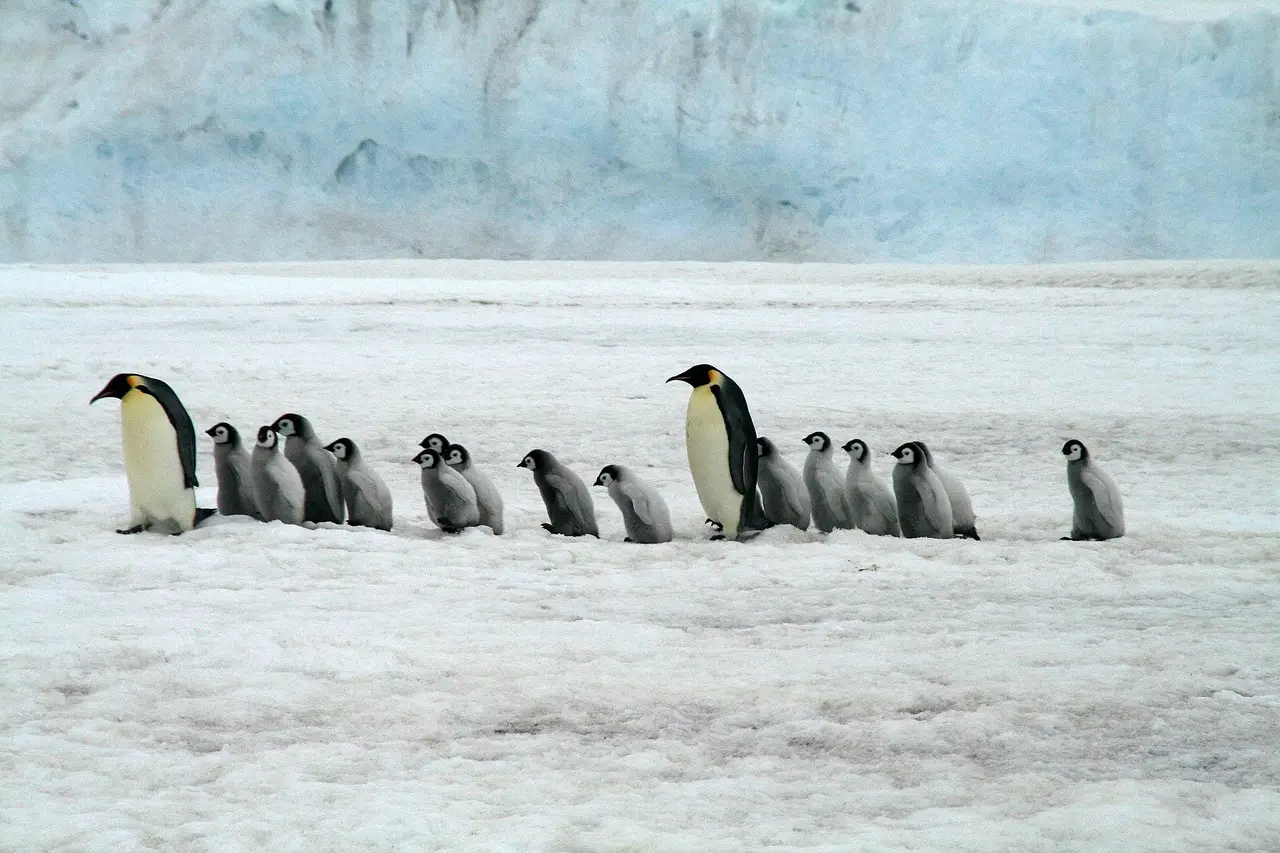
Juvenile emperor penguins from Jason Peninsula spent more than 60% of their time in recently fished zones during February and March, according to new tracking research that maps, for the first time, where the species spends its most vulnerable year.
The study, published in Biological Conservation and co-led by France's CNRS, the Center Scientifique de Monaco and the Woods Hole Oceanographic Institution, followed 48 young penguins from three colonies around the Weddell Sea: Snow Hill Island, Jason Peninsula and Atka Bay. It's the first time juveniles from the two western colonies had ever been tracked.
The punchline for policymakers: the birds' journeys are predictable. Very predictable. And that predictability is exactly what makes new marine protected areas worth arguing about.
What did the trackers actually show?
Young emperors leave their colonies at roughly five months old and head into open ocean, where they must learn to dive and hunt fast. Only about a third survive to adulthood.
Researchers fitted satellite tags to 20 penguins at Snow Hill Island and Jason Peninsula in December 2023 and January 2024, then combined that data with three years of tracking from Atka Bay on the other side of the Weddell Sea.
The pattern held across all three colonies:
- Departure from the colonies in March
- A northward trip to the Polar Front, a productive band of the Southern Ocean
- A southward move, then north again, following expanding winter sea ice
- A return to the Antarctic continent as the ice melts
"We were struck by the remarkable consistency of the penguins' movements," said Émile Brisson-Curadeau, a postdoctoral researcher at the Center for Functional and Evolutionary Ecology and first author of the study. "Despite traveling more than 1,500 kilometers (930 miles) and spending an entire year at sea, penguins from different colonies and in different years showed very similar movement patterns."
How much fishing do they meet?
The overlap numbers vary by colony, and the spread matters. Juveniles from Atka Bay spent 32% of their year inside proposed marine protected areas, or MPAs — zones where fishing would be restricted. Snow Hill birds spent 21%; Jason Peninsula birds just 15%.
Meanwhile, the two western colonies encountered heavier fishing activity, concentrated near the Antarctic Peninsula and around South Georgia. Most of it targets Antarctic krill, a key emperor penguin food source, with additional trawling for mackerel icefish and longlining for Patagonian toothfish.
So the penguins facing the most fishing get the least coverage from the proposed protected areas. The study doesn't prove fishing is killing juveniles — that link isn't established here. It shows the overlap exists and recurs.
"The critical thing in this research is the repeatability," said Daniel Zitterbart, co-lead author and associate scientist at the Woods Hole Oceanographic Institution. Existing Antarctic MPAs, he noted, protect waters near colonies — critical for adults, but they "fail to cover the sea areas where juveniles spend their vulnerable early years."
Because those areas are used year after year, Zitterbart argued, protecting them "will remain relevant in the future."
What does this change for the Weddell Sea?
Not much yet, if we're honest. A proposed MPA covering about 2.2 million square kilometers (850,000 square miles) of the Weddell Sea has sat on the table for more than a decade, blocked repeatedly by the consensus rule at the Commission for the Conservation of Antarctic Marine Living Resources (CCAMLR), the body of member states that governs Antarctic waters.
The timing is uneasy, though. Emperor penguin populations are in steady decline, and this year the IUCN listed the species as endangered, predicting numbers will halve by the 2080s as climate change reshapes sea ice.
"It's time for CCAMLR to protect critical habitat in the Weddell Sea, which supports around one-third of the world's emperor penguins," said Emily Grilly, oceans conservation manager at WWF-Australia.
Co-lead author Céline Le Bohec, of the Center for Functional and Evolutionary Ecology and the Center Scientifique de Monaco, framed the stakes beyond one species: managing the timing and intensity of fishing in key foraging areas, she said, is essential to securing the penguins' food and limiting bycatch. Those same grounds sustain krill, fish, seals, whales and other seabirds — "protecting the habitat of this ecologically important species means protecting the entire food web."
A caveat before anyone declares victory: tracking 48 penguins documents where they go, not whether fishing caused the observed population decline. The study strengthens the case for the MPAs. Approving them still takes politics.
via phys.org/rss-feed/ (Source)
More from James Calloway
Show full bio
Staff writer covering regulation, policy and their impact on general science news at SciBeat.
570 articles
Nearby plates
- Two Remote Pacific Atolls Rank Among the World's Last Intact Reefs
- Two-thirds of flooded coastlines could host invasive species by 2100
- South Korea Could Catch Zero Squid by 2043 as Seas Warm
- Green turtles rebound to 'least concern' amid steep global wildlife declines
- Aldabra's giant tortoises near 183,000 in first rigorous atoll-wide count