Recorded November 19, 2026
Biology & EvolutionReported finding
Portugal fossils push back Characeae expansion by 30 million years
Portuguese rocks hold 115-million-year-old Characeae fossils, pushing the algae family’s expansion back by 30 million years and suggesting that modern lineages diversified earlier than expected.
By James Calloway5 min read996 words
In brief
- 115 million years ago: Praia da Luz strata preserve the oldest known records of Characeae and associated algae.
- 30 million years earlier: Characeae expansion now appears roughly 30 million years earlier than previously thought.
- 18 species: The Portuguese assemblage included 18 species, four of which received new names.
- 2 million years: The proposed cooling interval would count as short on a geological timescale.
- 2026: Jordi Pérez-Cano and colleagues published the study in Palaeontographica Abteilung B.
By James Calloway
Characeae, a family of green freshwater algae, began expanding about 30 million years earlier than scientists thought, according to a 2026 study of fossils from Portugal’s Algarve Basin. The 115-million-year-old assemblage at Praia da Luz contains the oldest known records of Characeae and associated algae, and it undermines a simple story in which one family merely replaced another.
The study, by Jordi Pérez-Cano and colleagues in Palaeontographica Abteilung B, pushes the expansion of Characeae, including lineages that survive today, from roughly 80 million years ago to about 115 million years ago. It also shows those lineages overlapped with the still-dominant Clavatoraceae rather than replacing them.
That is a fossil-occurrence claim, not a complete rewrite of algal evolution. The rocks document presence and relative timing; they do not, by themselves, prove why the algae diversified.
What did the 115-million-year-old fossils reveal?
Researchers identified 18 species. Some were already known, but the Praia da Luz strata still held their oldest recorded occurrences. Four finds brought new names and unusual combinations of traits.
- Echinochara rebellis: A member of the extinct Clavatoraceae family, it had features unexpected for that age. Robert Egan, who had already described two Echinochara species, noticed the mismatch. He later recalled that a non-paleontologist friend called it “How rebellious!”, which supplied the name.
- Lychnothamnus pileatus: Previous finds of this living genus came from Europe, Asia and the Americas in rocks dating to about 80 million years ago. The Portuguese specimen sat in much older rock and looked as if it wore a hat. Pileatus refers to the pileus hats that distinguished freed slaves in ancient Rome.
- Nitellopsis lilliputiensis: The genus’s earliest known record came from 67-million-year-old rocks in the Catalan Pyrenees. Known species were 1.5 to 2 times larger than this specimen. The name honors the tiny inhabitants of Lilliput in Jonathan Swift’s Gulliver’s Travels. The researchers placed it in a smaller branch, the subgenus Campaniella.
- Acroleptochara cynetica: This new genus had unusually thin apical cells, the cells that form the growing tips of roots and shoots. Specialists in Barcelona, Montpellier, Argentina and China had seen nothing like it. The genus name means “Characeae with a tapered upper part,” while the species honors the Cynetes, the Algarve’s earliest recorded inhabitants.
How did the team recover and identify the fossils?
Micropaleontology—the study of microscopic fossils—often turns on chance because researchers do not know what a sample contains until they inspect it.
The expedition began in spring 2024, when the researchers traveled through the Algarve in southern Portugal to determine the age of rocks by their charophyte fossils. Charophytes are green freshwater algae, and the group includes the closest relatives of land plants. The method, biostratigraphy, dates rock layers by matching their fossils with known geological sequences.
They visited several locations studied between the 1960s and 1980s, and Praia da Luz produced the biggest surprise. There, the team collected 120 kilograms (265 pounds) of mostly clay-rich rock and sent it to Barcelona. The post-office clerk in Loulé could not believe the heavy parcel when the researchers described it as stones.
In Barcelona, the team placed the samples in water to break them apart, passed the material through sieves, and selected individual microfossils with fine brushes.
The result initially looked anomalous. During the Early Cretaceous, dated 145 to 100 million years ago, Clavatoraceae predominated. Its diversity began to decline around 110 million years ago, and the family became extinct 66 million years ago.
Characeae, the only surviving family, first appeared around 200 million years ago, while most present-day genera were thought to have emerged around 80 million years ago.
What could have let modern algae diversify so early?
The Cretaceous period spanned 145 to 66 million years ago and was generally a warm period with a strong greenhouse effect. Sea levels were high, much as they are today because melting polar ice caps raise them. Yet the climate was not uniform throughout the period.
Cold intervals lowered sea levels and expanded continents, creating lakes where charophytes thrive. At Praia da Luz, the rocks record continental environments associated with that sea retreat, including lakes. Marine records predominate in other parts of Europe, making the Algarve an unusual window onto past continents.
The authors frame this as a hypothesis, not a local temperature finding. “Our hypothesis is that, probably around 115 million years ago, a short cold period—‘short’ in geological terms means 2 million years—caused the sea to shrink,” they wrote. The Algarve itself contains no evidence of that cooling event.
Their proposed mechanism links the older Characeae expansion to global cooling. More importantly, the fossil community shows that the group diversified while Clavatoraceae remained dominant and evolving. One family did not simply replace the other.
What does this change for plant evolution?
For readers tracking plant evolution, the practical change is a 30-million-year-earlier expansion of Characeae, within the green-algae group that includes land plants’ closest relatives. The claim concerns Characeae, not a newly dated first land plant. Nor do the fossils settle whether cooling caused the expansion; they establish earlier presence and overlap, while the cause remains unproved.
The authors identify four issues for future work:
- What happened in those continental environments?
- Did the chemistry of the water change?
- Were Characeae better equipped to withstand environmental changes?
- Were those environments less stable?
The results appeared in Palaeontographica Abteilung B in 2026 as “Oldest records of crown-group Characeae co-occurring with diverse Clavatoraceae (Charophyta) in the late Aptian (Early Cretaceous) of the Algarve Basin, Portugal” (DOI: 10.1127/palb/0092). In the title, crown-group means the branch leading to living Characeae.
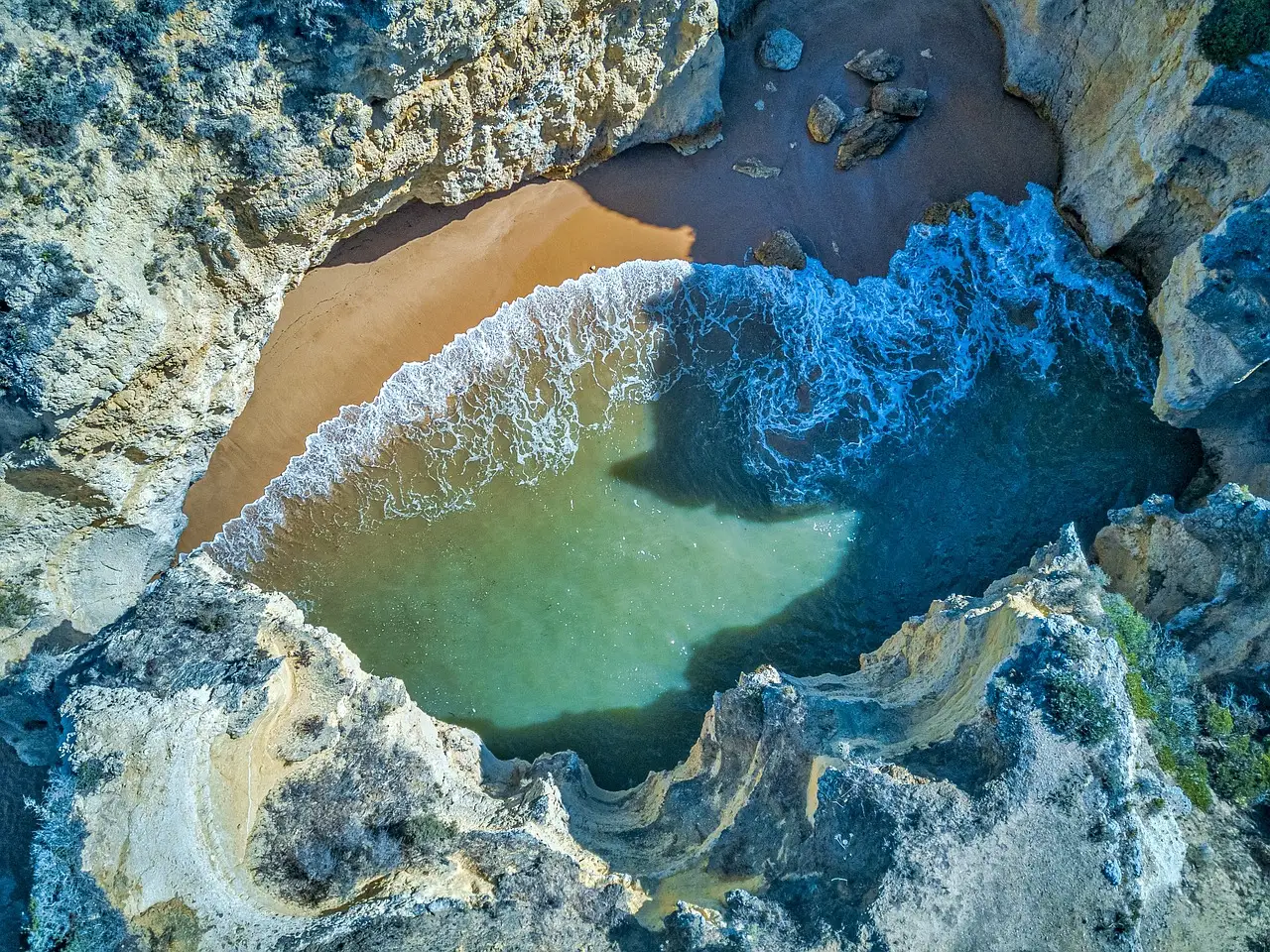
At Praia da Luz, annual swimmers may gaze at cliffs without realizing that the rocks hold a revised chapter in algal evolution. The discovery fixes older dates; it is not yet a complete causal account.
via phys.org/rss-feed/ (Source)
More from James Calloway
Show full bio
Staff writer covering regulation, policy and their impact on general science news at SciBeat.
570 articles
Nearby plates
- UV Light Reveals Camouflage Pattern on 125-Million-Year-Old Crocodile
- Half of These Rainforest Ferns Are Under Six Million Years Old
- 125,000-Year-Old Lakeside Site Reveals Poisoned Weapons and Daily Life in Green Arabia
- First global genome atlas maps hidden microbial life in 362 lakes
- 518-Million-Year-Old Fossil Rewrites the Starfish Family Tree