Plate Nº 79 · recorded November 17, 2026
Space & AstronomyReported finding
Twin NASA probes complete unprecedented powered Earth flybys to Mars
NASA’s twin ESCAPADE probes completed two powered Earth flybys in two days, keeping them on course for a September 2027 Mars arrival while gathering data on Earth’s distant magnetic tail.
By Marcus Bennett4 min read823 words
In brief
- Two powered Earth flybys were completed on Nov. 7 and Nov. 9, 2026.
- ESCAPADE launched in November 2025 after missing an October 2024 Mars launch window.
- A kidney-bean-shaped loitering orbit returned both probes to Earth in November 2026.
- The probes flew about 1.19 million miles from Earth while studying the distant magnetotail.
- NASA expects a September 2027 Mars arrival after minor course corrections.
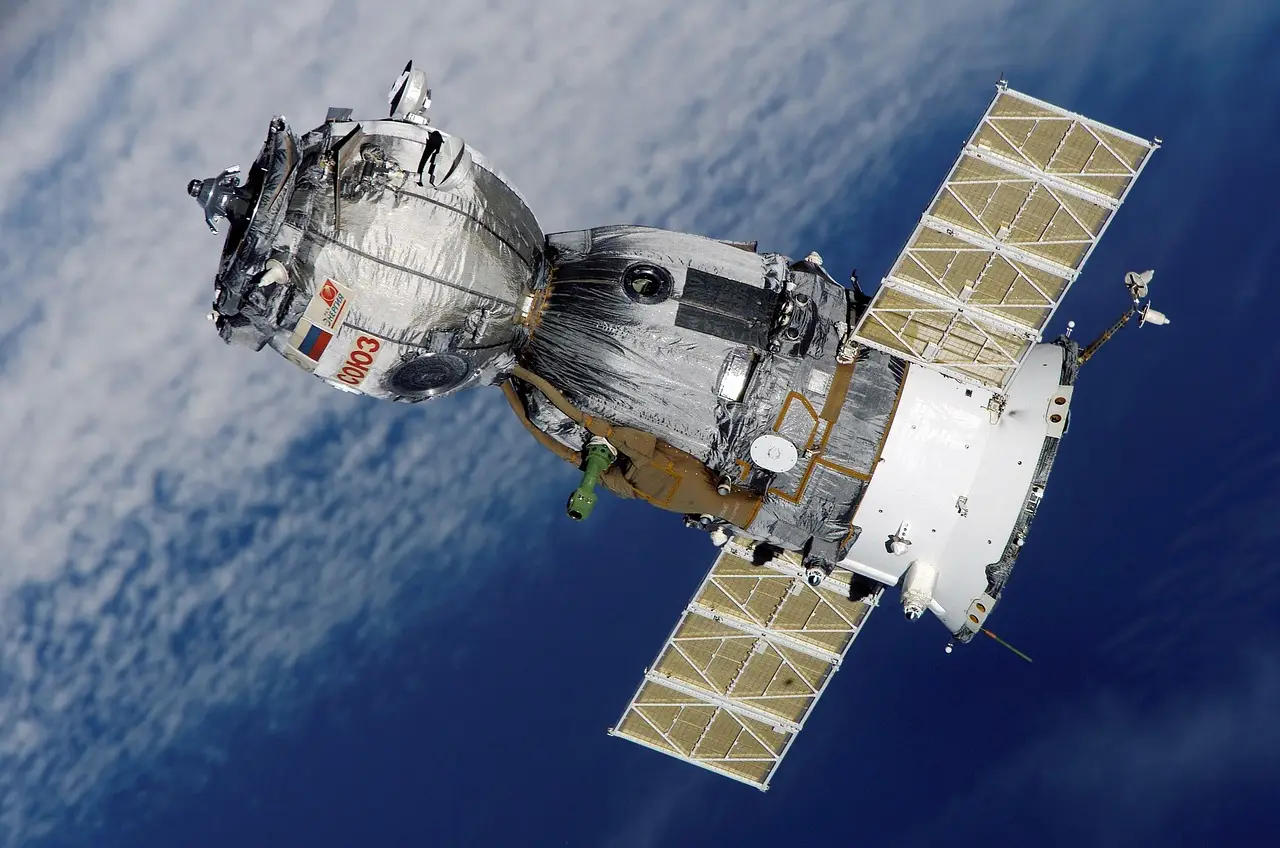
NASA completed two engine-powered Earth flybys in two days, the first time the agency has used the maneuver to propel a spacecraft toward Mars. Burns on Nov. 7 and Nov. 9, 2026, put the twin ESCAPADE probes on course for a September 2027 arrival after a yearlong detour through Earth’s neighborhood.
What forced ESCAPADE onto the long route?
The Escape and Plasma Acceleration and Dynamics Explorers mission launched in November 2025 on the second-ever flight of Blue Origin’s New Glenn rocket. Rather than head straight to Mars, the two probes followed a looping trajectory shaped like a kidney bean. Mission planners called it a “loitering” orbit designed to return both probes to Earth in early November 2026.
NASA had planned an October 2024 launch, when Earth and Mars sat in a favorable position for a direct Mars mission. Such launch windows occur only every 26 months. New Glenn delays forced ESCAPADE to miss that opening, so NASA redesigned the flight rather than wait for another routine launch opportunity.
In short: the long orbit converted a launch delay into an extra science pass before the trip to Mars.
How did a powered Earth flyby work?
A gravity assist is a flyby in which a spacecraft uses a planet’s moving gravity to alter its speed or direction. ESCAPADE added a demanding step: each probe had to fire its engine close enough to Earth for the planet’s pull to amplify the burn instead of relying on gravity alone.
The schedule left little room for error:
- The first probe completed its burn on Nov. 7, 2026.
- The second completed its burn on Monday, Nov. 9, 2026.
- NASA reported that both burns went perfectly.
Asal Naseri, acting associate flight director for NASA’s Heliophysics Division, said: “This is the first time NASA has used a powered Earth flyby to propel a spacecraft toward Mars, and we’ve now executed this maneuver twice, flawlessly, in just two days.”
Rob Lillis, a planetary and space physicist at the University of California, Berkeley, and ESCAPADE’s principal investigator, said: “No NASA mission has ever done this before.” He added that most missions do not need such a maneuver.
If the remaining course corrections hold, NASA expects the probes to continue toward a September 2027 arrival at Mars.
In short: the two engine burns did more than trim their path; Earth’s gravity helped redirect them toward Mars.
What will the probes measure at Mars?
Each ESCAPADE spacecraft is about the size of two refrigerators. Each carries three scientific instruments and a pair of cameras, all tailored to study Mars’s unusual magnetic field.
That field has two sources. Globally, charged particles from the Sun interact with the Martian atmosphere and create a magnetic field. Locally, patches of highly magnetic crust produce additional, concentrated fields. The instruments will examine the combined structure of those two sources and how it behaves around the planet.
In short: ESCAPADE will study a Martian magnetic environment shaped by both the Sun and the ground.
What did the detour reveal about Earth’s magnetotail?
Earth’s magnetic field is stronger than Mars’s and arises from Earth’s core, but the solar wind also stretches and distorts it. Solar wind means the constant stream of charged particles flowing away from the Sun and across space. On the side of Earth opposite the Sun, the field forms an elongated tail, like a windsock.
Scientists have studied this magnetotail at distances up to nearly 800,000 miles (1.27 million kilometers). Beyond that distance, its structure had remained a mystery. ESCAPADE crossed the far tail for about 10 days early in 2025, reaching roughly 1.19 million miles (1.91 million kilometers) from Earth.
Lillis said the probes captured the distant tail’s magnetic structure, including how it flapped, how it moved and how plasma flowed within it. Plasma is a gas of charged particles. He called the data unprecedented and said the team had, for the first time, made those observations with two spacecraft simultaneously.
In short: the probes sampled the far magnetotail, where its changing structure had remained a mystery.
Why did the Moon join the second magnetotail pass?
A second magnetotail encounter came during the summer of 2026, when the probes flew closer to Earth and the Moon passed through the same magnetic structure. ESCAPADE partnered with the twin ARTEMIS-THEMIS spacecraft near the Moon. The four spacecraft observed the magnetotail simultaneously from four perspectives.
Lillis called the geometry a major benefit for researchers studying magnetic field lines and plasma, which shift as the tail changes. He said these features generally cannot be measured remotely because a spacecraft has to be there to observe them.
In short: four spacecraft gave scientists simultaneous local views that a remote instrument could not provide alone.
ESCAPADE now faces the long cruise to Mars, with a September 2027 arrival as the next major milestone.
via space.com (Source)
More from Marcus Bennett
Show full bio
News editor covering regulation, policy and their impact on general science news at SciBeat.
493 articles
Nearby plates
- Twin ESCAPADE Probes Slingshot Past Earth November 7 and 9
- Twin Berkeley Spacecraft Slingshot Past Earth, Bound for Mars
- JUICE spacecraft completes 2nd Earth flyby, heads to Jupiter
- Juice spacecraft swings past Earth to bend its path to Jupiter
- ESA's Juice Spacecraft Used Earth as a Slingshot Toward Jupiter