Plate Nº 59 · recorded November 10, 2026
Space & AstronomyReported finding
Twin Berkeley Spacecraft Slingshot Past Earth, Bound for Mars
UC Berkeley's twin ESCAPADE spacecraft fired their engines past Earth on Nov. 7 and 9, completing the first powered gravity assist for a deep space mission. Mars arrival: September 2027.
By James Calloway4 min read866 words
In brief
- Blue and Gold completed their Earth gravity-assist burns on Nov. 7 and Nov. 9, 2026 — the first powered gravity assist for a deep space mission.
- Blue burned its engines over 9 minutes from about 1,000 miles above Earth; Gold followed from roughly 650 miles up.
- The spacecraft will enter Mars orbit on Sept. 7 and Sept. 9, 2027, with science operations starting in June 2028.
- ESCAPADE launched from Cape Canaveral on Nov. 13, 2025, and loitered near the Earth-Sun Lagrange point 2 for nearly a year.
- The twin orbiters will make the first coordinated observations of Mars's environment from two locations simultaneously.
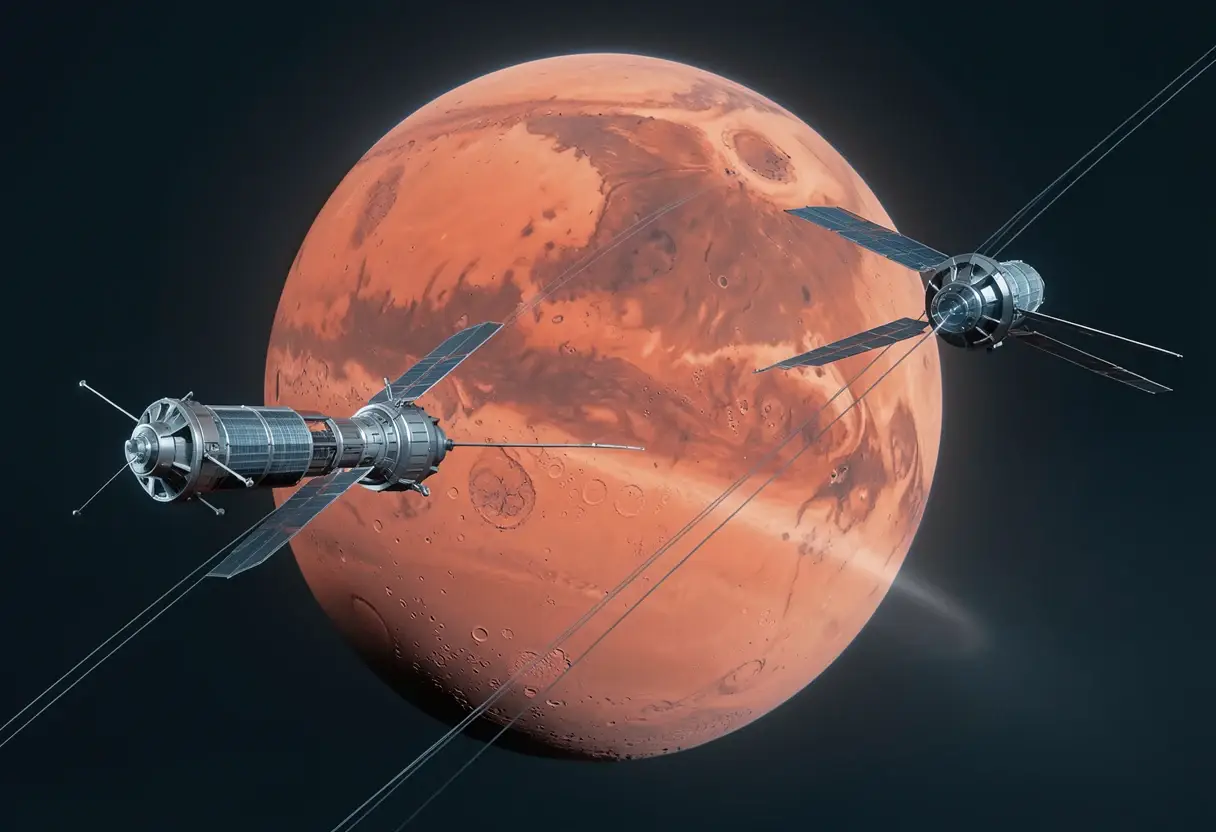
NASA's two ESCAPADE spacecraft — conceived, led and operated by UC Berkeley — left Earth behind this weekend, and they did it with a maneuver no deep space mission had ever pulled off: a powered gravity assist around our own planet.
The twin spacecraft, named Blue and Gold, fired their engines during close passes of Earth on Nov. 7 and Nov. 9, 2026, launching themselves onto trajectories that will intersect Mars's orbit. Blue burned its engines for more than nine minutes starting at 5 a.m. EST on Saturday, from roughly 1,000 miles (1,700 kilometers) above the surface. Gold followed at 6 a.m. EST on Monday, from about 650 miles (1,000 kilometers) up.
Both are expected to reach Mars in September 2027, entering orbit two days apart — Sept. 7 and Sept. 9.
"Our fantastic operations team at the Berkeley Space Sciences Lab put 110% into this critical maneuver, getting the spacecraft ready and watching like hawks for potential issues," said Rob Lillis, ESCAPADE's principal investigator and associate director for planetary science at the Space Sciences Laboratory. "We're excited to now focus on our interplanetary journey. Onward, to Mars!"
What made the maneuver a first?
Here's the technical wrinkle, in plain terms. A gravity assist uses a planet's pull to fling a spacecraft faster, like a slingshot — no fuel required. A powered assist adds an engine burn during the pass for extra push. Spacecraft have gravity-assisted around Earth before. None had ever done it for a deep space mission while thrusting.
The timing had to be near-perfect. Both spacecraft flew through Earth's radiation belts, charged particle zones that can make electronics suddenly shut down, right before their critical burns. Then they lit the engines anyway. It worked.
Mark Lewis, manager of SSL's Mission Operations Center, framed it as a familiar trick with a new twist: "It's a standard Holman transfer, but nobody else has done it with a powered gravity assist — in other words, thrusting while doing a gravity assist."
Why loiter near Earth for a year?
The mission launched from Cape Canaveral, Florida, on Nov. 13, 2025 — when Earth and Mars sat on opposite sides of the sun, the worst possible arrangement for a direct trip. Most Mars missions wait for a favorable alignment and blast off on a straight path, a route available only every two years.
ESCAPADE took a different road. Both spacecraft entered a first-of-its-kind, kidney-bean-shaped "loiter" orbit around the Earth-Sun Lagrange point 2, a gravitationally stable spot about a million miles from Earth. They idled there until the planets lined up favorably this past weekend, then swung back for the slingshot.
"It would open up the possibility for people to launch in between transfer windows, loiter around, and then go when it's convenient to do so," Lewis said. That's the real prize: launch flexibility, rather than a two-year waiting game.
What will the spacecraft actually study?
ESCAPADE stands for Escape and Plasma Acceleration and Dynamics Explorers, and the science target is the solar wind — a stream of material flowing from the sun at a million miles per hour. Once at Mars, the twins will study how that wind interacts with the Martian environment and strips away the planet's atmosphere.
They haven't been idle. During the loiter orbit, both spacecraft took observations while flying repeatedly through Earth's magnetotail, the portion of our magnetic environment stretched away from the sun by the solar wind. The 10-month cruise offers another window, letting them study solar wind dynamics between Earth and Mars.
At arrival, each spacecraft fires its engine for about 11 minutes to slow down and enter orbit. Several months of maneuvering follow before the first science formation, with one spacecraft trailing the other in the same orbit. Science operations begin in June 2028. Six months after that, the two split into different orbits — one farther out to sample the incoming solar wind, one closer in to watch Mars respond in real time. That campaign runs five months.
"This will be the first science mission to choreograph two orbiters around Mars, and the first time we will be able to make coordinated observations of the Martian environment from two different locations simultaneously," Lillis said.
Michele Cash, ESCAPADE program scientist at NASA headquarters, pointed to the practical stakes: "By better understanding how the solar wind affects the Martian environment, ESCAPADE's findings could help us plan and prepare for future human exploration of the Red Planet."
What does this change for future missions?
Potentially, the launch calendar. If powered gravity assists become routine, spacecraft could depart Earth almost anytime, loiter in nearby space, and depart when physics allows. That said, one successful demonstration doesn't make a playbook — the next mission will have to prove the trick repeats.
ESCAPADE is funded by NASA's Heliophysics Division under the SIMPLEx program (Small Innovative Missions for Planetary Exploration), which backs low-budget, innovative solar system missions. Berkeley's Space Sciences Laboratory leads, with partners including Rocket Lab, NASA's Goddard Space Flight Center, Embry-Riddle Aeronautical University, Advanced Space and Blue Origin.
via news.berkeley.edu (Source)
More from James Calloway
Show full bio
Staff writer covering regulation, policy and their impact on general science news at SciBeat.
474 articles
Nearby plates
- Twin ESCAPADE Probes Slingshot Past Earth November 7 and 9
- Twin NASA probes complete unprecedented powered Earth flybys to Mars
- BepiColombo's Mercury arrival begins with 3 September separation
- Eight Years in Space, and the Hard Part Starts Now
- Artemis III Will Rehearse Moon Landings in Earth Orbit in 2027