Plate Nº 61 · recorded October 10, 2026
Biology & EvolutionReported finding
Wild elephants use 40+ intentional gestures to say 'move away'
Wild African savanna elephants deliberately use more than 40 gesture types to signal 'move away' or 'stop that' to other elephants, the first systematic study finds.
By Marcus Bennett3 min read628 words
In brief
- Researchers logged around 840 individual gesture instances during 90+ hours of observation in South Africa
- Elephants used more than 40 distinct gesture types built from 32 distinct gesture actions
- Of 33 gesture types in successful communications, 21 (64%) served both 'move away' and 'stop that' goals
- Observations took place at Addo Elephant National Park and Marakele National Park and were compared with the ElephantVoices database covering Kenya and Mozambique
- The study was published in Animal Cognition in 2026
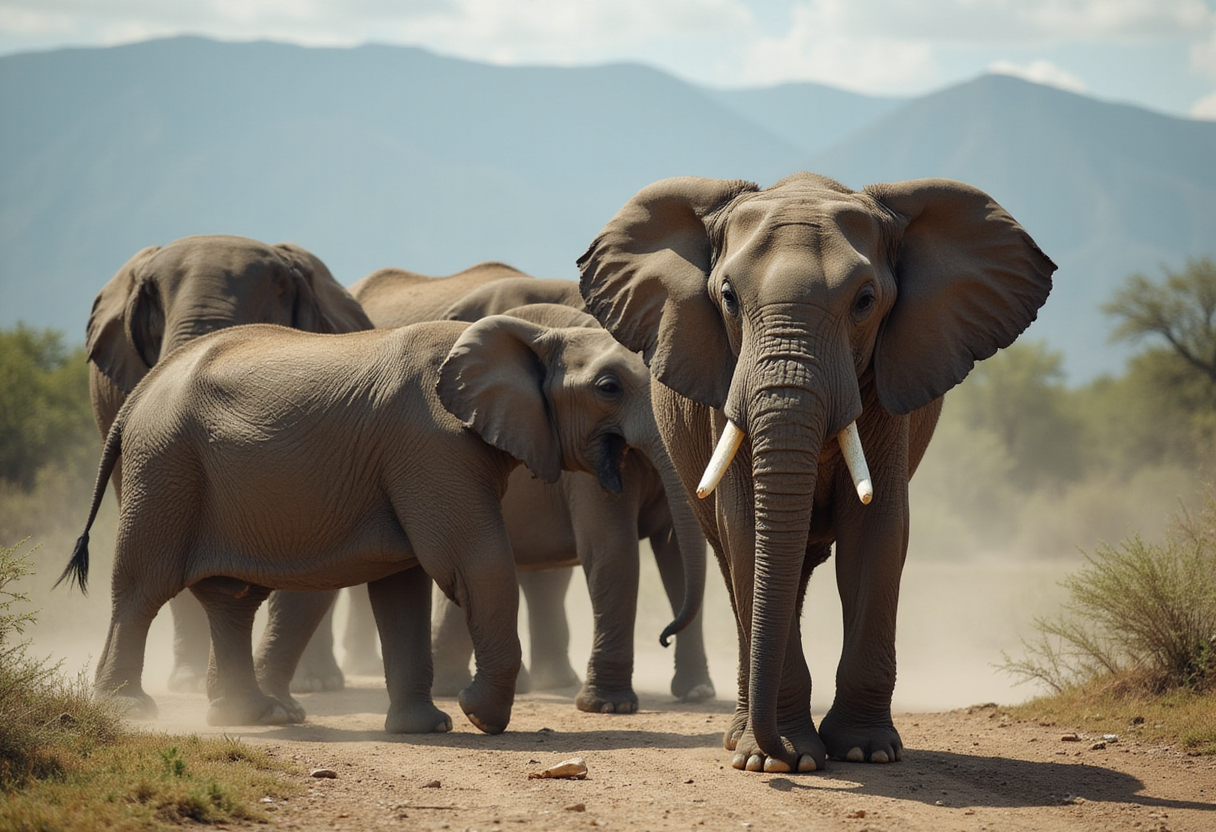
Wild African savanna elephants deliberately use more than 40 distinct gesture types to signal "move away" or "stop that" to other elephants, according to a study published in Animal Cognition in 2026.
The research marks the first systematic investigation of intentional gestural communication in wild African savanna elephants. An international team from the University of Portsmouth, the University of Vienna, and the University of St Andrews recorded approximately 840 individual gesture instances across more than 90 hours of observation.
What did the researchers observe?
The scientists studied elephants at two South African reserves: Addo Elephant National Park and Marakele National Park. They focused on competitive, or "agonistic," interactions such as disputes over water or shade.
The team catalogued 32 distinct gesture actions that elephants combine into more than 40 gesture types. Common moves include flinging the trunk, spreading the ears wide, and pushing.
How do elephants use gestures intentionally?
The researchers concluded that elephants gesture in a recipient-directed and goal-directed way. Elephants visually checked whether another elephant was paying attention before and during gesturing. They also adjusted their gesture modality to match the recipient's visual attention and waited for a response, producing more gestures when the first attempt failed.
Lead author Vesta Eleuteri of the University of Vienna said: "If you spend time observing wild elephants, you can't help but notice their conspicuous gestures. They may fling their trunk or spread their ears wide, and you intuitively understand that 'they mean business.' But until now, we didn't know whether wild elephants were using these gestures to communicate intentionally."
How flexible is the elephant repertoire?
The team recorded 33 gesture types in successful communications. Of these, 21 (64%) served both "move away" and "stop that" goals. Elephants therefore do not rigidly assign one meaning per gesture. They communicate flexibly across two broad intentions.
Do elephant populations share the same gestures?
The researchers compared their South African findings with the ElephantVoices database, which covers populations in Kenya and Mozambique. The populations shared the same gesture types. That overlap suggests elephants may draw on a common gestural "vocabulary" across regions.
Eleuteri added: "Such extensive, flexible gestural repertoires have previously been shown in apes and a few other primates. Finding the same in elephants is particularly exciting because elephants are so evolutionarily distant from primates. It suggests that sophisticated gestural communication may have evolved convergently in species that share advanced intelligence and complex social lives."
What does the study not yet cover?
The authors limited their analysis to competitive contexts. They did not examine gestures during bonding, mating, or play. Senior author Angela Stoeger, a professor at the University of Vienna who mainly studies elephant vocal communication, said: "These findings underscore why studying multiple modalities is essential. In the future, studying the interplay of acoustic, visual, tactile and seismic signals, together with context, will finally reveal their messages."
Why do these findings matter for conservation?
Habitat loss brings elephants into closer contact with humans across much of Africa. Co-author Dr. Lucy Bates of the University of Portsmouth said: "This work is important because humans and elephants increasingly come into contact with each other, as human populations expand in elephant range states. Understanding how elephants communicate when they're feeling threatened could help us better read their intentions or recognize when they don't want us around, giving us the chance to move away before interactions become dangerous."
What's next?
The team frames the work as a foundation rather than a finished map of the species' gestures. Future studies will need to test intentional gesturing outside competitive contexts and across more populations. If the gestural vocabulary holds up, it could reshape how researchers think about the evolution of complex communication in large-brained, socially demanding mammals.
via Phys.org Biology (Source)
More from Marcus Bennett
Nearby plates
- Elephants synchronize rumbles during group decisions, study finds
- What Makes a Snake Scary? Its Shape, Study Suggests
- Humpback Whale Mother Stayed With Dead Calf for Days, Study Finds
- Tracking 4,581 Animals Reveals a Hidden Human Effect on Wildlife
- Monkey Foot Flexibility Reshapes Ideas About Human Ancestor