Plate Nº 10 · recorded November 2, 2026
Biology & EvolutionReported finding
115-Million-Year-Old Dinosaur Bone May Hold Oldest Blood Traces Ever Found
Structures resembling red blood cells, plus heme chemistry, appear in a 115-million-year-old Brazilian theropod bone — the oldest such claim, though not all experts agree.
By Nathan Brooks4 min read722 words
In brief
- A PNAS study published Nov. 2 reports red-blood-cell-like structures and heme signatures in a 115-million-year-old dinosaur bone from Brazil.
- The bones belong to Aratasaurus museunacionali, a roughly 10-foot (3 m) theropod from the Early Cretaceous.
- The study is claimed to be the first to chemically identify heme-based signatures in dinosaur bones.
- Skeptic Mary Schweitzer says the structures lack the nuclear bulge of reptile and bird red blood cells and recommends resonance Raman spectroscopy.
- The structures were mineralized with hausmannite, a manganese oxide, and collagen-linked amino acids were also preserved.
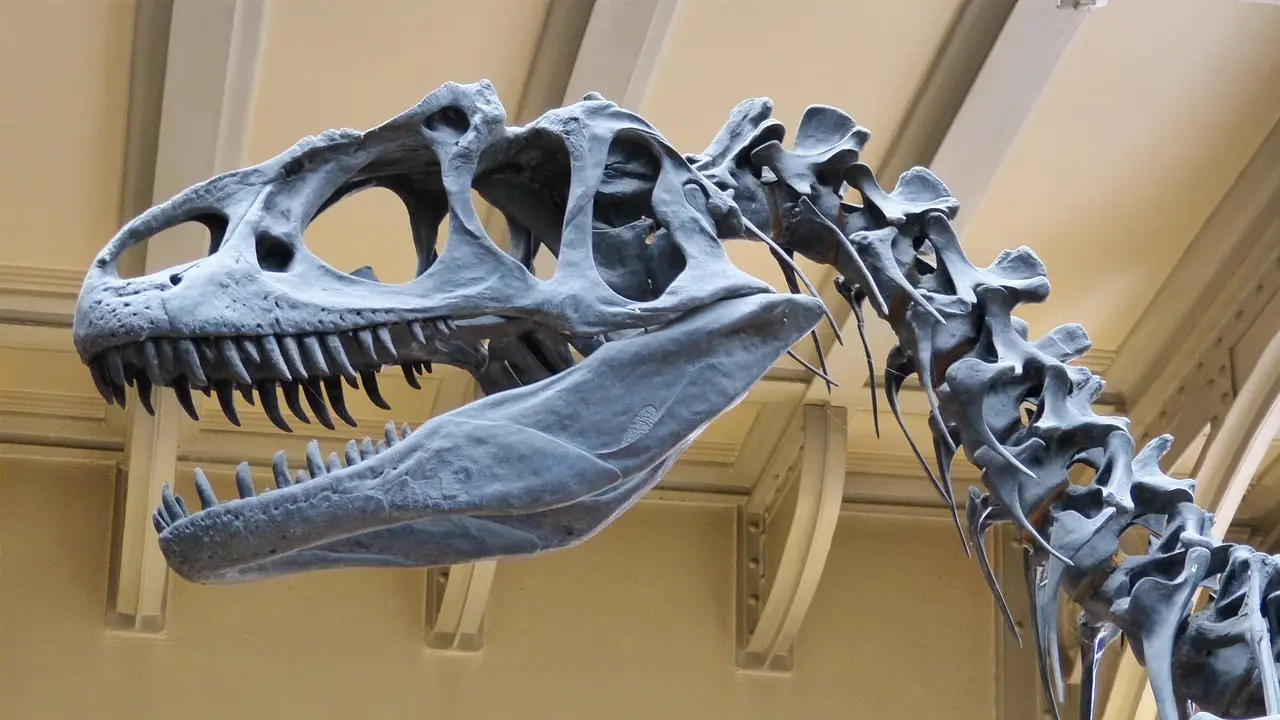
Red blood cell traces inside a 115-million-year-old dinosaur bone from Brazil are, their discoverers claim, the oldest chemical evidence of blood-related material ever recorded in a dinosaur fossil. The study appeared Monday, Nov. 2, in the journal PNAS — and not every expert reading it is convinced.
The bones belong to Aratasaurus museunacionali, a small two-legged meat-eating theropod roughly 10 feet (3 meters) long that lived in Brazil during the Early Cretaceous period. Theropods are the same group that produced famous predators like Tyrannosaurus rex and Velociraptor.
Researchers found microscopic structures resembling red blood cells sitting inside vascular canals — channels that once carried blood vessels through bone. Chemical analysis also detected signatures of heme, the iron-carrying ring-shaped molecule at the core of hemoglobin, the protein red blood cells use to transport oxygen. Earlier studies had detected blood in dinosaur fossils, but the team says this is the first to identify heme-based signatures through chemical processes in dinosaur bones.
What exactly did the team find?
Study co-author Kliti Grice, a professor at Curtin University's School of Earth and Planetary Sciences in Australia, framed the significance in an email to Live Science. "Traditionally, fossils give us information through bones, teeth, shells and morphology," she said. "But exceptionally preserved fossils may contain another archive of information: microscopic structures and molecular traces of the original organism."
That archive, she said, "opens the possibility of asking questions about ancient biology that skeletal anatomy alone cannot answer."
The team wasn't hunting for dinosaur blood. Grice says the project started from a broader question: how much of an ancient organism's original biology can survive fossilization? Using limb bones of the Brazilian theropod, they combined microscopy, mineralogical analysis and molecular geochemistry.
"Critically, we investigated the chemistry in situ [in the bone itself], so we could relate the chemical signals to the microscopic structures in their physical context within the fossil," Grice said. "That is much stronger than simply extracting molecules from a piece of fossil and assuming where they originated."
How did soft material survive 115 million years?
The researchers credit the burial conditions. They propose the animal was rapidly covered by sediment in a low-oxygen environment containing microbial mats — thin films of microorganisms — which may have disrupted normal decomposition.
The cell-like structures were mineralized with hausmannite, a manganese oxide mineral (Mn₃O₄). "We think early mineralisation helped stabilise or replicate microscopic biological structures before they were completely destroyed, while aspects of the associated chemistry also survived in altered form," Grice said. The fossil also preserved amino acids associated with collagen, the structural protein in bone.
Why are some experts skeptical?
Mary Schweitzer, a molecular paleontologist at North Carolina State University who wasn't involved in the study, offered a mixed verdict. "I very much appreciate this team bringing rigor to the study of deep time fossils," she said. "However, I am not convinced that the images they figure are remnant RBCs [red blood cells] for several reasons."
Her first objection is shape. Bird and reptile red blood cells keep their nuclei — unlike mammalian cells, which shed them — and that typically leaves a characteristic nuclear bulge. Schweitzer says the new microstructures appear concave, with no bulge, and run smaller than most non-mammalian red blood cells. "Morphological similarity is not met," she said.
She also argued the team hadn't fully met the criteria for identifying fossilized blood cells and suggested resonance Raman spectroscopy — a technique that characterizes chemical compounds — would have given more conclusive evidence. Schweitzer was part of a team that used exactly that method in 2025 to detect heme in tissues from Brachylophosaurus canadensis and T. rex.
Still, she welcomed the field's direction. "I appreciate these authors bringing technological innovations to the study of dinosaur fossils," Schweitzer said. "I am excited to see that this team and others are moving forward with a molecular approach to ancient fossil remains."
The full paper — 20-plus co-authors led by Grice — appears in Proceedings of the National Academy of Sciences under the title "Heme signatures in mineralized red blood cells within vascular canals of a 115-million-year-old dinosaur bone." Whether the structures are genuine blood cells or mineral mimics, the debate itself shows how much dinosaur paleontology now happens at the molecular scale.
via doi.org (Original)
More from Nathan Brooks
Show full bio
Market editor covering companies, deals and strategy in general science news at SciBeat.
268 articles
Nearby plates
- Neutron Imaging Reveals 66-Million-Year-Old Blood Vessels in T. Rex Rib
- 240-Million-Year-Old Tanzania Fossil Reshapes Dinosaur Timeline
- First European Meرaraptor Found in a Museum Drawer After 100 Years
- 66-Million-Year-Old Feather in Dinosaur Poop Sheds Light on Bird Survival
- Forgotten Museum Fossil Reveals New European Clawed Dinosaur