Recorded November 20, 2026
Earth & ClimateReported finding
43 Dead in China Landslides: Trees May Have Made It Worse
280 landslides and 43 deaths in Gansu Province traced to record rainfall and freeze-thaw-weakened slopes — with trees possibly amplifying the deadly debris flows, a new study finds.
By Nathan Brooks3 min read698 words
In brief
- 43 people were killed in the 7-8 August 2025 landslide cluster in Yuzhong County, Gansu, China; 28 remain listed as missing.
- Researchers mapped 280 individual landslides that amalgamated into channelised debris flows.
- The storm delivered 220.2 mm of rain — 56% of annual precipitation — with the peak between 11 pm and 1 am.
- Guo et al. 2026, in Natural Hazards vol. 122, attribute preconditioning to freeze-thaw cycles weakening the soil-bedrock interface.
- The study suggests woody debris from dense forest may have amplified the deadly debris flows, challenging the dogma that woodland always helps slope stability.
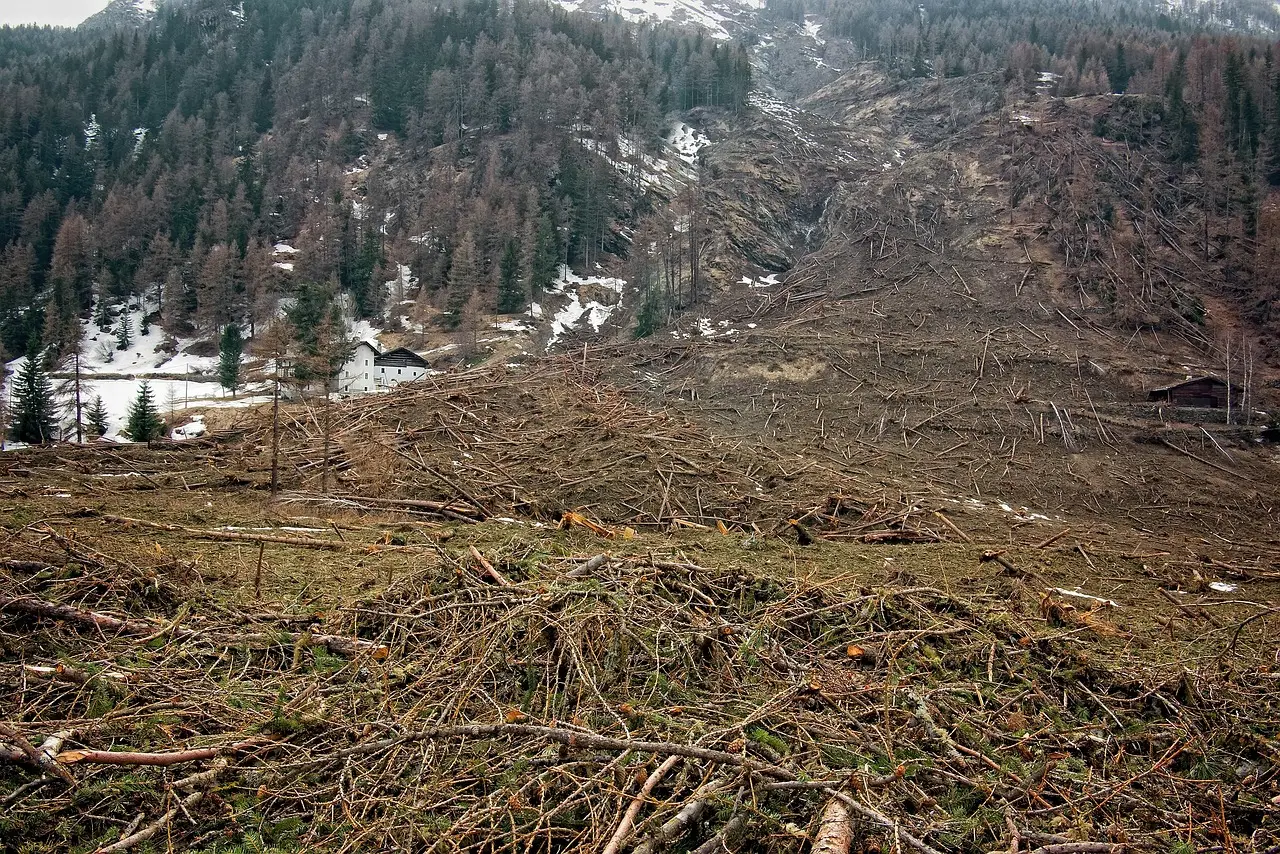
A new scientific analysis has put hard numbers on the 7-8 August 2025 landslide disaster in Yuzhong County, Gansu Province, China: 280 individual slope failures, 43 people killed, and a storm that dumped 220.2 mm of rain — more than half the area's typical annual total — in a single event.
The study, led by Guo and colleagues and published in the journal Natural Hazards (volume 122, article 677, 2026), maps the full cluster of landslides and reconstructs how a densely vegetated mountain collapsed into a deadly network of debris flows. Of the 43 victims, 28 remain officially listed as missing.
What triggered the landslides?
The rainfall was exceptional by any measure. The nearest rain gauge recorded 220.2 mm during the storm, which works out to 56% of the county's total annual precipitation arriving in roughly a day. To put that in everyday terms: more than six months' worth of rain fell in a single storm.
The rain came in two distinct spells. The second, between 11 pm on 7 August and 1 am on 8 August, was the more intense of the pair — and it was this pulse that triggered the landslides.
But rainfall alone doesn't explain the failure. Guo et al. conclude that the slopes were preconditioned by repeated freeze-thaw cycles, a process in which water repeatedly freezes and melts within soil, gradually weakening it at the soil-bedrock interface. In plain English: the ground had been slowly loosened at its base for years, and the intense precipitation delivered the final push.
How did the debris flows become so deadly?
The landslides themselves amalgamated — merged together — into channelised debris flows. These are fast-moving mixtures of rock, soil and water that race down confined drainage channels, and they did the killing in this event.
The research team identified a specific mechanism behind the flows' destructive power:
- Landslide debris blocked the drainage channels
- Those blockages then collapsed, generating rapid surge events
- Natural constrictions in the channels impeded the flows, amplifying the discharge — the volume of material surging through per unit of time
So the disaster wasn't simply slopes failing. It was a cascade: landslides dammed the channels, the dams broke, and the narrow gorges squeezed the resulting surges into something far more powerful.
Did the trees make things worse?
Here's the study's most provocative finding. One of the striking features of this event, visible in satellite imagery of the aftermath captured by Planet Labs on 13 August 2025, is that the landslides occurred on a mountain covered in dense vegetation.
Guo et al. conclude that woody debris — logs, branches and root masses swept into the flows — may have contributed to the channel blockages and surge events. That led them to a conclusion that runs against the commonly held dogma that woodland is good for slope stability. In this case, the trees that anchored the hillside may also have amplified the channelised debris flows once the ground gave way.
It's a finding with real weight for policy. If vegetation can worsen debris flows in certain conditions, reforestation and slope-management strategies in freeze-thaw-prone mountain regions may need a second look.
How solid are the conclusions?
As with any single-event study, the caveats deserve attention. The analysis covers one disaster on one mountain, so the woody-debris mechanism may not generalise to all forested slopes. The authors themselves frame the tree effect as a contribution to blockage and surging, not the sole cause. And the attribution of preconditioning to freeze-thaw cycling is an interpretation of the field evidence, not a directly measured timeline.
Still, the numbers anchor the story. Rainfall at 56% of the annual total. Two hundred and eighty mapped failures. Forty-three lives lost. The Yuzhong event now stands as a detailed case study in how an extreme storm, pre-weakened slopes and forested terrain can interact with devastating efficiency.
The paper, "Causes of mass shallow landslides in densely vegetated areas and their amplifying effect on debris flows: insights from the 2025 Yuzhong event," by Guo, F., Xie, Y., Zhao, Y. et al., appears in Natural Hazards (doi: 10.1007/s11069-026-08455-5).
via eos.org/feed (Source)
More from Nathan Brooks
Show full bio
Market editor covering companies, deals and strategy in general science news at SciBeat.
563 articles