Plate Nº 49 · recorded November 9, 2026
Earth & ClimateReported finding
55 Ancient Lakes, Zero Human Traces: Arabia's Desert Keeps Its Secret
A team surveyed 125 sites in Arabia's Empty Quarter, found 55 ancient lakes — and zero traces of humans. Water alone, it seems, wasn't enough to draw settlers.
By James Calloway3 min read623 words
In brief
- Researchers found evidence of ancient lakes at 55 of 125 surveyed locations in the Empty Quarter, but no traces of human presence.
- Lake deposits in the region date to approximately 122,000–67,000 years ago, per previous research.
- Only 10 of 125 sites had knappable stone, all on the desert's outer margins.
- The team's model suggests 57 percent of water-accessible terrain in prehistoric Arabia lacked suitable tool-making stone.
- The study, led by Rudolf Dellmour of the University of Vienna, appears in Nature (2026).
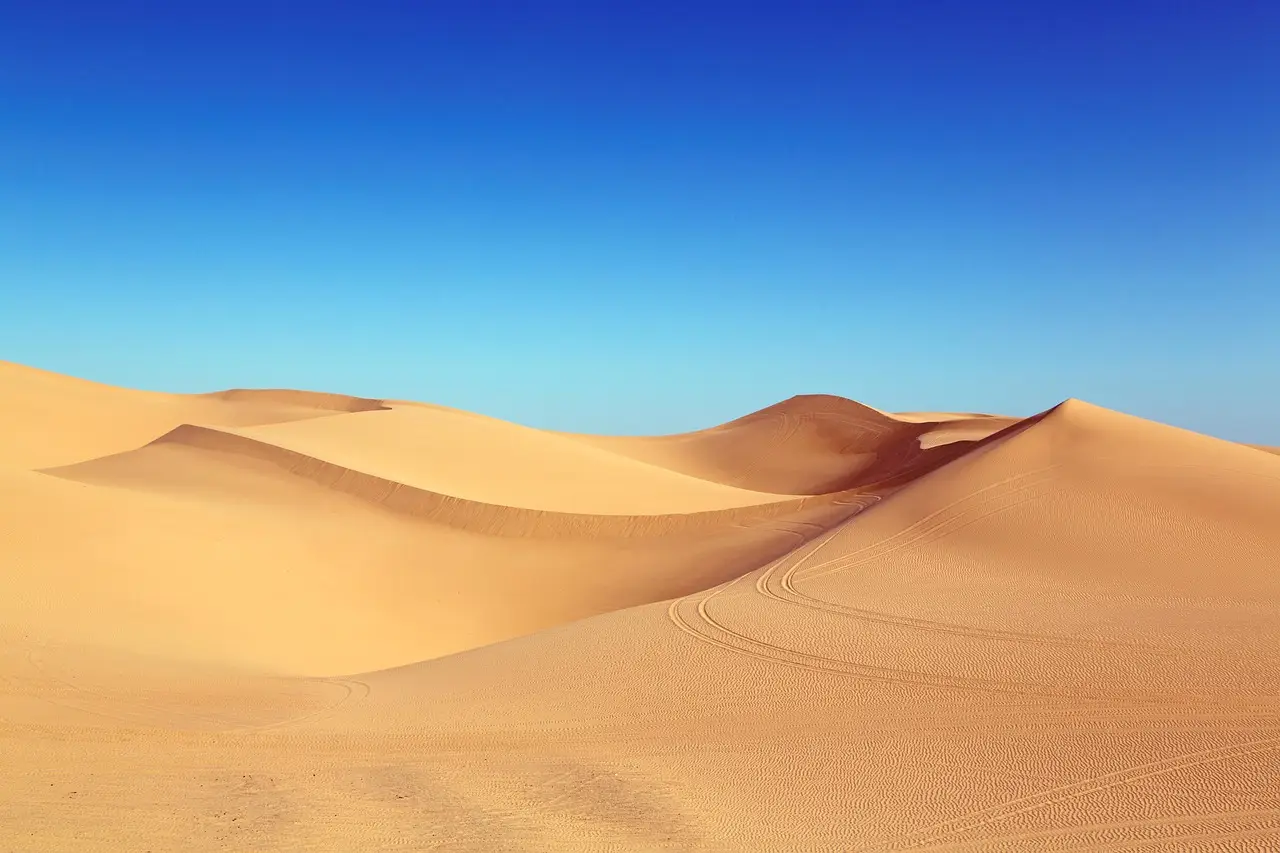
Researchers surveyed 125 locations across the Empty Quarter, confirmed ancient lakes at 55 of them, and found not a single trace of human hands. That's the headline result of a new study in Nature, and it quietly dismantles a decades-old assumption about how early humans left Africa.
The Rub' al Khali — the "Empty Quarter" — is the world's largest continuous sand desert, stretching 1,000 kilometers (620 miles) across the Arabian Peninsula. During wetter phases of the Pleistocene epoch, though, it wasn't the furnace we know today. Temporary lakes dotted the sand, and previous research suggested these "green corridors" could have guided human groups dispersing out of Africa toward Asia.
Lake deposits in the region date to roughly 122,000–67,000 years ago. Water was there. So where were the people?
"We stood on the shore of one ancient lake after another, yet found nothing made by human hands," says geoarchaeologist Rudolf Dellmour of the University of Vienna, who trekked approximately 1,500 kilometers through the desert with his team.
What does this change for the 'Green Arabia' theory?
For decades, archaeologists have hypothesized that temporary lakes and the grasslands around them would have attracted migrating humans. The new findings don't kill the theory. They complicate it.
Water sustains life, but it doesn't make tools. Of the 125 surveyed locations, only 10 offered geological deposits of knappable stone — rock that can be flaked into sharp edges — and every one of those sites sat on the desert's outer margins. The central basin is built from carbonate and evaporite formations, materials useless for stone tool manufacture. No stone, no toolkit. No toolkit, no camp.
"That humans need more than just a water supply is hardly a new archaeological insight," admits Emanuele Cancellieri, a prehistoric archaeologist at the University of Algarve who wasn't involved in the study but wrote a commentary on it in Nature. "The importance of this research lies instead in subjecting that idea to an ambitious study."
The ambition extends beyond sore feet. Alongside the fieldwork, the team built a model that predicts ancient settlement sites using both water availability and geology. The result: 57 percent of the terrain accessible to water in prehistoric Arabia lacked suitable stone for tool-making.
Is stone really the deciding factor?
The researchers lean on parallels. Knappable stone has previously been linked to human occupation in Libya, Tibet, Egypt, South Africa, and North America — places with very different climates and geologies.
"These convergent patterns, across different geological substrates, hydrological regimes and chronological contexts, provide analogical support for a 'tethering' effect whereby stone-tool-dependent populations become tied to raw-material sources," they write.
In those other settings, water was often plentiful, so the distribution of stone shaped where people settled. Arabia, they argue, followed the same rule — but with a twist. "The Arabian Peninsula seems to have comprised a patchwork of discrete zones where water and lithic raw materials co-occurred," the team explains. Their phrase for it: "Green Arabia" was really a "lithic archipelago," its islands defined by geology as much as by climate.
The practical warning is blunt. Dispersal models that ignore raw-material distributions, the authors write, "may systematically overestimate the area habitable by stone-tool-dependent populations."
What are the caveats?
Absence of evidence isn't proof of absence — a desert this size can hide a lot, and 125 sites is a sample, not a census. The study also depends on dating from prior work rather than fresh dates for every lake. Still, a 55-lake survey with zero artifacts is a hard number to argue with.
The takeaway is simple. If a lake appears in the desert, it doesn't necessarily make a town.
via sciencealert.com (Source)
More from James Calloway
Show full bio
Staff writer covering regulation, policy and their impact on general science news at SciBeat.
346 articles
Nearby plates
- Kneaded Like Dough for 200 Million Years: The Making of Iran and Afghanistan
- Perseverance Finds Early Mars Hosted Complex, Hot Water Systems
- Hidden 100-Million-Year-Old Volcanic Arc Discovered in Iran
- Child Fingerprints on Ancient Clay Figures Suggest a Shared Craft
- Keepsakes May Date Back Half a Million Years, Study Claims