Recorded November 19, 2026
Space & AstronomyReported finding
Astronomers Propose AI 'Supertelescope' From $6 Billion of Sky Surveys
Astronomers propose fusing the Rubin, Euclid and Roman telescopes into an AI-powered 'supertelescope' — squeezing more from $6 billion of surveys of billions of galaxies across the sky.
By Priya Raman4 min read894 words
In brief
- A preprint paper released in August by more than two dozen authors proposes an AI-fused 'supertelescope' combining Rubin, Euclid and Roman.
- Public investment in the three telescopes already exceeds $6 billion.
- Rubin images some 20 billion galaxies, scanning the southern sky every three days over 10 years.
- 100 million volunteers would need 120,000 years to annotate Rubin's data; AI could do it almost instantly.
- Roman begins its cosmic survey in early 2027.
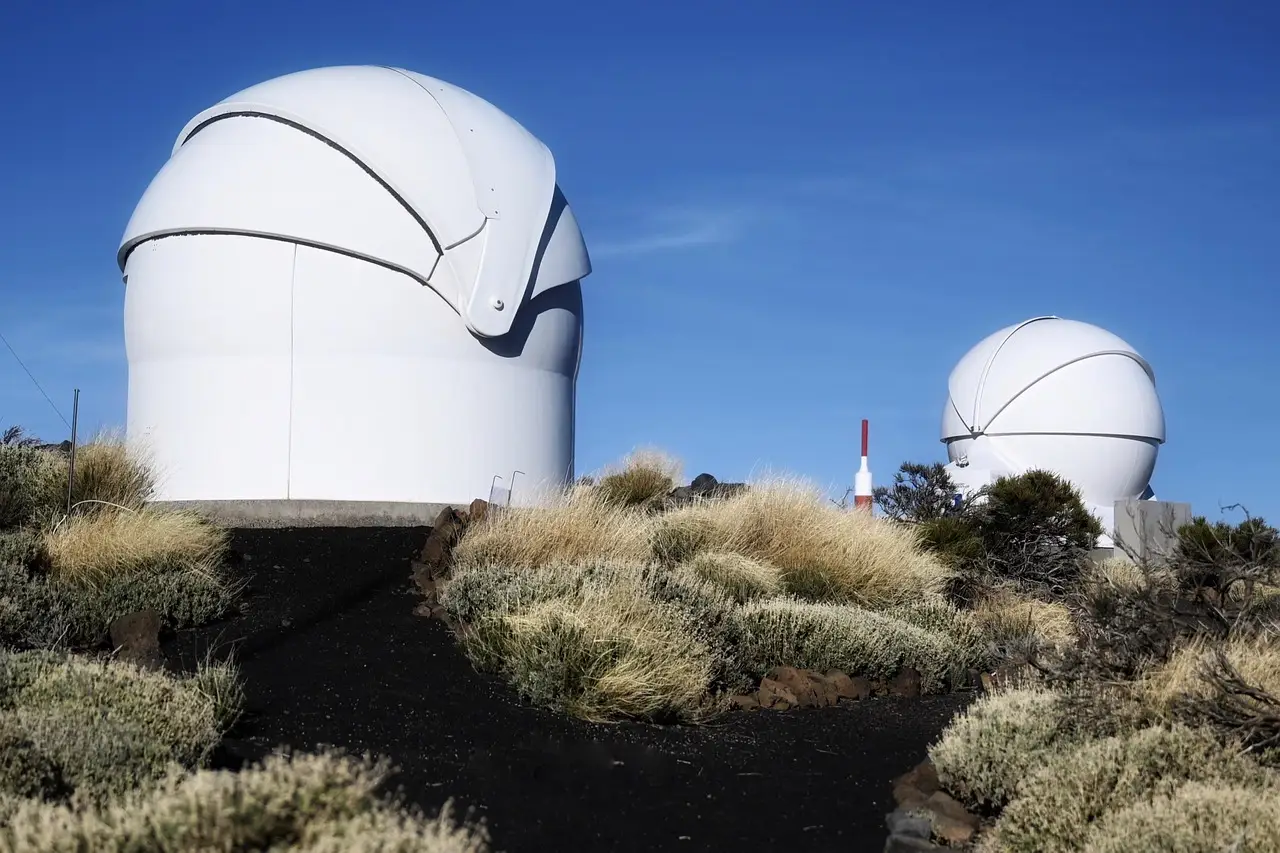
More than $6 billion of public money has already bought humanity three of the most powerful survey telescopes in history. Now, more than two dozen astronomers argue in a preprint paper released in August that artificial intelligence could fuse those machines into a fourth — a virtual supertelescope no one has yet switched on.
"The public has already paid for the three telescopes," said Gioia Rau, a fellow at the U.S. nonprofit Renaissance Philanthropy who leads its space science portfolio. "Processed together, they make a fourth. And nobody has switched it on."
The three machines in question are the Vera C. Rubin Observatory in Chile, the European Euclid space telescope orbiting one million miles from Earth, and the Nancy Grace Roman Space Telescope, which launched in August 2026 and is still in its commissioning phase. Rau and her co-authors call on the overseeing agencies — the National Science Foundation and the U.S. Department of Energy for Rubin, the European Space Agency for Euclid and NASA for Roman — to invest in stitching the observatories together before the opportunity slips away.
Why combine three telescopes?
Each observatory sees the sky differently. Rubin, which began its 10-year survey in June, scans the entire southern sky in visible light every three days and will image some 20 billion galaxies, catching moving or changing objects such as asteroids and supernovae. Euclid, launched in 2023, is mapping a third of the sky in visible and near-infrared light over six years — sharper than Rubin, but slower. Roman will look deeper still, with a mirror twice the size of Euclid's, though its main survey covers just 12 percent of the sky.
Where their views overlap, the telescopes will produce petabytes of data — one petabyte equals one million gigabytes. "This is thousands of square degrees seen as one," Rau said. "We are talking about so much data."
AI and cloud computing would do the fusing. Astronomers have used the cloud for smaller projects for "about two and a half decades," said Lior Shamir, a computational astronomer at Kansas State University, but never at this scale. "If we had 100 million volunteers, it would take us 120,000 years to annotate all of what the Rubin Observatory is acquiring," he said. "With AI, it's pretty instant."
The goal goes beyond merging catalogs. Scientists want to "combine the pixels to get an image that is extremely high-resolution," said Tony Tyson, Rubin's chief scientist and a paper co-author. That sharpness would sharpen studies of dark energy (the force accelerating cosmic expansion) and dark matter (invisible mass shaping galaxy structures). A supertelescope, the authors argue, would map dark matter's distribution and dark energy's effects better than any single observatory could.
"It is a very demanding analysis that requires very good characterization of what we believe the galaxies to look like," said Peter Melchior, an astrophysicist at Princeton University and a co-author.
What could the supertelescope find?
The payoffs, as outlined in the paper and by outside researchers, span the cosmos:
- Supernovae and transients: Rubin's map could help Roman find exploding stars farther back in time and rapidly cross-check them, ruling out false positives.
- Twin black holes: a supertelescope might spot pairs of supermassive black holes spiraling toward merger and emitting gravitational waves (ripples in spacetime). "Roman and Euclid from space will find 10-times-closer pairs than we're able to find from the ground," said Yale astrophysicist Meg Urry, who was not a co-author.
- Asteroids: viewing the same rock from two vantage points reveals its distance through parallax, aiding the hunt for near-Earth objects and worlds beyond Neptune.
- Exoplanets: Roman will detect alien worlds via gravitational microlensing, in which a star's or planet's gravity briefly magnifies a background star's light; Euclid could watch the same event from another angle, yielding the planet's mass — and occasionally even evidence of a moon.
Tyson said the unknown excites him most: "What interests [us] even more is the discovery of the unexpected, something totally new that will blow our minds."
What stands in the way?
Urry called the proposal a no-brainer — "It has to be done" — but cautioned: "This is a very complicated problem to do well." Huge computers and experts in statistics and inference will be essential.
A NASA spokesperson said the agency was "aware of this concept and has had conversations with multiple community members about the prospect for joint processing of data," and would "continue to listen to the community." The NSF declined to comment; ESA did not respond.
Some groundwork exists. A NASA-funded team is building software to jointly process Roman and Rubin images, Tyson said, while a team co-led by the California Institute of Technology and the NSF is exploring Rubin–Euclid data sharing. What is missing is a unified, funded three-telescope program — a gap that may require philanthropy, since combining missions "has never been in any one agency's line budget," Rau said.
Roman begins its survey in early 2027, and the clock is ticking. "The point is to start now while the surveys are still young enough to agree on some of the basics," Rau said. "This isn't just slightly better measurements. It's science that exists only when the images are processed together."
Together, they would be supercharged.
via scientificamerican.com (Source)
More from Priya Raman
Show full bio
Senior reporter covering people, launches and day-to-day practice in general science news at SciBeat.
549 articles
Nearby plates
- Euclid Telescope Maps One Billion Cosmic Objects in First Big Release
- Euclid Telescope Finds 15,000 New Cosmic Magnifying Glasses
- NASA's Roman Telescope Will Image 100× More Sky Than Hubble
- NASA's Roman Telescope Will Survey 200 Times More Sky Than Hubble
- Euclid Telescope Logs Nearly a Billion Cosmic Objects in First Big Data Drop