Recorded November 22, 2026
Space & AstronomyReported finding
Dark dimension theory puts the Universe’s missing 95% to the test
DESI’s hints that dark energy is changing give a string-based “dark dimension” a serious test, but scientists say the evidence remains weak and several explanations fit.
By Elena Vasquez5 min read1,059 words
In brief
- Dark matter and dark energy make up 95% of the Universe; ordinary matter accounts for 5%.
- Dark matter was proposed in the 1930s after astronomers found galaxies rotating too quickly for visible matter to explain.
- A prominent 10-dimensional string-theory model allows a dark dimension about one micron across.
- DESI uses 5,000 fibre-optic eyes to measure 35 million galaxies and chart cosmic expansion.
- DESI’s evidence is described as tantalising and a good hint, not a smoking gun.
By Elena Vasquez
Ninety-five percent of the Universe remains unexplained; a string-theory proposal says one hidden dimension could produce both dark matter and dark energy.
The dark dimension has no decisive proof. Its strongest clue comes from DESI, whose data appear to show dark energy changing over time. That fits some string-theory models, but researchers call the evidence tantalising, not conclusive. Nothing confirmed yet.
What does the dark dimension propose?
Ordinary matter—planets, stars, galaxies and dust—makes up only 5% of the Universe. The other 95% comprises dark matter, hypothetical mass that does not interact with light, and dark energy, associated with accelerated cosmic expansion.
Dark matter was proposed in the 1930s, when galaxies rotated too quickly for visible matter to hold them together. Its gravity also shapes cosmic structure. Most cosmologists favour an unknown particle, but nearly a century of searching has produced no convincing candidate.
Modified Newtonian dynamics, or MOND, alters gravity’s strength at certain acceleration scales. It remains fringe because the standard frameworks built by Isaac Newton and Albert Einstein explain much of the observable Universe accurately.
MOND’s backers say it fits large-scale galaxy motion better than the dark-matter model. The challenge is reconciling gravity at everyday scales with different effects at the largest scales, while also explaining dark energy, introduced after accelerating expansion was discovered about 30 years ago.
Astronomers proposed dark energy after finding faster-than-expected cosmic expansion; its origin remains unclear. Quintessence, one alternative, treats it as a field that changes with nearby ordinary matter, unlike a fixed cosmological constant. Such ideas have struggled to yield clear tests.
The dark dimension instead makes both components effects of one structure. String theory adds extra dimensions, rolled up inside the familiar three of space and one of time. In a prominent 10-dimensional version, one could generate dark matter and dark energy.
It would exceed other microscopic dimensions but remain tiny: about one micron, or a millionth of a metre. Prof Dieter Lüst of the Max Planck Institute for Physics, who helped propose the idea, called that very large by particle-physics standards. A human hair is about 50 microns across, trillions of times larger than typical subatomic scales.
Takeaway: The proposal replaces two unexplained components with one hidden structure, but its scale and contents remain uncertain.
What does DESI show?
DESI is attached to the Mayall Telescope at Kitt Peak National Observatory in southern Arizona. Its 5,000 fibre-optic “eyes” measure distances to 35 million galaxies, building a 3D map from which astronomers calculate cosmic expansion. Because expansion bears directly on dark energy, DESI can infer that force’s strength.
The data suggest dark energy is weaker now than in the Universe’s earlier stages. A fixed amount would weaken as expansion spread it across more space, but the observations appear to show more: energy from a given region is becoming less powerful.
That challenges the cosmological-constant picture, in which vacuum energy stays unchanged. String theory predicts that positive vacuum energy cannot remain stable. “Decades of work have convinced us that when the vacuum energy is positive, there are no stable configurations,” said Prof Cumrun Vafa of Harvard University. “There’s always an instability.”
No smoking gun. The match remains provisional. Cosmologist Prof Carsten van de Bruck of the University of Sheffield said the evidence was not “super strong,” calling it “tantalising”: “It’s not a strong hint, but it’s a good hint,” enough to take the theories more seriously.
Takeaway: DESI has supplied a testable clue, not a detection, and several explanations could fit it.
What could fill the hidden dimension?
Several models could give it effects. One proposes primordial black holes, tiny holes formed soon after the Big Bang. Familiar black holes are often many times the Sun’s mass; Lüst said these would weigh a fraction of a gram and survive to the present.
Under that model, the holes enter the extra dimension and produce what we call dark matter and dark energy. They should slowly evaporate through Hawking radiation, particles emitted just beyond a black hole’s event horizon. That radiation could yield detectable gamma rays or neutrinos.
Hawking radiation would feed energy into the hidden dimension, slightly enlarging it. Lüst said its size would change by a tiny amount over time and that the far-future Universe would contain no dark energy. The change would take far longer than the Universe’s current age, but could guide experiments and show observers where to look.
Other models include:
- Gravitons: Hypothetical particles that carry gravity could leave our spatial dimensions and become dark matter.
- Hybrid fields: Dark matter and dark energy could be fields whose energy passes between them, allowing dark matter to convert into dark energy.
Van de Bruck said such models commonly require a new force of nature, specifically a fifth force mediated by the dark-energy field.
Takeaway: The models offer checkable consequences, but nothing inside the dimension has been confirmed.
How can researchers test it?
Researchers need more data from large sky surveys and particle experiments. The European Space Agency’s Euclid spacecraft will survey the heavens, while CERN experiments probe subatomic particles. Expansion measurements and particle searches could separate the dark dimension from ordinary dark matter or modified gravity.
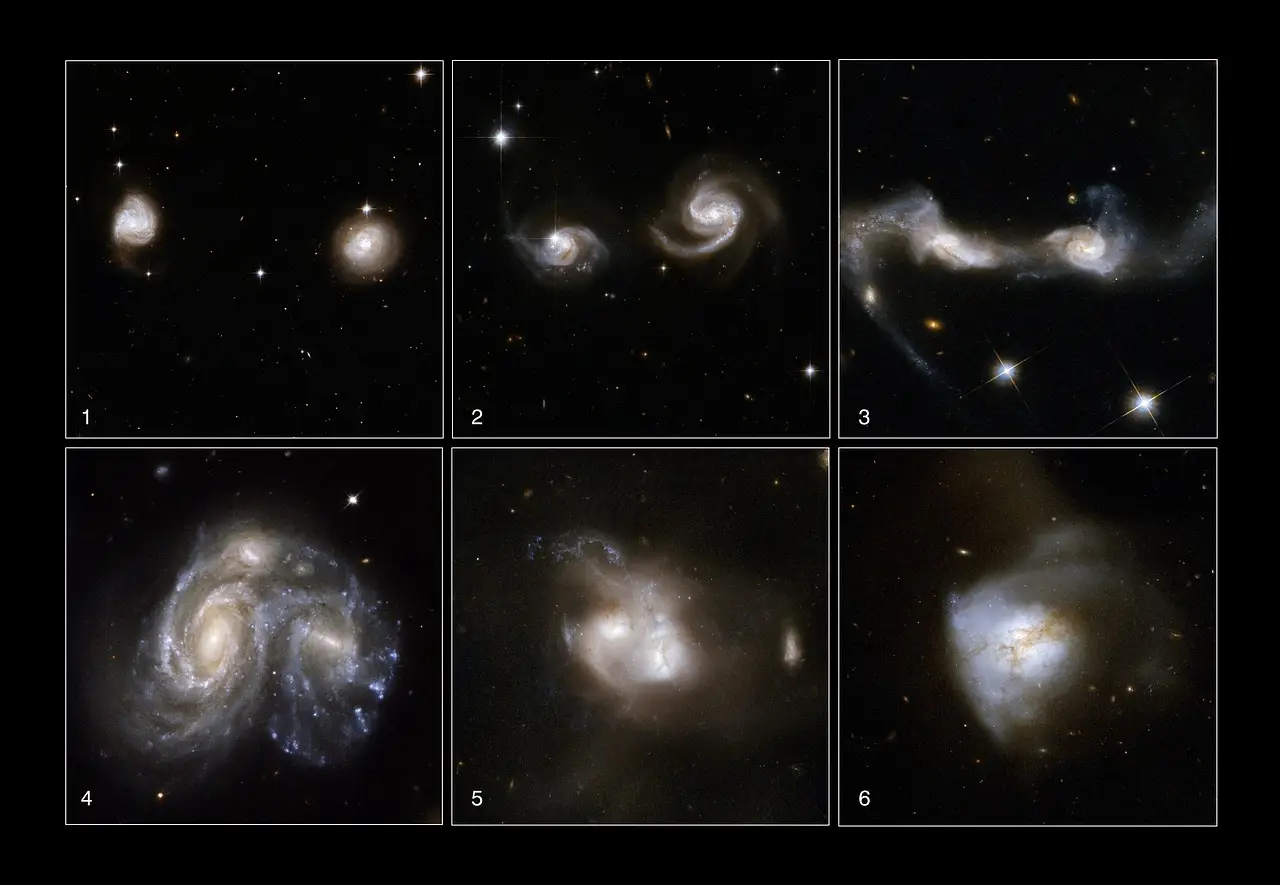
Galaxy interactions offer another test because visible matter and unseen mass both shape what happens when systems pass. The dark dimension makes precise predictions about that behaviour. In the galaxy cluster Abell 1689, unseen mass bends light from surrounding galaxies, revealing it indirectly.
A James Webb image of M74, the Phantom Galaxy, shows a dark-matter halo around dense stars, gas and dust, holding them together against their spin.
String theory has often produced concepts that cannot be tested. The dark dimension differs because its models predict how visible matter should move, how cosmic expansion should change and what radiation might appear. More precise predictions make competing models easier to separate.
Data decide. The researchers’ standard is plain: Lüst said observations and data must settle which ideas survive, regardless of how elegant the theory looks. Whether dark matter is an unseen particle, an unfamiliar property of gravity or a microscopic extra dimension, only measurements can separate those claims.
Takeaway: The proposal has become testable, but it still must meet rival theories on precise, repeated observations.
via sciencefocus.com (Source)
More from Elena Vasquez
Show full bio
Correspondent covering money, funding and market shifts around general science news at SciBeat.
592 articles
Nearby plates
- Micron-scale hidden dimension could explain the Universe’s missing 95%
- Planets and Stars as Dark Matter Traps: New Study Rules Out Scenarios
- Wave Simulations Bring Fuzzy Dark Matter Into Sharper Focus
- Dark Energy May Need No New Particles, QCD Study Claims
- Dark-Matter-Free Model Reproduces Rotation of All 175 SPARC Galaxies