Recorded November 22, 2026
Space & AstronomyReported finding
Dark Energy May Need No New Particles, QCD Study Claims
Dark energy makes up ~70% of the universe's energy, and a new Astrophysical Journal study says the strong nuclear force may explain it — no new particles required.
By Elena Vasquez3 min read696 words
In brief
- Dark energy accounts for about 70% of the universe's total energy budget.
- The study, published in the Astrophysical Journal in 2026, links dark energy to quantum chromodynamics (QCD), the theory of the strong nuclear force.
- The model matches supernovae and early-universe radiation data as well as standard cosmological models.
- No new particles or fitting parameters are needed; the dark-energy scale emerges from known physical constants.
- Next-generation space telescopes will provide the decisive tests of the framework.
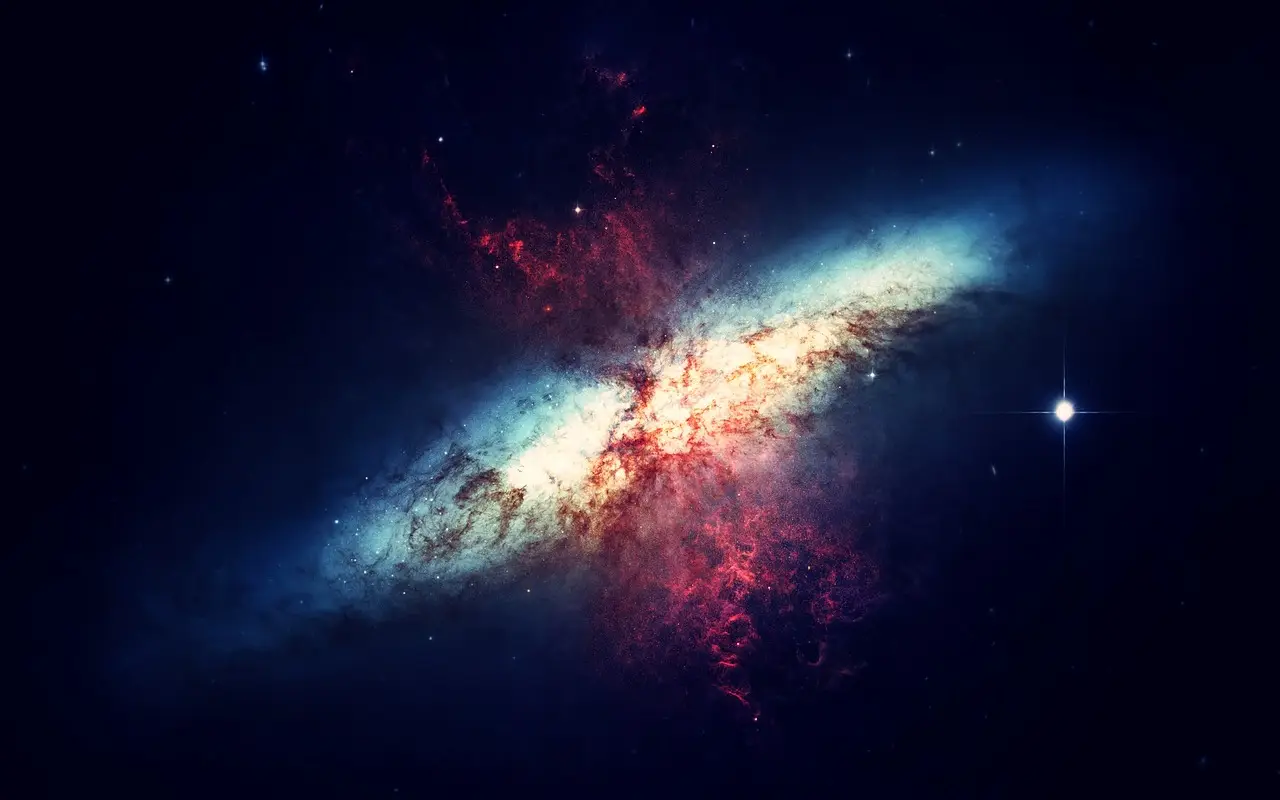
Roughly 70% of the universe's total energy budget is dark energy — and physicists may not need a single new particle to explain it. A study published in the Astrophysical Journal in 2026 argues that the force holding atomic nuclei together could also be driving the accelerating expansion of the cosmos.
Researchers at the University of British Columbia and the University of Sheffield developed the framework. Their claim is bold: the origin of dark energy might already sit inside the standard model of particle physics, the established rulebook for known particles and forces.
That's a sharp break from convention. For nearly three decades, most proposed explanations for dark energy have invoked hypothetical extra fields or undiscovered particles. None has ever been detected experimentally.
What does the new model actually propose?
The answer starts with quantum chromodynamics, or QCD — the well-tested theory describing the strong nuclear force, which binds quarks inside protons and neutrons. Empty space, in this picture, is never truly empty. It's packed with subatomic fields and quantum energy, and in QCD that vacuum has topological properties that can influence space across vast distances.
The UBC team proposed that as the universe expands, this subatomic vacuum structure responds differently over time. That shifting response generates an energy scale just strong enough to drive cosmic acceleration — no new particles, no invented parameters.
"Our theoretical framework suggests no new particles may be required at all," said Ariel Zhitnitsky, a physics and astronomy professor at UBC whose theoretical ideas laid the foundation for the paper. "The characteristic energy scale predicted from the QCD vacuum and gravity comes out close to the observed dark-energy scale today without having to introduce an ad hoc new field or a new parameter."
His colleague emphasized the same point. "The most striking result is that the observed dark-energy scale emerges naturally from known physical constants, without the need for any additional fitting parameters," said UBC professor Ludovic Van Waerbeke.
In short: the numbers fall out of physics we already trust.
How well does it match real observations?
The Sheffield team compared the model against the latest cosmological data. The test used light from distant supernovae — exploding stars — plus leftover radiation from the early universe.
The result: the model matched observations just as well as standard cosmological models do, while adding something those models lack — a possible physical origin for dark energy itself.
"The idea that the quantum vacuum as described by QCD could have the right properties to account for the accelerated expansion of the universe is very intriguing," said Dong Ha Lee, a Ph.D. researcher at the University of Sheffield and lead author on the paper.
Lee was careful about what the analysis does and doesn't show. Testing such models against cosmological data is essential, he said, and the current work shows the model can reproduce the evolving dark-energy behavior suggested by present observations.
"This motivates further theoretical work to better understand how the QCD vacuum responds to cosmic expansion and to develop predictions that can be tested with future observations," Lee said.
That's a hedge worth taking seriously. Matching existing data is not the same as passing a stricter test. The findings are preliminary in the sense that the model has not yet faced the sharper constraints coming from next-generation instruments.
What happens next?
The team plans to refine its calculations and run the framework against incoming data from next-generation space telescopes, which are set to deliver unprecedented detail on the universe's history over the coming years.
If the model survives those tests, the implications are significant. Dark energy — the dominant component of the cosmos, unknown for nearly 30 years — would trace back to quantum chromodynamics and gravity, two pillars of established physics.
If it fails, physicists return to hypothetical fields. Either way, the next telescope data will decide.
The paper is Dong Ha Lee et al., "Evolving Dark Energy Is Vacuum Energy After All," The Astrophysical Journal (2026), DOI: 10.3847/1538-4357/aeb9cc.
The bottom line: known physics may already contain the answer to the universe's biggest puzzle — and future observations will tell whether it does.
via phys.org/rss-feed/ (Source)
More from Elena Vasquez
Show full bio
Correspondent covering money, funding and market shifts around general science news at SciBeat.
592 articles
Nearby plates
- Dark Energy May Not Need New Physics, Study Suggests
- Micron-scale hidden dimension could explain the Universe’s missing 95%
- Dark dimension theory puts the Universe’s missing 95% to the test
- Dark Energy May Be Weakening, DESI Survey Data Suggest
- Dark-Matter-Free Model Reproduces Rotation of All 175 SPARC Galaxies