Recorded November 23, 2026
Space & AstronomyReported finding
Dark Energy May Not Need New Physics, Study Suggests
A new theory in The Astrophysical Journal proposes that dark energy, roughly 70% of the universe's energy, may arise from the strong nuclear force already described by known physics.
By Priya Raman3 min read581 words
In brief
- Dark energy accounts for roughly 70% of the universe's total energy.
- The study was published in The Astrophysical Journal by researchers at the University of British Columbia and the University of Sheffield.
- The theory links dark energy to the strong nuclear force, described by quantum chromodynamics.
- The model fits observations of distant supernovae and early-universe radiation about as well as standard cosmological models.
- The framework requires no new fundamental particle or adjusted extra parameter.
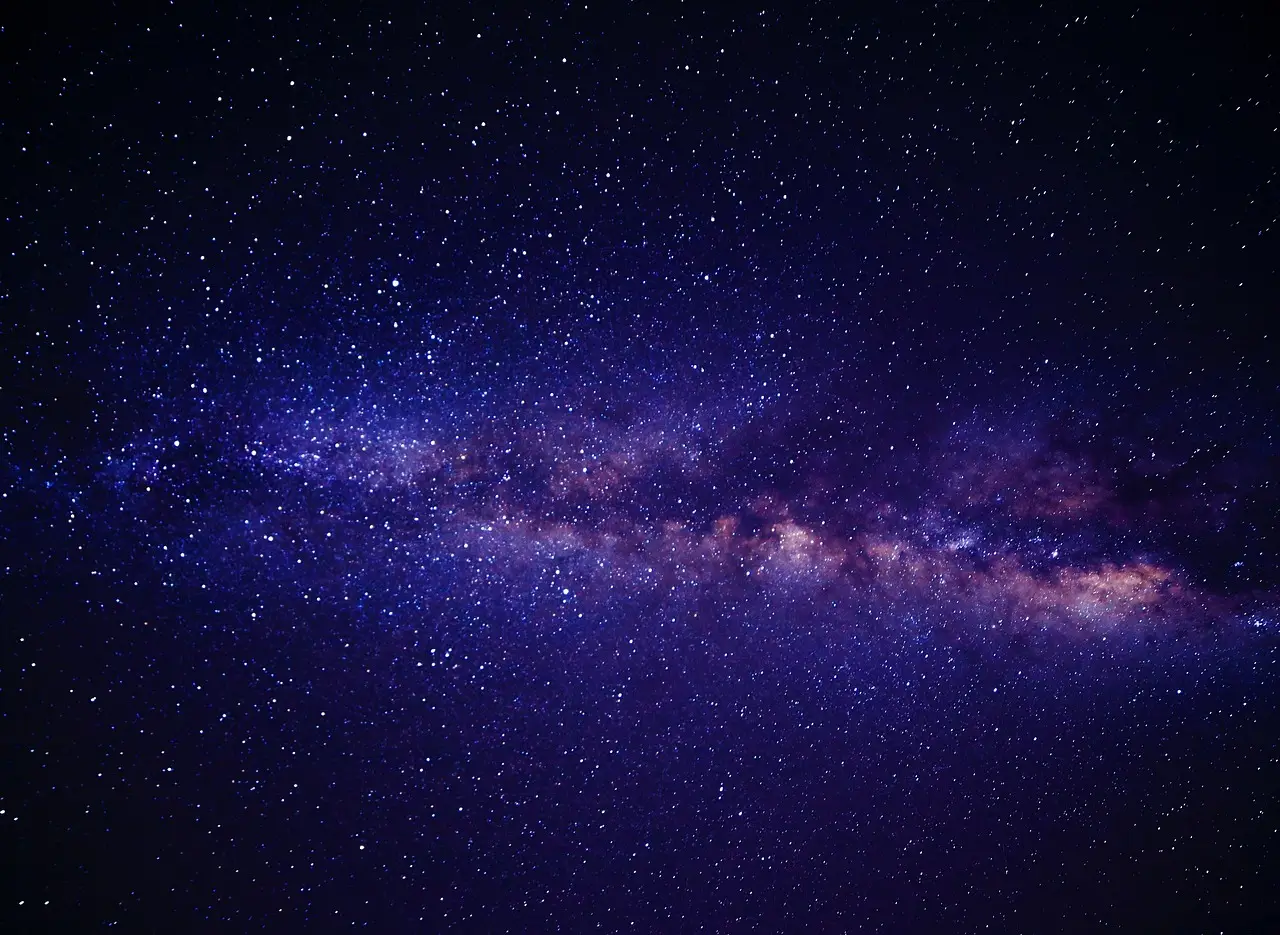
Dark energy accounts for roughly 70 percent of the total energy in the universe, and a new study argues that physicists may not need to invent anything new to explain it. Researchers at the University of British Columbia and the University of Sheffield propose that this mysterious influence arises from physics already on the books: the strong nuclear force that holds atomic nuclei together.
The finding appeared in The Astrophysical Journal, where the authors describe their methods and the evidence behind the result.
What does the new theory actually claim?
Astronomers infer dark energy from observations showing that the expansion of space has been speeding up. Its physical origin, however, remains uncertain. The standard response has been to posit some exotic ingredient — a new particle, a new force, a field added by hand to the equations.
The new proposal takes a different route. It connects dark energy to the strong nuclear force, the interaction that binds quarks (the constituent pieces of protons and neutrons) inside atomic nuclei. Physicists describe this force with an established framework called quantum chromodynamics, a theory tested over decades in particle accelerators.
The researchers focus their attention on the quantum vacuum — the physical fields that persist even in apparently empty space. Their theory suggests that certain properties of these fields could respond to the expansion of the universe itself.
How close is the match to observation?
According to the researchers, that response might produce an energy contribution with a size close to the dark energy inferred from observations. This is the crux of the claim: their calculations aim to explain the observed scale of dark energy without adding a new fundamental particle and without adjusting an arbitrary extra parameter to force the numbers to agree.
The study also tested the model against real astronomical measurements. The team compared its predictions with:
- light from distant exploding stars, which astronomers use to track cosmic expansion;
- radiation left over from the early universe, the faint glow known as the cosmic microwave background.
The researchers reported that their framework could fit those observations about as well as standard cosmological models. They add that the model may also accommodate hints from recent measurements suggesting that dark energy's behavior changes over time — a possibility that the simplest standard models struggle to capture.
Why the authors urge caution
A good fit is not a proof. Several competing models can reproduce much of the same evidence, and a mathematical match is not the same as a direct measurement of what dark energy actually is.
The difficulty is structural. Dark energy cannot be collected in a laboratory sample. Scientists must instead compare mathematical predictions against patterns in the light and radiation reaching telescopes across vast distances — an indirect method that leaves room for multiple explanations to survive on the same data.
The next challenge, the researchers say, is to develop clearer predictions that distinguish this theory from its rivals. More precise measurements of cosmic expansion from future telescopes could help scientists test whether the proposed connection is realistic.
Why the idea matters
The proposal is appealing because it links two apparently separate puzzles: the behavior of matter at tiny scales, governed by quantum chromodynamics, and the expansion of the universe at enormous scales, governed by cosmology. Bridging the two with known physics, rather than new inventions, would mark a considerable simplification of our picture of the cosmos.
For now, the idea remains a theoretical possibility — but one that can be tested against increasingly detailed observations.
via knowridge.com (Source)
More from Priya Raman
Show full bio
Senior reporter covering people, launches and day-to-day practice in general science news at SciBeat.
549 articles
Nearby plates
- Dark Energy May Need No New Particles, QCD Study Claims
- DarkSide-50 narrows the search for nuclear dark matter
- Micron-scale hidden dimension could explain the Universe’s missing 95%
- Dark dimension theory puts the Universe’s missing 95% to the test
- H.E.S.S. telescopes set strongest limits yet on Milky Way dark matter