Recorded November 22, 2026
Space & AstronomyReported finding
Micron-scale hidden dimension could explain the Universe’s missing 95%
A string-theory “dark dimension” could make dark matter and dark energy effects of one extra spatial dimension. DESI data lend the idea cautious support, but the signal remains far from conclusive.
By James Calloway5 min read1,062 words
In brief
- Ordinary matter is 5% of the Universe; dark matter and dark energy make up the other 95%.
- The proposed extra dimension is roughly one micron in scale, compared with a 50-micron human hair.
- DESI uses 5,000 fibre-optic “eyes” to check distances to 35 million galaxies.
- DESI observations suggest dark energy has weakened over time, but the evidence is not super strong.
- One model fills the dimension with primordial black holes whose masses amount to a fraction of a gram.
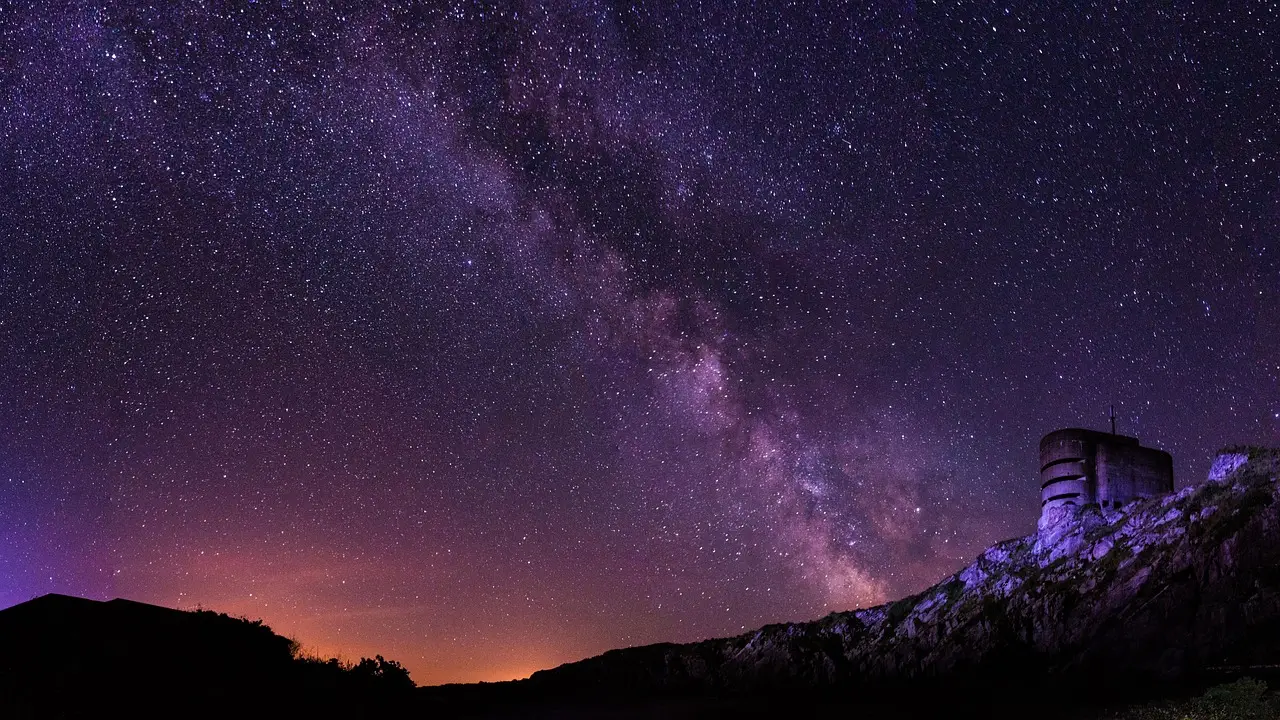
A proposed extra spatial dimension, about one micron across, could explain dark matter and dark energy through one underlying structure. That would cover the 95% of the Universe ordinary matter cannot. The claim remains theoretical, and the observational signal cited in support is not a smoking gun.
What does the Universe’s missing 95% include?
Only 5% of everything is ordinary matter: planets, stars, galaxies and dust. Dark matter and dark energy make up the other 95%, but neither has yielded direct detection. Dark matter does not interact with light; dark energy is a hypothesized influence driving the Universe apart.
Dark matter was first suggested in the 1930s when galaxies rotated too fast to stay intact without extra gravitational pull. Its unseen mass appears to hold galaxies together and shape the cosmos. A century of searching has yielded no identified particle, though its gravity matches many observations.
Webb imagery of M74, the Phantom Galaxy, shows the standard picture: an invisible halo keeps its dense stars, gas and dust from spinning apart.
Some researchers suspect gravity itself. Modified Newtonian dynamics, or MOND, lets gravity vary with acceleration. The decades-old idea remains fringe because Newtonian and Einsteinian gravity predict so well; most cosmologists favor dark matter. Advocates say MOND fits galaxy motion better, yet must explain gravity’s extreme-scale exceptions.
About 30 years ago, astronomers found cosmic expansion was faster than expected and proposed dark energy to explain it. Its origin remains unknown. Quintessence treats dark energy as a field roughly inverse to ordinary matter, varying with its amount and potentially linking the two mysteries, but has produced few testable predictions.
What is the “dark dimension”?
String theory adds tiny extra dimensions beyond our familiar three of space and one of time, rolled up inside ordinary space. In a prominent 10-dimensional version, one extra dimension would generate the effects attributed to dark matter and dark energy.
It must be much larger than other microscopic dimensions, although large remains relative in physics. Prof Dieter Lüst of the Max Planck Institute for Physics, who helped propose the idea, said micron size was a big number for cosmologists and particle physicists.
For comparison, a human hair is about 50 microns across, trillions of times larger than the subatomic distances particle physicists usually study.
What does DESI show?
The Mayall Telescope at Kitt Peak National Observatory in southern Arizona carries DESI, the Dark Energy Spectroscopic Instrument. It builds a 3D cosmic map, measures expansion and lets astronomers infer dark energy’s strength.
DESI’s grey collector barrel contains 5,000 fibre-optic “eyes” that check distances to 35 million galaxies. The readings suggest dark energy is weaker now than in earlier eras. Expansion could dilute a fixed amount across a larger volume, but the data appear to show more: energy from each region of space is losing strength.
That conflicts with a cosmological constant, which fixes dark energy in the equations. String theory allows positive vacuum energy to change and requires it to change. Harvard physicist Prof Cumrun Vafa said decades of work show no stable configuration exists when that energy is positive; an instability always remains.
That does not make the dark dimension the winner. Cosmologist Prof Carsten van de Bruck of the University of Sheffield called the evidence tantalising but not super strong. He said: “It’s not a strong hint, but it’s a good hint. Enough to say, ‘Okay, we should take these theories more seriously than we have done.’”
What could fill the extra dimension?
Several models could fill the extra dimension, and none has won. One proposes primordial black holes, tiny holes formed soon after the Big Bang. Lüst said each has a mass of a fraction of a gram and has survived to the present.
Under that idea, the holes enter the hidden dimension and become the source of what we call dark matter and dark energy. They should slowly decay through Hawking radiation—particles emitted just beyond a black hole’s event horizon—which could produce detectable gamma rays or neutrinos.
Energy released into the hidden dimension would make it grow by a tiny amount, Lüst said. Far in the future, he said, the theory yields a universe with no dark energy. The process would run on time scales far longer than the Universe’s current age, so it is no immediate concern. Its growth could guide experiments toward possible clues.
Other models use hypothetical gravitons, particles said to carry gravity, escaping into the extra dimension and becoming dark matter. A hybrid model treats dark matter and dark energy as fields that exchange energy, allowing dark matter to become dark energy.
Such models often require a new force of nature, van de Bruck said, namely a fifth force mediated by the dark energy field.
What does this change for the search for dark matter?
It offers a rival to the missing-particle search: researchers could look for a dimension generating both invisible mass and cosmic acceleration. Unlike many string-theory ideas, it yields predictions about expansion and galaxy behaviour that observations can test.
The catch is specificity. A model must predict how the hidden dimension affects visible matter, not merely name the missing 95%. Successful predictions could test dark matter as geometry rather than a particle and compare models filled with black holes, gravitons or fields.
What evidence could decide the case?
Large sky surveys and particle experiments offer separate routes. The European Space Agency’s Euclid spacecraft surveys the sky, while CERN experiments probe subatomic particles. Data on expansion or the Universe’s smallest constituents could expose the proposed structure or rule against it.
Galaxy collisions supply another test because ordinary and dark matter shape their interaction. In the Abell 1689 cluster, astronomers infer dark matter from the way it bends background galaxies’ light. A dark-dimension model must predict such visible behaviour precisely; models that fit more accurately deserve more confidence.
This proposal offers what many earlier string-theory concepts lacked: a comparison with observations. It does not prove the dimension exists. It offers a testable way to ask whether the missing 95% is a particle, altered gravity or geometry.
Still, the burden rests with the data. Lüst summed up the standard: “We develop nice ideas and nice theories but, in physics, observations and data should tell us what is true and what isn’t.”
via sciencefocus.com (Source)
More from James Calloway
Show full bio
Staff writer covering regulation, policy and their impact on general science news at SciBeat.
570 articles
Nearby plates
- Dark dimension theory puts the Universe’s missing 95% to the test
- Planets and Stars as Dark Matter Traps: New Study Rules Out Scenarios
- Dark-Matter-Free Model Reproduces Rotation of All 175 SPARC Galaxies
- Dark Energy May Need No New Particles, QCD Study Claims
- Wave Simulations Bring Fuzzy Dark Matter Into Sharper Focus