Recorded November 19, 2026
Space & AstronomyReported finding
Radio pulses every 62 minutes point to a possible dead star
Radio source LPT J1555−5631 repeated polarized bursts every 62 minutes in 2022 observations from MeerKAT and ASKAP, suggesting a slowly rotating neutron star or white dwarf, with no candidate confirmed.
By Priya Raman3 min read609 words
In brief
- In 2022, MeerKAT recorded LPT J1555−5631 for 15 hours, and ASKAP also detected signals from the same sky region.
- LPT J1555−5631 repeated bursts roughly every 62 minutes, with two similarly strong pulses of unequal duration in each cycle.
- Its shorter pulse was almost entirely circularly polarized; the longer pulse combined circular and linear polarization.
- The 2022 evidence supports, but does not confirm, a neutron star or white dwarf as the source.
- Hyman and colleagues detected five Galactic-center bursts in 2002, about 77 minutes apart; the signals returned in 2003 and 2004.
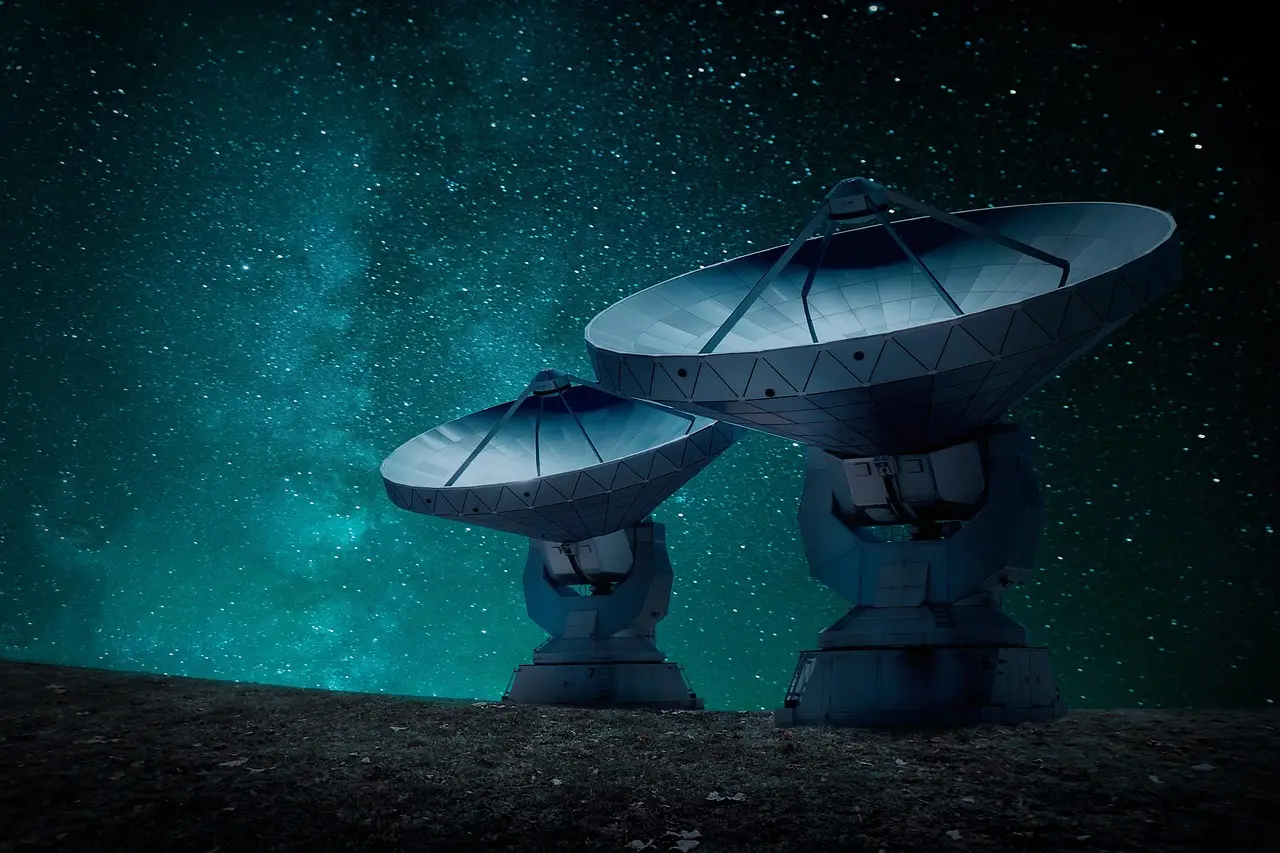
LPT J1555−5631 emitted radio bursts about every 62 minutes in 2022, and their polarization offers evidence for a slowly rotating neutron star or white dwarf without confirming either candidate.
What did the telescopes record?
Scott D. Hyman and colleagues found the source in archived observations from the MeerKAT radio telescope in South Africa. MeerKAT collected the data in May 2022 during a survey of supernova remnants, the dispersed remains of exploded stars.
Over a 15-hour period, LPT J1555−5631 produced radio signals that varied with time. No signal appeared in observations made before or after that interval.
The ASKAP radio telescope in Australia had also observed the same region of sky and detected the signals. Researchers combined the two data sets to reconstruct the source’s changing behavior more clearly.
What did the pulses reveal?
The source sent bursts roughly every 62 minutes. Like ticks on a slow clock, the bursts recurred roughly every 62 minutes.
Each cycle contained two distinct pulses of similar strength. One pulse lasted considerably longer than the other, giving the signal a paired but uneven structure.
The combined MeerKAT and ASKAP data showed this pattern more clearly than either telescope’s observations alone.
What did polarization reveal?
The shorter pulse carried almost entirely circular polarization: its radio waves oscillated in a rotating pattern as they traveled through space. The longer pulse combined circular polarization with linear polarization, in which waves oscillated back and forth along a single direction.
These differences gave researchers a clue about the source’s emitting geometry. They believe the pulses may arise near opposite magnetic poles of a slowly rotating object.
Could a dead star explain the signal?
Scientists place LPT J1555−5631 in a class called long-period radio transients: sources that emit radio bursts at intervals ranging from minutes to hours. The class is known, but its cause remains unsettled.
Possible producers include a neutron star (NS) or a white dwarf (WD), both dense remnants of dead stars. A magnetosphere is the region around an object governed by its magnetic field.
Scott D. Hyman and colleagues wrote in the journal: “While no single observation conclusively identifies LPT J1555-5631 as either an NS or a WD, its pulse properties serve as a stringent stress test for models of LPT magnetospheres.”
That statement sets a firm limit on the claim: the pulse pattern places strong demands on magnetic-field models, but it cannot by itself establish the object’s identity.
What happened in 2002?
The class had already puzzled Hyman and colleagues. In 2002, they detected five bursts near the center of the Milky Way, spaced roughly 77 minutes apart. The signals returned in 2003 and 2004, then disappeared. Years of searching produced no sign of their return.
Why the new source matters
The 2022 source does not settle what causes long-period radio transients. Its value lies in timing and polarization measurements from two telescopes and a 15-hour active window, which give researchers firmer constraints on possible magnetic models.
What remains unresolved?
The Astrophysical Journal published the 2026 findings in a paper by Scott D. Hyman and colleagues. The paper’s digital object identifier (DOI) is 10.3847/1538-4357/aeb002, and the report date was November 18, 2026.
The observations show that LPT J1555−5631 repeats on a roughly 62-minute cycle and that its two pulses carry distinct polarization. They do not establish whether the source is a neutron star or a white dwarf, and they do not explain the wider class of long-period radio transients.
The observations narrow the possibilities, but they leave the dead-star identification unproven.
via phys.org/rss-feed/ (Source)
More from Priya Raman
Show full bio
Senior reporter covering people, launches and day-to-day practice in general science news at SciBeat.
579 articles
Nearby plates
- White dwarf pair sends radio pulses to Earth every eight minutes
- Webb Pins Down the Farthest Fast Radio Burst Ever Seen — and Its Odd Home
- Eight-Minute Radio Flashes Traced to a Dead Star and Its Sun-Like Partner
- A Dead Star Flashes Every 8 Minutes — and Its Partner Is Nearly the Sun
- Zombie Star Pulses Every 7.9 Minutes, and a Sun-Like Star May Be Why