Recorded November 27, 2026
Space & AstronomyReported finding
Red giant devours companion in rare AT2025abao stellar merger
Astronomers tracked a red giant swallowing a smaller companion in Andromeda, then saw gas and dust flare into the luminous red nova AT2025abao on Oct. 17, 2025.
By Elena Vasquez4 min read712 words
In brief
- AT2025abao flared in Andromeda on Oct. 17, 2025 after a red giant swallowed its companion.
- Big Bao was described as 350 times bigger than the Sun and carried about seven solar masses.
- Little Bao reached the giant’s core in fewer than 10 orbits and had about 70% of the Sun’s mass.
- The collision sent stellar material outward at roughly 1.8 million mph.
- The team’s research was published Nov. 18 in Nature.
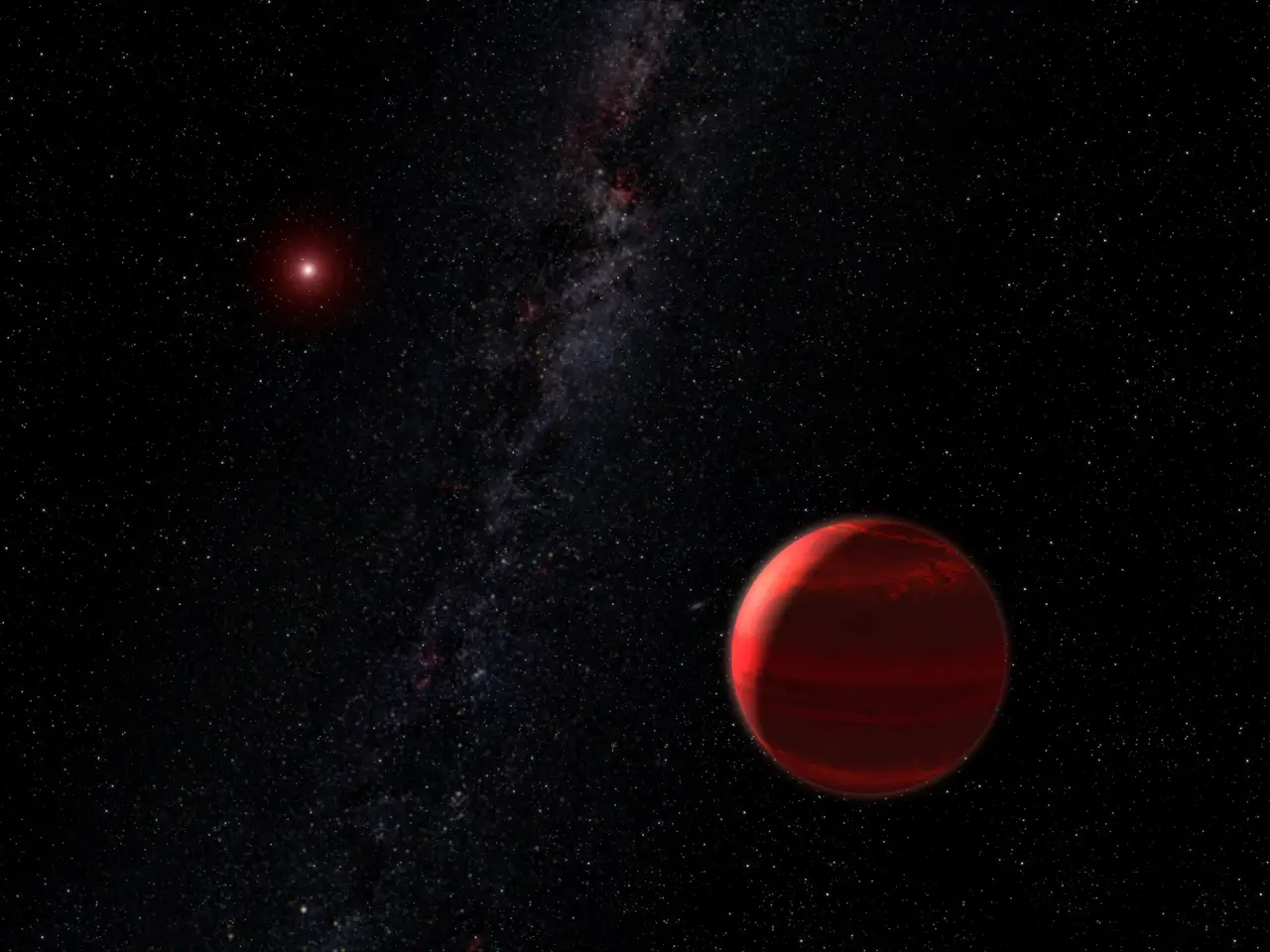
A red giant described as 350 times bigger than the Sun devoured a smaller companion and produced the luminous red nova AT2025abao in the Andromeda galaxy on Oct. 17, 2025.
Astronomers classified AT2025abao as a rare stellar merger, in which one star takes in another. The larger star became known as “Big Bao” and its companion as “Little Bao,” a playful reference to bao buns and the event’s designation.
Big Bao carried about seven times the Sun’s mass; a later estimate put Little Bao near 70% of a solar mass.
“The excitement was real,” said Viraj Karambelkar of Columbia University. “We couldn't quite believe our luck. With detailed observations for several years before the merger, for the first time, we now have an unprecedented glimpse of the conditions that lead to such cosmic events.”
How did astronomers catch the merger?
A bright flash in the nearby Andromeda galaxy, where scientists had not expected a cosmic explosion, started the investigation. Karambelkar and colleagues turned a wide array of ground- and space-based instruments toward the source.
The campaign included NASA missions NEOWISE, SPHEREx and the James Webb Space Telescope (JWST), plus the W. M. Keck Observatory in Hawaii.
The team tied the flash to a source listed as WNTR23bzdiq / WTP19aalzlk. It had stayed stable for the previous 30 years, then brightened steadily from 2019; the team followed the slow, continuous rise for two years.
Karambelkar said the gradual change had revealed a red giant expanding toward the end of its life, just as the Sun will one day. He noted that such stars remain relatively stable for thousands of years, so an explosion during a researcher’s lifetime seemed unlikely.
The long, steady change gave astronomers a rare chance to watch a merger build.
What happened when the stars collided?
A red giant has exhausted the hydrogen in its core and puffed outward, sometimes to hundreds of times its original size. The team theorizes that Big Bao expanded so rapidly and violently that it swallowed Little Bao.
Little Bao then spiraled into Big Bao’s core in fewer than 10 orbits. The impact ejected stellar material at roughly 1.8 million miles per hour.
That material struck the surrounding shell of gas and dust that Big Bao had already expelled. Their collision produced the flash recorded on Oct. 17, 2025.
Little Bao’s inward spiral turned a slow stellar brightening into a violent collision.
What clues exposed the hidden cause?
Before the eruption, SPHEREx found in July 2025 that Big Bao was fading in optical light but brightening in infrared light, a form of heat radiation. The team read that combination as evidence that Big Bao was cooling and spewing out dense clouds of gas and dust that enveloped the star.
Two instruments at Caltech’s Palomar Observatory then witnessed the massive eruption in October 2025: the Zwicky Transient Facility (ZTF) and the Wide-field INfrared Transient ExploreR (WINTER).
On Dec. 24, 2025, JWST supplied the mass of the gas and dust around Big Bao, tracing material from two months before the eruption. That measurement helped set Little Bao’s mass at about 70% of the Sun’s.
The mass estimate carries an important caveat: JWST measured surrounding gas and dust, not Little Bao directly, so the 70% figure remains approximate.
Combining several kinds of light exposed the hidden cause behind the October flare.
Why does this discovery matter?
The team’s research was published Nov. 18 in Nature. Beyond reconstructing one merger, the project showed how ground and space telescopes can work as a coordinated observing team across institutions.
“It was kind of symbolic how the year was coming to an end as we managed to bring together the puzzle pieces from the story of Big and Little Bao,” Karambelkar said. “But in my mind, this felt like a closure of just one chapter in a story that is just starting.”
He added that the team learned about conducting coordinated, multi-facility, multi-team astronomical discoveries. Karambelkar’s caution fits a reconstruction built from changing light signals and an estimated mass, rather than a complete account of every stage of the merger.
One well-timed stellar merger showed what several kinds of telescope can learn together.
via space.com (Source)
More from Elena Vasquez
Show full bio
Correspondent covering money, funding and market shifts around general science news at SciBeat.
659 articles