Recorded November 25, 2026
Space & AstronomyReported finding
Solar vortex simulations trace rotating jets to their magnetic roots
3D MURaM simulations trace a rotating solar jet to a photospheric vortex and magnetic reconnection, quantifying its mass flux and ~525 W m⁻² energy delivery to the corona.
By Marcus Bennett4 min read876 words
In brief
- The study was published in Astronomy & Astrophysics on Nov. 10 (DOI: 10.1051/0004-6361/202661571).
- The simulated jet event lasted about 10 minutes and rose to roughly 4,000 km above the solar surface.
- At 4,000 km, the jet's mean upward mass flux was about 10⁻⁷ kg m⁻² s⁻¹ and its Poynting flux about 525 W m⁻².
- Alfvén, fast-mode and slow-mode wave energy fluxes stood in a ratio of roughly 10:7:3 in the lower corona.
- Pressure gradients drove the jet low in the atmosphere; the Lorentz force dominated in the upper chromosphere.
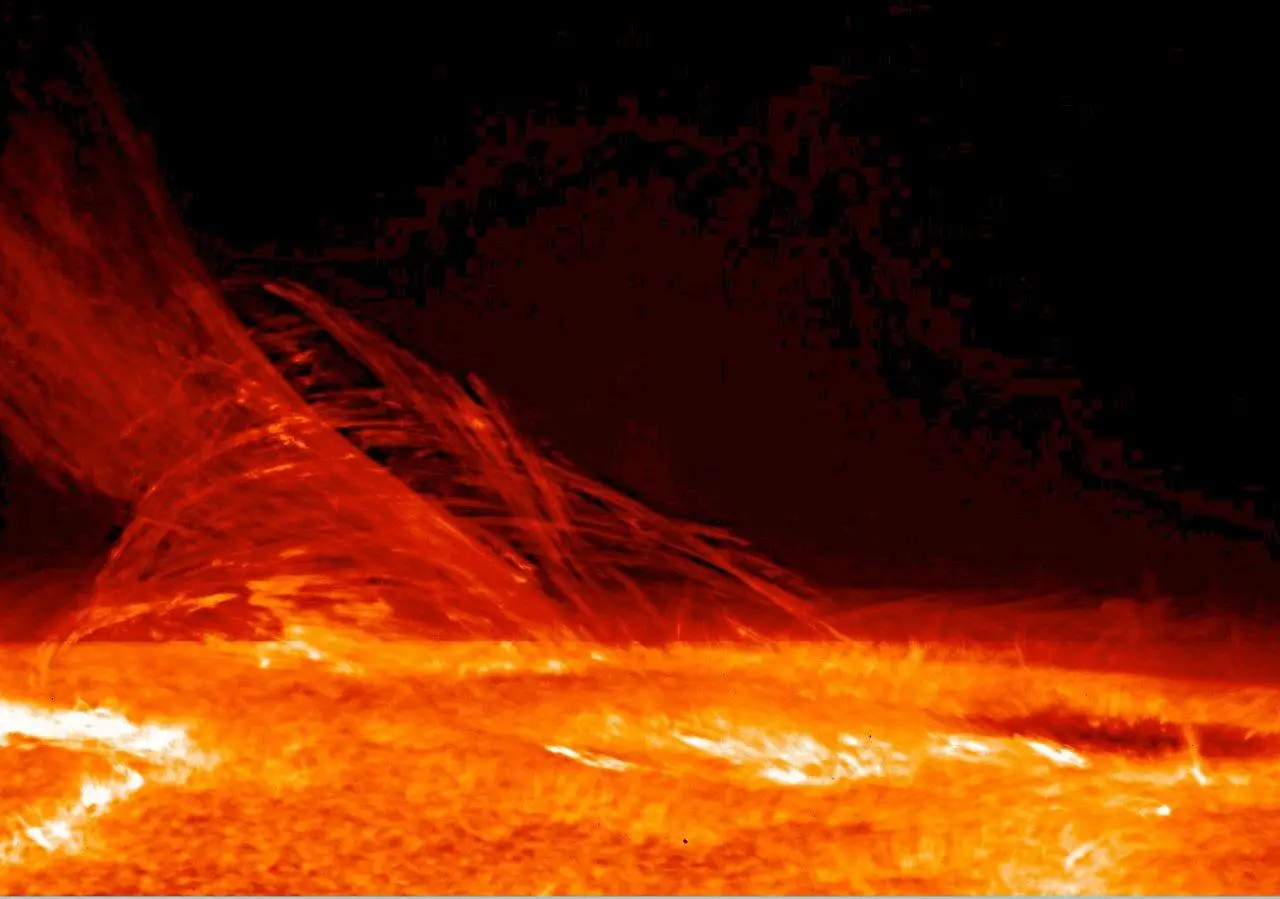
Simulations published in Astronomy & Astrophysics on Nov. 10 show that a photospheric vortex, twisting magnetic field lines until they reconnect, can launch a rotating solar jet that carries measurable mass and energy into the lower corona. The study puts numbers on a process solar physicists have suspected for years but could not fully trace.
The work comes from Liufan Gong and colleagues at the Yunnan Observatories of the Chinese Academy of Sciences, working with researchers at the University of Science and Technology of China and the University of Sheffield. Their paper, "Formation dynamics of a rotating solar spicule-like event and associated energy-mass transport" (DOI: 10.1051/0004-6361/202661571), targets two long-standing gaps: how small vortices between convection-driven granules in the photosphere help form spicules, and how much mass and energy those jets actually deliver upward.
What did the simulations capture?
The team used the MURaM code to run three-dimensional radiative magnetohydrodynamic simulations — models that track plasma, radiation and magnetic fields together — in an open magnetic-field configuration. The computational domain stretched from the upper solar convection zone to the lower corona, the Sun's outer atmosphere.
Several spicule-like jets tied to vortex motions emerged naturally in the runs. The researchers selected one representative event lasting about 10 minutes and traced its full formation. Spicules themselves are slender, short-lived jets common in the chromosphere, the layer between the photosphere and the corona; they lift relatively cool plasma upward and sometimes rotate as they evolve.
Before this jet appeared, a photospheric vortex twisted the magnetic field lines. The rotating structure then extended into higher atmospheric layers, forming what the researchers call a "magnetic tornado." The jet rose gradually inside this structure, rotating about the same axis.
Takeaway: the simulation connects a vortex in the visible surface directly to a rotating jet higher up, with the magnetic tornado as the bridge.
How does reconnection drive the jet?
At the tornado's periphery, the twisted field lines developed locally downward-directed components and reconnected with upward-directed fields — both in the surrounding background and in the vortex core — changing their magnetic connectivity. The simulation showed thin current sheets and bidirectional outflows at different stages, both characteristic signatures of magnetic reconnection, the process by which magnetic field lines break and rejoin, releasing energy.
As the tornado rose and rotated, the reconnection sites moved with it. Multiple fine jet structures matched the upward outflows from these sites.
Force analysis at different heights answered what pushed the plasma up. Pressure gradients dominated in the photosphere and lower chromosphere. In the upper chromosphere, the Lorentz force — the force a magnetic field exerts on plasma — took over, with the strongest upward magnetic forces concentrated around the tornado's periphery.
Takeaway: two mechanisms hand off the job — gas pressure below, magnetic force above — with reconnection at the tornado's edge feeding the fine structure of the jet.
How much mass and energy does the jet carry?
The team calculated the mean mass flux density and electromagnetic energy flux density in the jet region over the event's lifetime, and found net upward mass transport at every height analyzed.
At about 4,000 km (2,500 miles) above the solar surface:
- Mean upward mass flux density: approximately 10⁻⁷ kg per square meter per second.
- Mean upward Poynting flux density — the flow of electromagnetic energy: about 525 W m⁻².
Decomposing that energy flux showed magnetic shearing and twisting carried most of the energy upward.
Takeaway: the jet is not just visually dramatic; it delivers a quantified payload of mass and electromagnetic energy to the lower corona.
What waves does the jet excite?
During formation, continuous perturbations of the plasma and magnetic field excited several types of magnetohydrodynamic waves. The team estimated the energy flux of each mode during the jet's mature stage, when its morphology was relatively stable.
In the lower corona, roughly 3,000–4,500 km (1,900–2,800 miles) above the surface, the energy flux densities of Alfvén, fast-mode and slow-mode waves stood in a ratio of about 10:7:3. Alfvén waves — oscillations traveling along magnetic field lines — carried approximately half of the combined energy flux of the three modes.
Takeaway: the jet launches a wave mixture with a clear hierarchy, and Alfvén waves lead it.
Why does this matter for coronal heating?
The study links the combined action of photospheric vortices and magnetic reconnection to the mass and energy the resulting jets transport into the lower corona. That connection provides a theoretical basis for understanding how small-scale jets contribute to coronal heating — the long-standing puzzle of why the corona runs far hotter than the surface below — and to supplying mass to the solar wind.
One caution: these are simulation results for a single representative event, and the numbers describe what the model transports, not a direct measurement of a specific observed spicule. The 10:7:3 wave ratio and the 525 W m⁻² energy flux are model estimates, useful as benchmarks until observational instruments can resolve comparable quantities.
Even so, the result gives practitioners a concrete chain: vortex, twisted field, reconnection, rotating jet, quantified mass and wave flux — all traced in one self-consistent 3D run.
via phys.org/rss-feed/ (Source)
More from Marcus Bennett
Show full bio
News editor covering regulation, policy and their impact on general science news at SciBeat.
623 articles
Nearby plates
- Millions of tiny solar tornadoes may explain the sun's hottest mystery
- Gravity can snap and reconnect like the sun's magnetic field, study finds
- Simulations Explain Why Black Hole Jets Glow Brightest at Their Edges
- Solar Orbiter traces solar wind switchback back to the Sun
- Black Hole Winds Pack 100 Times More Power Than Scientists Expected