Recorded November 26, 2026
Biology & EvolutionReported finding
Theropod teeth needed one-third less force in backward pulls
A DinoSAW test found that pulling an allosaur tooth backward through ballistics gel required 14 newtons, versus 21.4 for a straight-down bite, favoring neck-powered feeding.
By Marcus Bennett5 min read970 words
In brief
- An allosaur tooth replica cut backward at 14 newtons, versus 21.4 newtons vertically.
- Backward pulling reduced average peak force by about one-third.
- DinoSAW provided the first physical test of theropod “steak knife” teeth.
- The study appeared in Palaeontology on November 26, 2026.
- The team plans to test other teeth, including saber-toothed cat incisors.
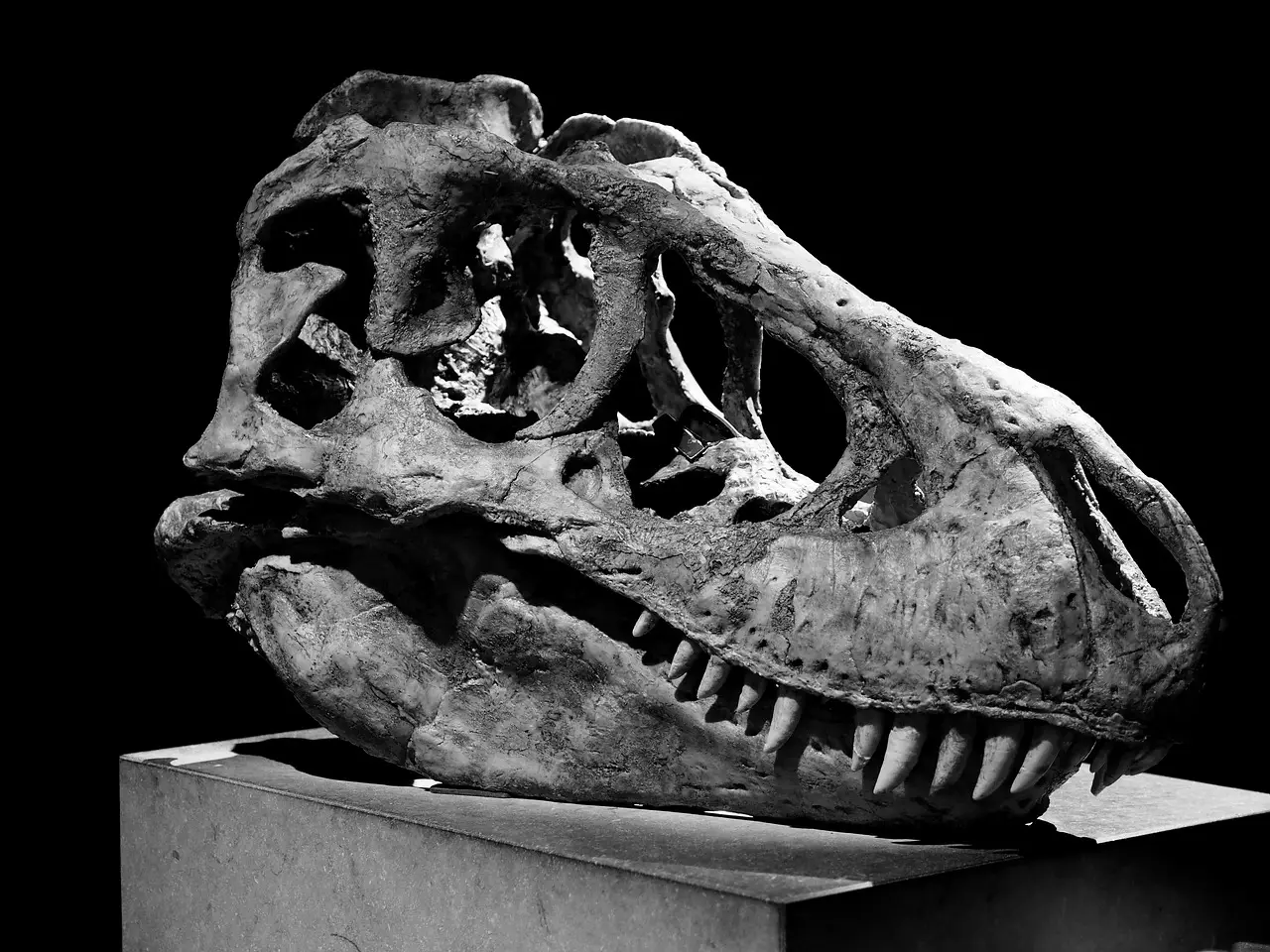
Pulling a replica theropod dinosaur tooth backward through flesh-like gel cut it with an average peak force of 14 newtons, about one-third less than the 21.4 newtons required by a straight-down bite, experiments published on November 26, 2026, suggest.
Researchers at the University of Reading and the University of Illinois Urbana-Champaign ran the first physical test of how theropod “steak knife” teeth cut. Their result supports a feeding style in which a dinosaur sinks in its teeth, then uses its neck to pull backward rather than pressing straight down.
For scientists who model skulls, teeth and feeding, that changes a basic assumption: bite direction may matter as much as bite strength. The study does not directly observe an extinct dinosaur, so it identifies a more efficient mechanical option rather than proving an animal’s behavior.
What did the DinoSAW machine test?
Theropods include Allosaurus, Velociraptor and all modern birds. Many meat-eating members had flat, backward-curving teeth with saw-like serrations on the front and back, much like a steak knife. The research team built a machine called DinoSAW to test whether those teeth worked better as saws or daggers.
The researchers pushed a replica of a theropod tooth from an allosaur into ballistics gel, a soft test material often used to mimic flesh. They imposed two cutting motions while sensors recorded the force:
- A vertical push drove the tooth straight down.
- A diagonal backward pull drew the tooth through the gel along its curve.
Dr. Manabu Sakamoto, a paleobiologist at the University of Reading who led the study, said: “We often picture meat-eating dinosaurs crunching straight down on their prey, but their teeth tell a different story. These teeth are curved backward and serrated on both edges, so we wanted to test whether pulling them through flesh worked better than biting down. It did, by a clear margin.”
His interpretation was that the teeth might have worked much like an eagle tearing at a carcass: the animal would anchor its teeth and pull back with a strong neck. That also gives modelers a specific variable to add: the direction of a bite, not only the force behind it.
In plain terms: The machine gave a backward pull a clear advantage over a straight-down bite.
Why did pulling require less force?
The average peak force fell from 21.4 newtons for the vertical motion to 14 newtons for the diagonal pull. Newtons measure force, meaning the push applied during cutting. The backward method therefore required roughly one-third less force at its highest point.
Tooth shape explained the difference. A vertical bite used only the serrated front edge. A backward pull followed the tooth’s curvature and brought both serrated edges into the cut, using the blade-like design more fully.
The team also filmed the gel under polarized light to reveal internal stress, or concentrated force within the material. Vertical biting produced bright flashes where stress clustered. Diagonal pulling distributed stress more evenly and at lower levels.
The experiment gives researchers a physical way to compare feeding motions. Instead of asking only which bite was stronger, they can test which direction engages more of the tooth and spreads force across the material.
In plain terms: Curvature and two serrated edges spread the load and reduce the force needed to cut.
Could dinosaurs have pulled with their necks?
The researchers point to the powered, S-shaped necks of theropods. Their proposed sequence starts with the teeth puncturing flesh, followed by the neck pulling the head backward so the curved teeth act as saws. The work resembles the way birds of prey tear food from a carcass.
Birds of prey offer a living comparison because they are themselves theropods. Komodo dragons provide another: the researchers describe them as the only living reptiles with similar teeth. These comparisons suggest mechanics rather than document the behavior of the extinct species directly.
Fossil bite marks add another clue. Marks on dinosaur bones often form grooves, and grooves fit a tooth dragged across a surface better than a mark made only by a vertical puncture. The authors say this evidence supports a pull-first interpretation.
That challenges an earlier proposal in which a theropod bit down first and then pulled. Under the new results, the team argues, that order would waste effort; pulling probably produced both the initial puncture and the cut.
In plain terms: The tooth shape and neck anatomy fit a pull-first feeding motion better than a bite-then-pull sequence.
What can the experiment settle?
Study co-author Dr. Philip Anderson, a professor of evolution, ecology and behavior at the University of Illinois Urbana-Champaign, put the limit plainly: “We can never truly know how an extinct animal behaved since we cannot directly observe it. But using theory and methods from physics and engineering allows us to investigate what types of feeding behaviors may have been more efficient and perhaps more likely to have occurred.”
The test centered on one allosaur tooth replica in gel. It measured cutting mechanics, not a living animal’s muscles, posture or choices. The findings therefore support a likely and efficient feeding mode, while leaving its use across different theropod species less certain.
Sakamoto said the modeling implication was to consider the direction of the bite as well as its strength. The team plans to use DinoSAW for other tooth shapes and feeding motions, including the “cookie-cutter incisors” of extinct saber-toothed cats.
The paper, “Recurved teeth of theropod dinosaurs are more efficient at diagonal pull-cutting than vertical puncturing,” appeared in Palaeontology (2026). Its DOI is 10.1111/pala.70096.
In plain terms: Physics points to backward pulling as the more efficient option, but no extinct animal can confirm the behavior in practice.
via phys.org/rss-feed/ (Source)
More from Marcus Bennett
Show full bio
News editor covering regulation, policy and their impact on general science news at SciBeat.
625 articles
Nearby plates
- Duck-Billed Dinosaur's 'Teeth' Were Actually Blood Vessels, Study Finds
- 120-Million-Year-Old Mammal Fossil Had Three Sets of Teeth
- 240-Million-Year-Old Tanzania Fossil Reshapes Dinosaur Timeline
- T. rex Ran Hot: Fossil Tooth Shows 97°F Body Temperature
- Saw-Toothed 'Killer' Dolphin Hunted Off South Carolina 28 Million Years Ago