Plate Nº 17 · recorded November 13, 2026
Space & AstronomyReported finding
Vulcan Centaur Returns to Flight With 40 Amazon Leo Satellites
ULA's Vulcan Centaur lifts off Nov. 13 after nine months grounded, carrying 40 Amazon Leo satellites and an untested fix for a booster nozzle failure.
By Priya Raman3 min read661 words
In brief
- Vulcan Centaur launches Nov. 13 at 12:54 p.m. EST — its first flight in nine months.
- The mission carries 40 Amazon Leo broadband satellites to be deployed about 70 minutes after liftoff.
- Two previous flights suffered a solid rocket booster nozzle failure about 30 seconds after launch.
- Amazon Leo will eventually exceed 3,200 satellites; about 400 have launched on 15 missions so far.
- The launch falls in a busy stretch with SpaceX's first Starship Ship catch attempt and Rocket Lab's 100th mission.
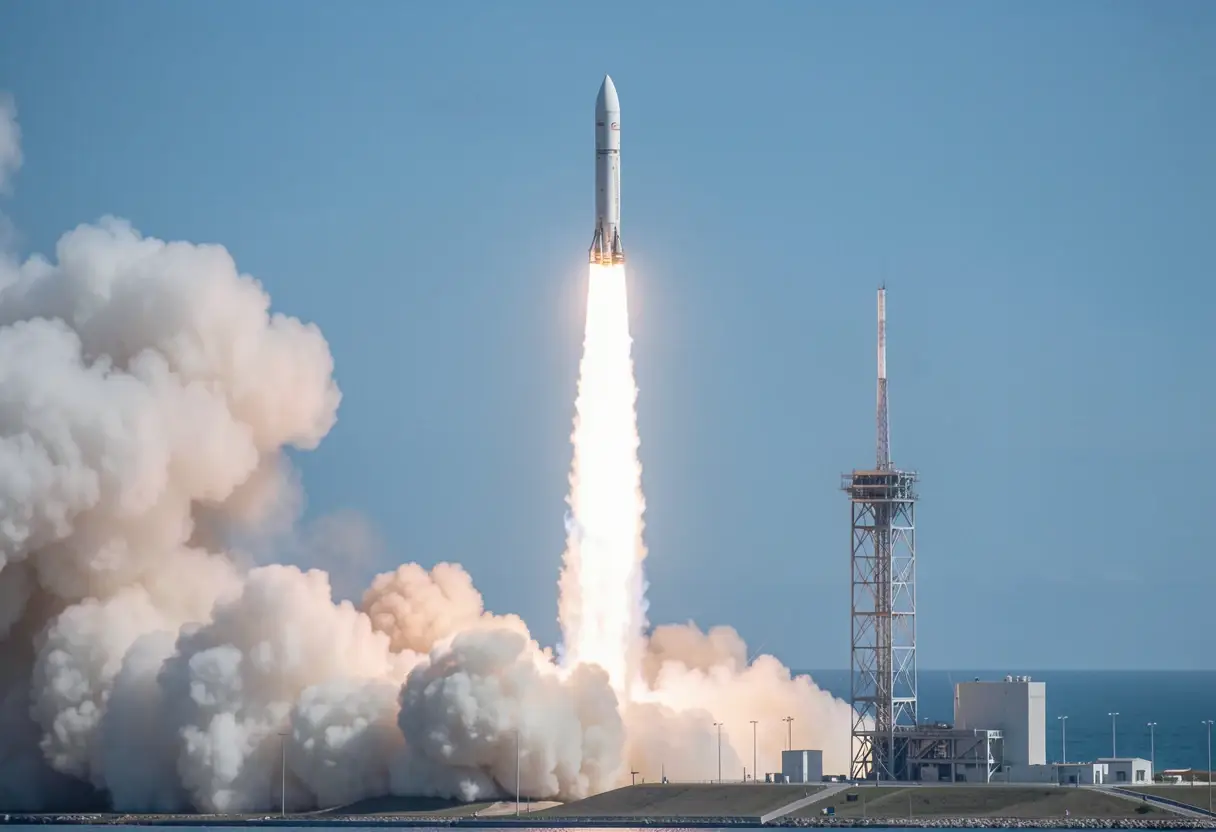
Nine months after its last flight, United Launch Alliance's Vulcan Centaur rocket is scheduled to lift off today, Nov. 13, at 12:54 p.m. EST (1754 GMT) from Florida's Cape Canaveral Space Force Station, carrying 40 Amazon Leo internet satellites. The stakes are high: the mission doubles as the first real-world test of a fix for a booster nozzle defect that twice alarmed the U.S. Space Force.
Live coverage begins 20 minutes before liftoff, provided by ULA.
What went wrong on the last two flights?
Vulcan Centaur, the successor to ULA's long-serving Atlas V rocket, debuted in January 2024 and has flown four times in total. On two of those missions — the second, in October 2024, and the fourth, in February of this year — one of the rocket's solid rocket boosters (strap-on motors that provide extra thrust at liftoff) failed in an unsettling way.
In both cases, the booster's nozzle (the bell-shaped structure that directs exhaust) burned through and fell off roughly 30 seconds after launch. The rocket's main engines compensated each time, and both missions successfully delivered their payloads to the correct orbits. But the Space Force, whose national security payloads flew on Vulcan's third and fourth launches, paused those missions until ULA resolved the problem.
Why does ULA trust the fix?
ULA says its engineers have identified several likely contributors to the anomaly and corrected them. In an Oct. 28 update, the company stated: "The integrated team has made great strides in improving our understanding of the SRB anomaly that occurred on the previous Vulcan flight and have identified several potential contributors, which have been mitigated through design and process improvements to the nozzle."
Today's launch will use the improved nozzle design, while additional testing and analysis continue in parallel. "By flying the improved design, ULA gains valuable flight data that validates these improvements and is the most beneficial path in support of all our customers," the company said.
The confidence remains preliminary. The new nozzle has not yet flown, and today's ascent will supply the first flight data showing whether the redesign performs as intended.
What is Amazon Leo?
Formerly known as Project Kuiper, Amazon Leo is the company's planned broadband constellation in low Earth orbit (the region of space below roughly 1,200 miles, where most communication satellites now operate). It is intended to compete with SpaceX's Starlink network, which has operated for several years.
The constellation will eventually exceed 3,200 satellites. About 400 have reached space so far across 15 launches flown by three different rockets: ULA's Atlas V, SpaceX's Falcon 9 and Arianespace's Ariane 6. Today marks the first Amazon Leo mission for Vulcan Centaur, which is why ULA named the flight Vulcan Leo 1.
If all proceeds to plan, the rocket will deploy its 40 satellites over a 25-minute span, beginning about 70 minutes after liftoff. The spacecraft will be released at an altitude of roughly 270 miles (435 kilometers) above Earth.
A busy day for the launch industry
The Amazon Leo mission anchors a crowded 12-hour stretch for the space sector. SpaceX plans to launch its Starship megarocket this afternoon on a test flight that will attempt, for the first time, to catch the vehicle's Ship upper stage in mid-air. Rocket Lab follows with its 100th mission overall, scheduled for 12:30 a.m. EST (0530 GMT) on Saturday, Nov. 14.
What happens next for Vulcan?
A clean flight today would restore confidence in a rocket that ULA needs badly: the older Atlas V has only about a half-dozen launches remaining on its manifest, leaving Vulcan to carry the company's future workload, including those suspended national security missions. A nozzle failure, by contrast, would deepen the pause and complicate the Pentagon's launch plans.
No engine has ever had to prove itself twice in one afternoon.
via space.com (Source)
More from Priya Raman
Show full bio
Senior reporter covering people, launches and day-to-day practice in general science news at SciBeat.
378 articles
Nearby plates
- ULA Vulcan Rocket Cleared to Launch 40 Amazon Leo Satellites Friday
- NASA Chief Maps SLS Through the 2030s: Cheaper Flights, No Second Launcher
- NASA and Boeing Map Starliner's Road Back to Crewed Flight
- SpaceX Aims to Catch Both Starship Stages for the First Time
- Starship reaches Earth orbit for the first time — with 26 satellites and an engine failure