Plate Nº 60 · recorded November 11, 2026
Earth & ClimateReported finding
Weddell Sea deep water carries stable organic carbon, study finds
A 2026 study of Weddell Sea water sampled in 2016 and 2021 found little change in dissolved organic carbon entering the deep ocean after 6 to 12 years on the shelf.
By Nathan Brooks4 min read747 words
In brief
- Two Polarstern expeditions sampled southern Weddell Sea water in 2016 and 2021.
- Dense shelf water remained for an estimated 6 to 12 years before entering the deep ocean.
- Researchers detected almost no change in the amount or molecular composition of dissolved organic matter.
- The Nature Communications paper appeared in 2026 with DOI 10.1038/s41467-026-79040-4.
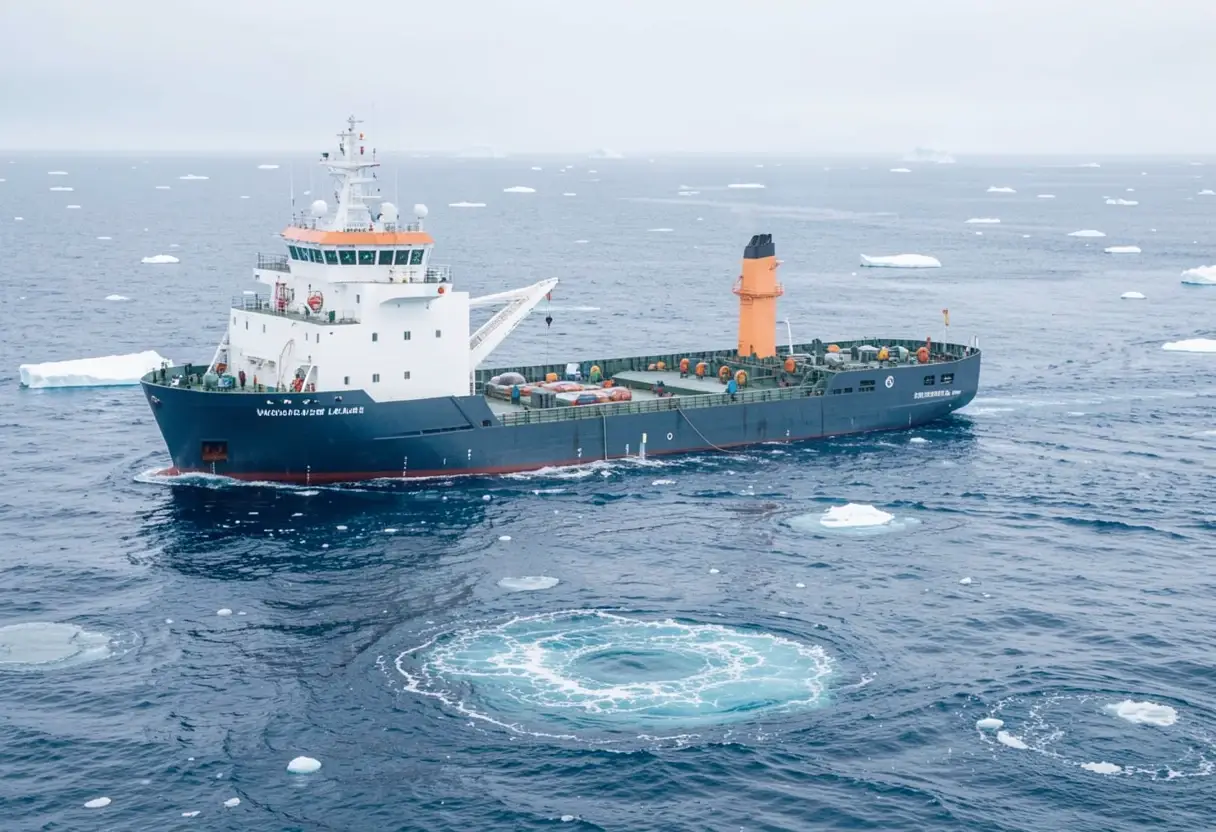
A 2026 analysis of Antarctic water sampled in 2016 and 2021 found almost no detectable change in the amount or molecular makeup of dissolved organic carbon carried into the deep ocean.
The result came from two expeditions aboard the research icebreaker Polarstern, operated by the Alfred Wegener Institute, Helmholtz Center for Polar and Marine Research (AWI). The team sampled the southern Weddell Sea shelf, an important site for forming Antarctic bottom water.
An international team led by first author Dr. Gonzalo V. Gomez-Saez analyzed the samples. He now leads a DFG Emmy Noether research group at Ludwig-Maximilians-Universität München and previously worked at AWI with joint senior authors Dr. Moritz Holtappels of AWI and Dr. Thorsten Dittmar of the University of Oldenburg’s Institute for Chemistry and Biology of the Marine Environment.
Gomez-Saez said: “Our study reveals that the molecular properties of dissolved organic matter are conserved during deep-water formation in the southern Weddell Sea. Our findings highlight dissolved organic matter as a stable component of the regional Southern Ocean carbon cycle.”
What is dissolved organic matter?
Dissolved organic matter is released during both the production and breakdown of marine life. It contains tens of thousands of compounds, some rapidly consumed by microbes and others capable of persisting for much longer. The material forms the ocean’s largest reservoir of organic carbon, making its transformation and transport essential to climate projections.
Why did researchers expect a molecular fingerprint?
Scientists expected seasonal phytoplankton blooms on the Antarctic continental shelf to leave a clear molecular fingerprint of fresh, “labile” organic matter. Labile means easy for microbes to break down. The expectation followed from the intense biological activity surrounding shelf waters as they descended into the deep ocean.
Deep water arriving from the north rises onto the shelf, where extreme cold and sea-ice formation make it denser. This heavy water sinks into the deep ocean and helps form Antarctic bottom water, the coldest, densest and one of the world’s most voluminous water masses.
Abundant marine life and active biological processes affect the carbon carried by that water. Understanding those effects matters because rising temperatures and declining sea ice could alter how the Southern Ocean stores and transports carbon. Reaching the remote, difficult-to-access Weddell Sea shelf also requires specialized vessels such as Polarstern.
How did researchers detect subtle changes?
The team combined complementary methods:
- Advanced instruments at the University of Oldenburg examined the molecular makeup and structure of complex organic mixtures.
- AWI’s MICADAS, or Mini Carbon Dating System, facility helped determine the age of the carbon.
The analyses found that intense biological activity and major changes in water masses left almost no detectable trace in the amount or composition of dissolved organic matter entering the deep ocean. The molecular properties of the deep-water reservoir remained largely conserved.
What explains the missing fingerprint?
The key was time. Dense waters remain on the Weddell Sea continental shelf for an unusually long 6 to 12 years while circulating beneath the large Filchner–Ronne Ice Shelf.
That residence period outlasted the five-year gap between the 2016 and 2021 expeditions. Microbes had enough time to completely break down and “remineralize” newly produced surface carbon before the water left the shelf. Remineralization here means converting that organic material into dissolved inorganic carbon.
This conversion helps explain why fresh, easily degraded carbon left no distinct molecular trace, even as the deeper organic-carbon pool remained stable.
What does this mean in a warming ocean?
Holtappels, an AWI biogeochemist, said: “Global warming is now reaching the Antarctic shelf seas. If the large reservoir of dissolved organic matter is scarcely affected by processes on the shelf, this suggests that this carbon reservoir could remain largely unaffected by climate change in this region.”
The result does not mean every carbon form behaves the same way. Organic particles sinking toward the seabed and dissolved inorganic carbon in seawater may respond more strongly to changes in temperature, sea-ice cover and marine life. Because the study covered two expeditions in one deep-water formation region, it does not establish identical stability across the Southern Ocean.
Researchers will continue tracking how different carbon forms respond to environmental change. Antarctica InSync, an international initiative, brings scientists together to study the rapidly changing Antarctic environment.
The paper, “Conserved molecular properties of dissolved organic matter during Weddell Sea Deep Water formation,” appeared in Nature Communications in 2026. Its DOI is 10.1038/s41467-026-79040-4.
via phys.org/rss-feed/ (Source)
More from Nathan Brooks
Show full bio
Market editor covering companies, deals and strategy in general science news at SciBeat.
325 articles
Nearby plates
- Southern Ocean Weakened Carbon Storage and Fueled Eocene Heat
- Ice Ages May Have Started With a Pole-to-Pole Ocean Chain Reaction
- Fossil Teeth Suggest Some Dinosaurs Grazed on Seaweed
- A Famous 2-Billion-Year-Old Signal From Early Earth May Be Local, Not Global
- Northern Baltic Sea's nutrient regime has shifted, 30-year study finds