Recorded November 24, 2026
Space & AstronomyReported finding
First Detection of a Star's Final Nuclear Heartbeat Challenges Sun Death Models
ALMA has imaged a 6,500-year-old gas ring around the dying star IRAS 06530-0213 — the first direct evidence of a Sun-like star's final thermal pulse, with chemistry that defies existing models.
By Priya Raman4 min read719 words
In brief
- ALMA imaged a gas ring around IRAS 06530-0213, about 12,000 light-years away, ejected 6,500 years ago and half a light-year wide.
- The ring is the first direct evidence of a Sun-like star's final thermal pulse before the planetary nebula phase.
- The hourglass nebula around the star began forming only about 700 years ago.
- Unexpected isotopes of carbon, oxygen and nitrogen do not match current stellar models.
- The research was published November 20 in The Astrophysical Journal.
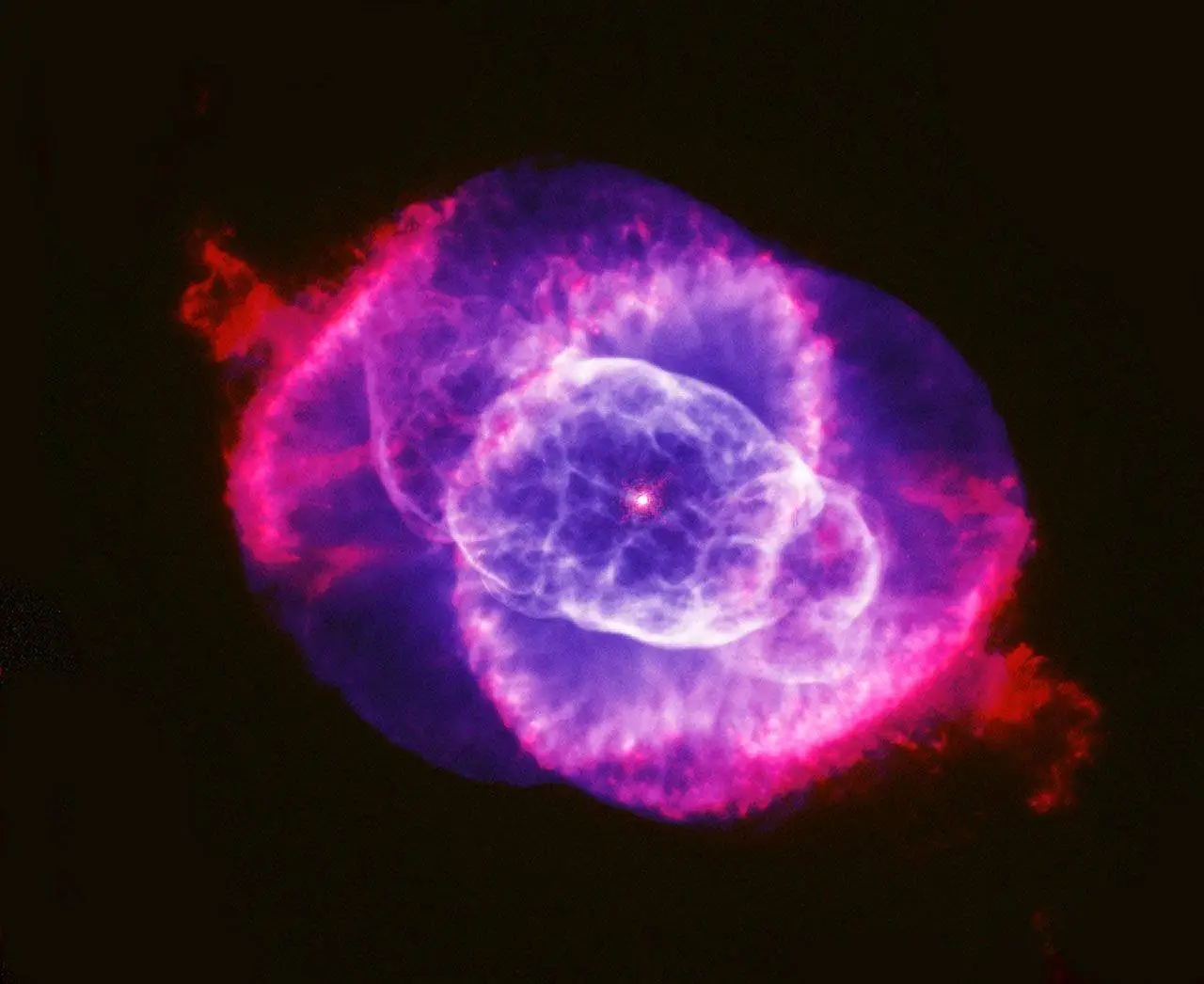
Astronomers have captured, for the first time, the fossilized aftermath of a dying Sun-like star's last thermonuclear flare: a ring of gas half a light-year wide, ejected 6,500 years ago, imaged by the Atacama Large Millimeter/submillimeter Array (ALMA) and reported on Friday, November 20, in The Astrophysical Journal.
ALMA, an array of 66 radio antennas in northern Chile and the world's largest radio telescope, resolved the ring around a star called IRAS 06530-0213, which lies roughly 12,000 light-years away in the constellation Monoceros. The ring circles an hourglass-shaped planetary nebula (a shell of shed stellar debris) that is still in the act of forming.
"It's essentially a physical snapshot of an event that, until now, we've mostly inferred from theoretical models," said Raghvendra Sahai, the NASA Jet Propulsion Laboratory researcher who led the investigation. "We've caught, for the first time, a star's final nuclear heartbeat, frozen in gas."
How do Sun-like stars die?
Sun-like stars die when the hydrogen in their cores runs out. With the core's hydrogen-to-helium fusion halted, the star loses its main energy source, and the outward pressure that once balanced its own gravity disappears. The core collapses into a dense remnant called a white dwarf, while the outer layers, where hydrogen still fuses, swell outward. This bloats the star into a red giant — a relatively short-lived phase.
During that phase, shells of hydrogen and helium surrounding the contracting core occasionally erupt in flares of nuclear activity called thermal pulses. Each pulse hurls stellar material into space. Eventually the outer layers cool and disperse, leaving the white dwarf wreathed in a planetary nebula. The Sun will follow this path itself, though not for billions of years; unlike massive stars, it will not end in a supernova.
What did ALMA actually see?
The gas ring around IRAS 06530-0213 is a frozen fossil of the star's final thermal pulse — the last flare before such a star enters the closing chapter of its life. This is the first direct evidence of that terminal pulse.
The observations also let the team reconstruct a timeline. For roughly 2,000 years after the pulse, the star shed mass at a low rate. Over the following 1,000 years, that mass loss increased sharply, building the lumpy shell now visible as a tangle of material filaments. The filaments trace a spiral pattern, which may indicate an unseen companion star orbiting IRAS 06530-0213 and stirring the gas. The hourglass nebula closer to the star began taking shape only around 700 years ago, meaning the red giant phase ended very recently, in cosmic terms.
"Most of us think of stars as unchanging points of light, but this is a real-time snapshot of a star's death throes," Sahai said. "It's the brief, violent transition between a bloated red giant and a glowing planetary nebula, frozen mid-action."
Why do the results challenge existing models?
Two surprises emerged. First, the team found an unexpected abundance of heavy versions of elements — isotopes — of carbon, oxygen and nitrogen around the star. Current models of how Sun-like stars forge elements and mix them into their surroundings do not predict this chemistry, though similar signatures have appeared around other odd stellar objects where violent bursts of nuclear fusion are the suspected cause.
Second, ALMA detected no disk of dust around the dying star. Such compact disks commonly accompany dying stars and their companions; the disks mark material dragged from a close companion onto the dying star, a process scientists have invoked to explain jet-sculpted hourglass shapes. The team suggests a disk may have existed briefly, powered a short burst of high-speed jets that carved the hourglass, and then faded.
"Dying stars so often have hidden companions that reshape their ejected material into intricate, bipolar or multipolar forms instead of simple spheres," Sahai said. "IRAS 06530 shows that the story is more complicated than the tidy explanation we've been using."
The findings remain tied to a single object, and the companion star remains hypothetical. Still, if the Sun's death throes follow a script anything like this one, its final act will be more intricate than the quiet fade astronomers once assumed.
via space.com (Source)
More from Priya Raman
Show full bio
Senior reporter covering people, launches and day-to-day practice in general science news at SciBeat.
576 articles
Nearby plates
- ALMA Catches a Dying Star's Final Nuclear Heartbeat, Frozen in Gas
- Zombie Star Pulses Every 7.9 Minutes, and a Sun-Like Star May Be Why
- Dead Star Pulses Every Eight Minutes, and Astronomers Are Puzzled
- Dead Star With Two Debris Rings May Preview Our Solar System's End
- Dead Star Fires Radio Pulse Every Eight Minutes, and a Sun-Like Star Answers