Recorded November 27, 2026
Space & AstronomyReported finding
New Equation Dates Moon Craters From Two Simple Measurements
Chinese Academy of Sciences researchers built a compact equation that dates lunar craters from diameter and depth-to-diameter ratio, applied it to 140 craters near the Chang'e-6 site and found a degradation rate of 5.24 m²/Myr.
By Priya Raman4 min read702 words
In brief
- Model applied to 140 craters larger than 480 m in the Chang'e-6 landing area
- Derived degradation rate: 5.24 ± 0.22 m² per million years, consistent with prior mare estimates
- Maximum degradation state found: 14,830 ± 645 m²
- Calibration uses 2.83-billion-year age of returned farside basalt samples
- Simulated craters had initial diameters of 0.4–5.0 km; study published in Icarus (2027)
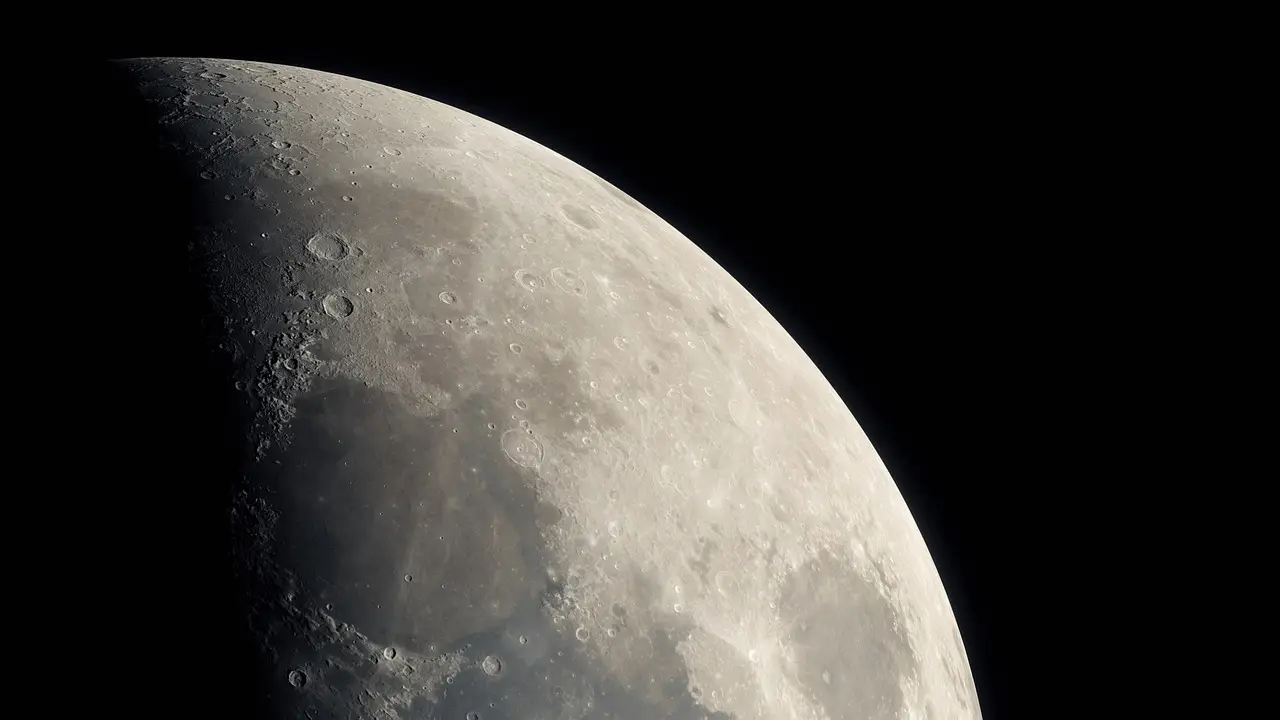
A team at the Aerospace Information Research Institute of the Chinese Academy of Sciences (AIRCAS), working with collaborators, has built a mathematical model that estimates how old and how worn-down a lunar impact crater is from just two measurements: its diameter and its depth-to-diameter ratio. Applied to 140 craters in the Chang'e-6 landing area, the approach produced a degradation rate of 5.24 ± 0.22 square meters per million years — a figure broadly consistent with earlier estimates for lunar mare surfaces. The work appears in the journal Icarus.
Why does crater dating matter?
Consider a crater on the Moon. Over millions of years, micrometeorites hammer the surface relentlessly, and each impact chips material from the crater's rim and walls. The bowl slowly grows shallower; its walls grow gentler. Read carefully, that wear records the history of the lunar surface itself.
Scientists use this gradual decay to date terrain. The trouble is method. The standard technique relies on the topographic diffusion model (a mathematical description of how impact-stirred material spreads downslope over time), and it requires repeated simulations and side-by-side comparisons of crater profiles for every crater studied. The process is computationally expensive and slow — a cost that multiplies when researchers want to survey hundreds of craters at once.
How does the model work?
The researchers took a hybrid route. First, they combined diffusion-based degradation simulations with symbolic regression (a machine-learning technique that searches for compact mathematical formulas fitting a dataset, rather than fitting parameters to a fixed equation).
The team drew on several published models of fresh crater shapes and simulated how simple craters — those with initial diameters between 0.4 and 5.0 km (0.25–3.1 miles) — would degrade over time. From those simulated sequences, symbolic regression distilled a compact equation that links a crater's present-day diameter and its depth-to-diameter ratio to a standardized degradation measure called K₁₀₀₀.
Once a crater's degradation state is known, its age follows from a degradation-rate calibration. In experiments, the researchers report, the compact equation effectively reproduced the degradation states that conventional diffusion simulations produce under the same assumptions about the initial shape of the crater — but at a fraction of the computational effort.
What did the Chang'e-6 application reveal?
The team turned the model on 140 craters larger than 480 m (1,575 feet) in diameter in the Chang'e-6 landing area on the lunar farside. The analysis found a maximum degradation state of 14,830 ± 645 square meters.
Combining that value with the 2.83-billion-year age of the farside basalt samples returned by the Chang'e-6 mission yields the degradation rate of 5.24 ± 0.22 square meters per million years. That the number aligns with previous estimates for lunar mare surfaces (the dark, basaltic plains formed by ancient lava flows) lends the method credibility, though the agreement also reflects shared underlying assumptions about how craters erode.
What are the limitations?
The study itself quantifies where the uncertainty comes from. The researchers analyzed errors in the degradation estimates arising from three distinct sources:
- Measurement noise in the shape of the crater as observed.
- Residuals — the leftover mismatch — from fitting the derived equation to the simulated data.
- Assumptions about the profile of the crater when it was fresh, which no observer can verify directly.
Those caveats matter. The model inherits the assumptions of the diffusion framework it replaces, and its validation so far covers simple craters within the simulated diameter range. Whether the equation holds for complex craters, which have terraced walls and central peaks rather than a simple bowl, remains an open question the publication does not address.
Still, the practical gain is real. Where conventional dating demands repeated numerical simulation for each crater, the new approach reduces the task to evaluating one compact formula from two measurable quantities — measurements that orbiting spacecraft can supply in bulk.
The research appears as Chenxu Zhao et al., "A mathematical model for dating a degraded lunar crater using morphometric parameters," Icarus (2027), DOI: 10.1016/j.icarus.2026.117368.
One equation, two measurements, and the Moon begins to give up its timeline.
via phys.org/rss-feed/ (Source)
More from Priya Raman
Show full bio
Senior reporter covering people, launches and day-to-day practice in general science news at SciBeat.
610 articles
Nearby plates
- NASA's Moon Orbiter Spots 728-Foot Crater That Formed in 2024
- Moon's Largest Impact Basin Dated at 4.34 Billion Years in HKU Study
- Oklahoma's Ames Crater Is 100 Million Years Younger Than Thought
- 3.95-Billion-Year-Old Rocks in China Hint at Early Plate Tectonics
- New Simulations: The Moon May Have Formed Intact in Five Hours