Plate Nº 65 · recorded November 13, 2026
Biology & EvolutionReported finding
Older harvester ant colonies show lower death risk, more reproduction
A 34-year study of 3,285 western harvester ant colonies found that older colonies survived and reproduced better, but did not make individual ants biologically younger.
By Priya Raman3 min read642 words
In brief
- Researchers analyzed 34 years of observations from 3,285 western harvester ant colonies in Mesa County, Colorado.
- Fifty-one colonies established before the project began were still alive in 2024, with estimated ages of 40–42 years.
- Older and larger colonies were less likely to die and more likely to reproduce.
- Queens can live for decades, while individual workers live about one year.
- The study appeared in the Proceedings of the National Academy of Sciences in 2026 under DOI 10.1073/pnas.2612817123.
By Priya Raman
A 34-year study of 3,285 western harvester ant colonies found that older colonies faced a lower risk of death and a higher likelihood of reproduction.
In Mesa County, Colorado, University of Houston biologists Blaine Cole and Diane Wiernasz began monitoring western harvester ants in 1992. Their long record revealed a reversal of the usual age-related pattern, which scientists call negative senescence (survival or reproductive performance improving with age).
“Life is always showing us different solutions to similar problems,” Cole said.
What did the decades of observations show?
For this study, Cole and Wiernasz, both in the Department of Biology and Biochemistry, analyzed 34 years of observations from 3,285 colonies of known ages. They tracked which colonies survived, how they grew and whether they reproduced. Their main results were:
- Fifty-one colonies established before the project began were still alive in 2024. The researchers estimated their ages at approximately 40–42 years.
- Older colonies were less likely to die and more likely to reproduce.
- Larger colonies also were less likely to die and more likely to reproduce.
- Colony growth did not come at the expense of reproduction.
The researchers originally set out to describe how ant colonies grow, reproduce and die. Only after about a decade did the unusual longevity become apparent. Cole said no single moment of epiphany marked the discovery; instead, it became a dawning realization of how unusual the ants’ aging pattern was.
How can an older colony become more resilient?
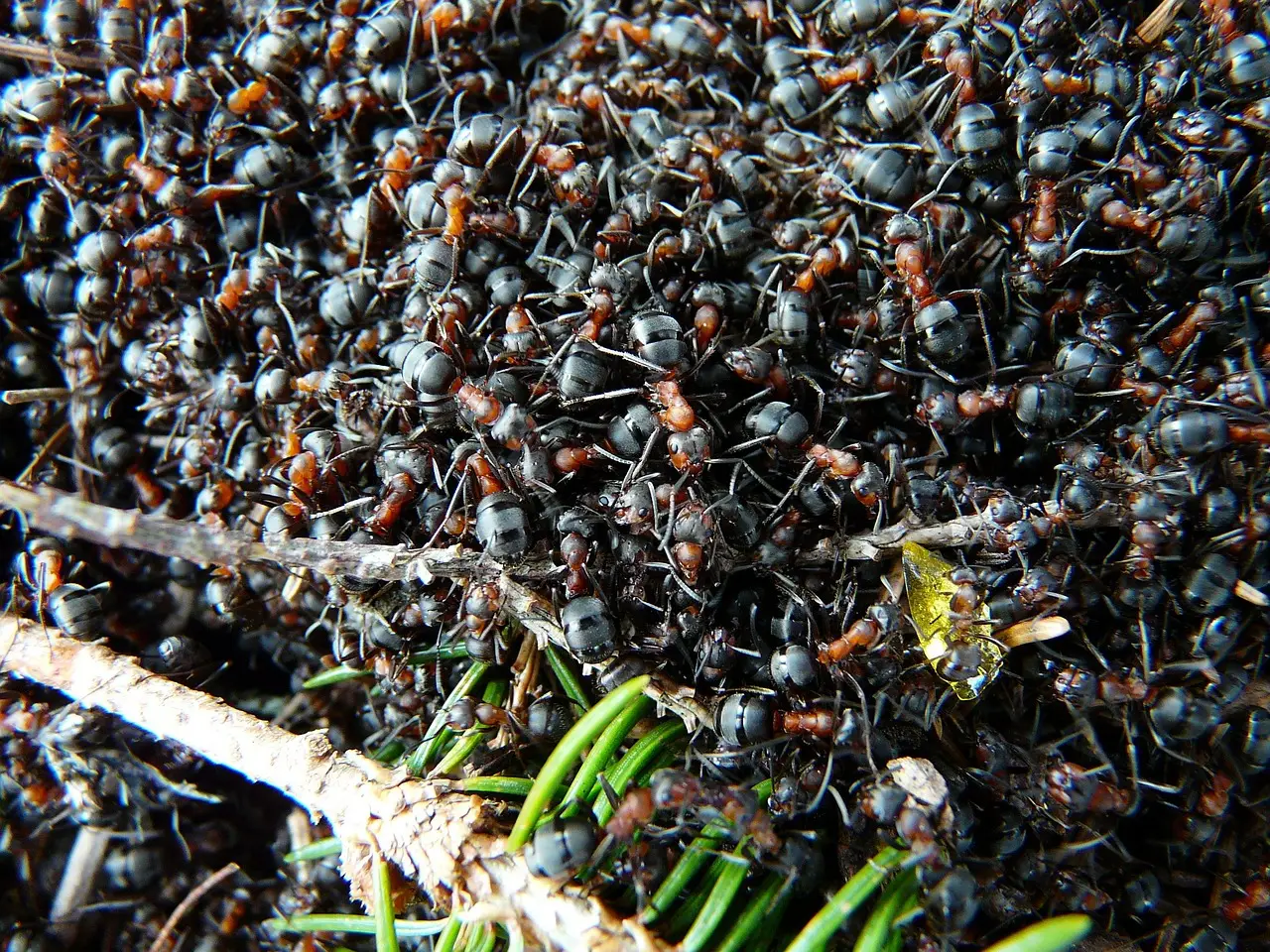
An ant colony functions as a superorganism (a group whose members operate in some ways like a single living organism). One queen produces offspring, while workers gather food, care for young and maintain the nest. The queen can live for decades, but an individual worker lives about one year.
As workers die, new workers replace them and renew the colony’s functioning body even as the colony ages. Cole and Wiernasz describe this mechanism as a replaceable soma (the continual replacement of a colony’s nonreproductive workforce, which supports its reproductive queen and overall functioning). Cole explained that the age of this workforce remains effectively unchanged whether the colony is 2 years old or 40.
The researchers linked this renewal to two connected colony traits: continued growth and continual worker turnover. Together, expansion and replacement provide the proposed mechanism behind improved survival and reproduction, rather than a trade-off in which growth reduced reproductive activity.
Does this mean individual ants age more slowly?
No. The result concerns aging at the colony level, not inside individual ants. An older worker does not become biologically younger, and the study provides no evidence of that kind of rejuvenation. It describes a social unit whose members turn over while the larger organization persists.
Negative senescence is not unique to ants. Certain plants, fish and sea urchins also show improved survival or reproduction with age. The harvester ant finding stands out because the researchers identified a mechanism tied to a highly organized insect colony: growth combined with continual replacement of workers.
This comparison helps scientists examine why aging evolves differently across living systems and how social organization can shape survival and reproduction. It also demonstrates the value of long-term observation, because patterns that a short study might miss can become clear across several decades.
What will Cole study next?
Cole hopes to test whether other highly social insects, including leaf-cutter ants and termites, show the same colony-level pattern. His broader lesson concerns the persistence required in fundamental research.
Blaine J. Cole and colleagues published “A replaceable soma enables negative senescence in harvester ants” in the Proceedings of the National Academy of Sciences in 2026. The paper’s DOI is 10.1073/pnas.2612817123.
“If you study something long enough and pay attention closely enough, you will inevitably discover new and amazing things,” Cole said.
via phys.org/rss-feed/ (Source)
More from Priya Raman
Show full bio
Senior reporter covering people, launches and day-to-day practice in general science news at SciBeat.
368 articles
Nearby plates
- Wasps Are Hijacking 10-Million-Year-Old Ant Homes in Borneo's Trees
- Half a Million Bird Records Show Females Dying Younger
- Bat Genomes Reveal Why Some Species Live 50 Years Without Cancer
- Asian Elephant Social Networks Fracture After 12 Years of Decline
- Where You Live May Speed Up How Fast Your Body Ages