Plate Nº 39 · recorded November 18, 2026
Reported finding
Roman Glass and Han Jade Found in Mongolia's Largest Xiongnu Tomb
A 240-foot 'inverted pyramid' tomb in Mongolia yielded 400+ grave goods, possible Roman glass and Han-style jade. The occupant's identity remains unknown.
By James Calloway4 min read763 words
In brief
- The tomb at Duurlig Nars is the largest Xiongnu tomb ever found in Mongolia, about 240 feet (73 m) long.
- More than 400 grave goods were recovered from the 2,000-year-old nine-level burial.
- A broken glass cup with a handle may have been made in the Roman Empire; tests are planned to confirm it.
- 15 jade pieces resemble Han dynasty 'bi' disks but carry irregular, engraved designs.
- DNA analysis of teeth and hair will try to identify the occupant's sex and relatives.
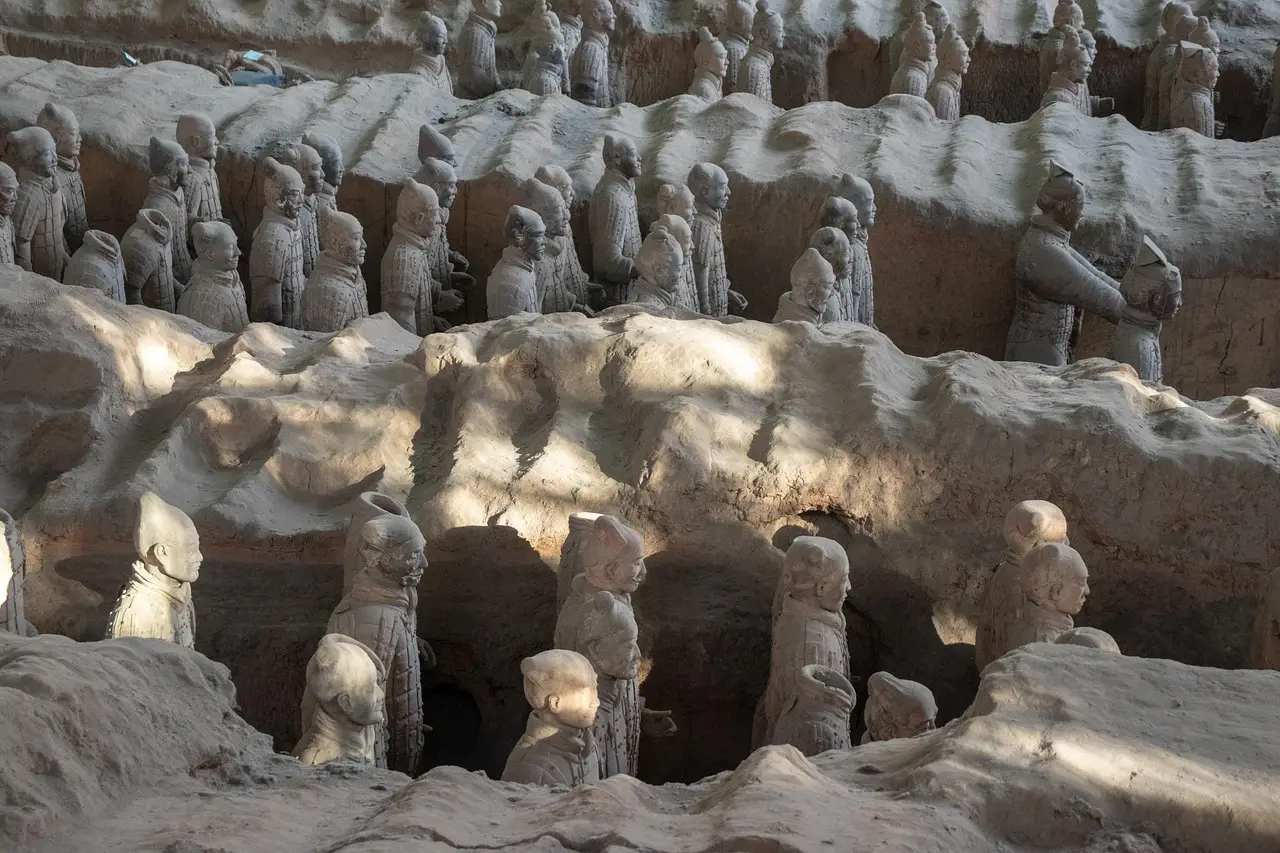
Archaeologists have pulled more than 400 grave goods from the largest Xiongnu tomb ever found in Mongolia — including a glass cup that may have been made in the Roman Empire. The tomb, roughly 2,000 years old, sat in an elite burial ground at Duurlig Nars in northern Mongolia. A team from the National Museum of Korea excavated it over four years, working with the Institute of Archaeology of the Mongolian Academy of Sciences and the National Museum of Mongolia.
That is a big claim on its face. A Roman cup in a steppe nomad's grave? The researchers themselves hedge: they say the transparent, handled cup may have been manufactured in the Roman Empire, and additional tests will try to pin down where the glass actually came from. Until those tests run, the cup's origin is a hypothesis, not a fact.
What exactly did they find?
The tomb itself is the headline. It is roughly square, with a long passageway stretching out from it. Measured with the passageway, the whole structure runs about 240 feet (73 meters) — roughly the length of the Great Sphinx of Giza. Digging down about 48 feet (14.5 meters), the archaeologists found nine concentric layers of stone, each smaller than the last. The result is a kind of inverted pyramid sunk into the ground.
Inside, the central chamber held a wooden burial chamber and a coffin. The grave goods recovered so far include:
- Silver-and-quartz accessories crafted to decorate horses
- A wheel from a lacquered horse-drawn carriage
- Fifteen flat, overlapping jade pieces laid on the bottom of the coffin
- The broken glass cup with a handle, possibly Roman
The horse gear and the carriage wheel both point to an occupant of high social status. Nomad elites rode; poor nomads walked.
Why does the jade matter?
The jade pieces are the most culturally loaded find. The Han dynasty — ancient China's second imperial dynasty, arising around 200 B.C. — buried its important people with at least one "bi," a jade disk. But the jade in this tomb doesn't follow the recipe. The Han "bi" is typically circular; the Xiongnu pieces are irregular, engraved with elaborate designs.
The researchers' reading: the Xiongnu adopted a Han burial practice but put their own spin on it. It's a plausible interpretation, and it fits what else we know. But keep in mind nobody has published a full analysis of these pieces yet — this comes from a translated museum statement, not a peer-reviewed paper.
Who was the Xiongnu, anyway?
The Xiongnu, also called the Hunnu, were a collection of nomadic tribes that coalesced into a mobile empire on the Mongolian steppe in 209 B.C. They were famous for fighting and horsemanship, and they sat astride a trading network that stretched from the Roman Empire in the west to China and the Korean Peninsula in the east. The tomb's mix of possible Roman glass and Han-style jade is exactly the kind of assemblage you'd expect from a hub of that network.
When the empire fractured in the late first century B.C., one band moved west, picked up new tribes along the way, and eventually became the horde known as the Huns. So some Xiongnu were ancestors of the Huns — a lineage archaeologists have been chasing for decades.
What does this change for our picture of the empire?
Possibly the timing of its decline. The burial chamber in this tomb is smaller than those of other elite Xiongnu burials, even though the tomb complex itself is the largest ever found in Mongolia. The researchers suggest the shrunken chamber signals a society in transition, with Xiongnu power waning when the tomb went up in the late first to second century A.D. One tomb can't carry that whole argument, but it's a data point.
Duurlig Nars itself is the largest noble burial complex of the Xiongnu Empire, with nearly 300 ancient burial mounds called kurgans.
Who was buried there?
Here the honest answer is: nobody knows yet. Archaeologists plan DNA analysis on teeth and hair recovered from the coffin, hoping to determine the person's chromosomal sex and whether the individual was related to others interred at Duurlig Nars. Future analyses, the museum statement says, should paint a more detailed picture of Xiongnu society two millennia ago.
That's a promise, and promises in archaeology take years to keep. But the tomb is spectacular, the finds are real, and the questions — Roman glass in Mongolia, Chinese ritual in steppe hands — are worth asking.
via livescience.com/feeds/news (Source)
More from James Calloway
Show full bio
Staff writer covering regulation, policy and their impact on general science news at SciBeat.
478 articles
Nearby plates
- 11,000-Year-Old Clay Fragments Show Humanity's First Pottery Trials
- Keepsakes May Date Back Half a Million Years, Study Claims
- Half a Million Years Ago, Humans May Have Kept Souvenirs
- 15,000-Year-Old Clay Figures Rewrite Story of Early Human Creativity
- 3.95-Billion-Year-Old Rocks in China Hint at Early Plate Tectonics