Recorded November 23, 2026
Reported finding
Stone Tools Across 27 Sites Show Neanderthal-Linked Craft in China
Quina toolmaking, a technology tied to Neanderthals in Europe, shows up at 27 sites in southwest China. The surface finds extend a pattern first seen at Longtan—but can't yet be dated.
By Elena Vasquez3 min read673 words
In brief
- Quina-type stone tools were identified at 27 locations in southwest China, Xiao et al. report in Palaeogeography, Palaeoclimatology, Palaeoecology.
- The team analyzed 166 scrapers and 58 resharpening flakes from surface collections in the Huangping and Binchuan basins; the finds are undated.
- Trachyte made up about 96% of collected scrapers but only 28% of 469 river cobbles sampled.
- The earlier Longtan material was dated to roughly 60,000–50,000 years ago.
- Quina technology is closely associated with Neanderthals in Europe; shared knowledge versus independent invention remains unresolved.
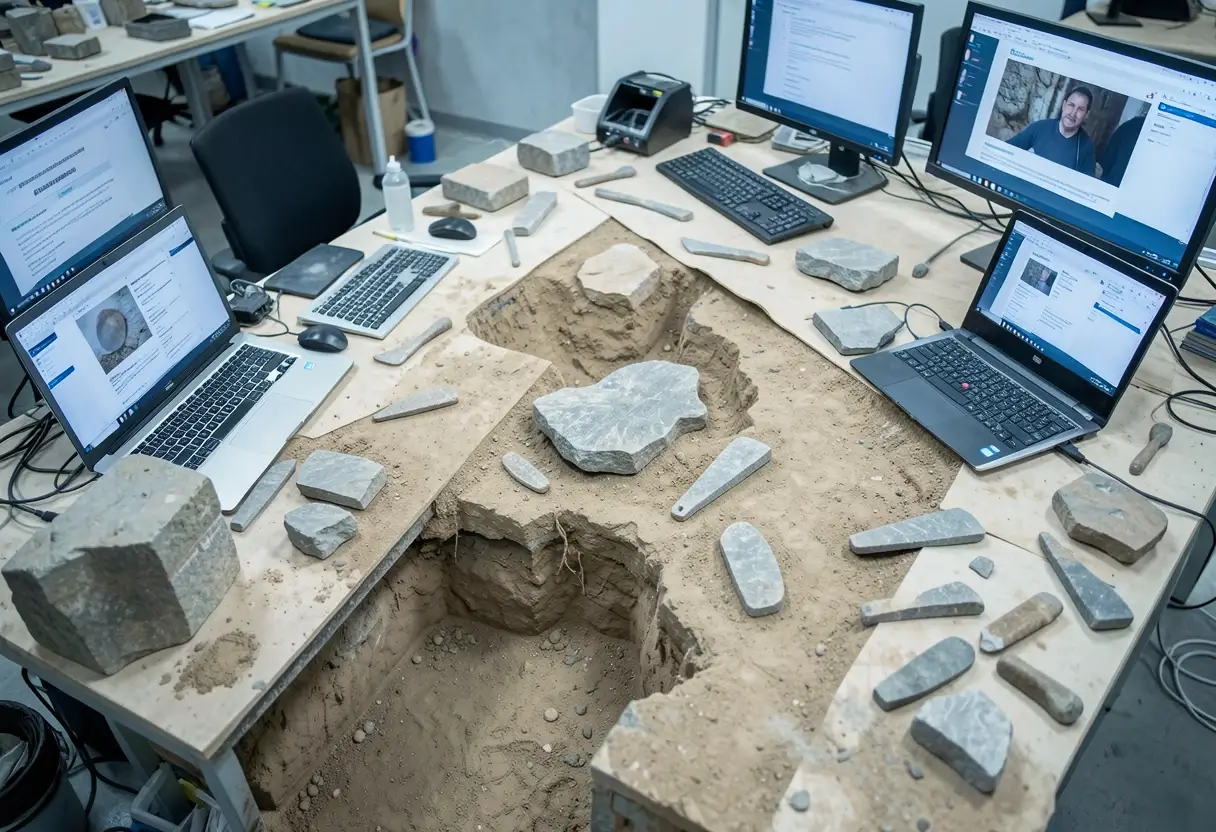
Archaeologists have identified a Neanderthal-linked stone technology at 27 locations across southwest China, hundreds of kilometers from the site where it was first spotted. Pei-Yuan Xiao of the Chinese Academy of Sciences and colleagues report the findings in Palaeogeography, Palaeoclimatology, Palaeoecology.
The technology is called Quina, and in Europe it's closely associated with Neanderthals. Its appearance in China raises a real puzzle: did the knowledge travel, or did distant populations invent similar methods on their own? Nobody knows yet.
What did the researchers actually find?
The team analyzed 166 scrapers and 58 resharpening flakes from surface collections in the Huangping and Binchuan basins, near the southeastern margin of the Tibetan Plateau. An earlier study by members of the same group had identified Quina toolmaking at Longtan, in excavated material dated to roughly 60,000–50,000 years ago. The new surface finds have not been dated.
Quina toolmaking has a distinctive logic. Toolmakers shaped thick, asymmetric flakes so that a honed working edge sat opposite a substantial rounded back, which held a reserve of stone for later sharpening. Think of it as a knife designed to be resharpened many times over its life.
The scrapers told that story physically. They retained thick backs and overlapping generations of scars from repeated edge maintenance. Detached flakes preserved traces of earlier sharpening. Some larger pieces had served double duty—first as tools, then as sources of fresh flakes for new cutting edges.
Measurements backed the visual read. Thickness, edge angles and other features closely matched the excavated Quina scrapers from Longtan, and both groups clearly differed from non-Quina scrapers at the site. In plain terms: this looks like a recurring, deliberate method of working stone, not a coincidence of shape.
Why the rock choice matters
The toolmakers were picky. Trachyte, a fine-grained volcanic rock, accounted for about 96% of the surface-collected scrapers—but only 28% of the 469 cobbles sampled from nearby river gravel. Cobble, in plain English, just means a rounded rock between 2.5 and 10 inches across.
"Trachyte was selected and sandstone rejected, regardless of local abundance," the researchers write. The sampled trachyte cobbles were larger than the sandstone ones, and their fine grain suggested more predictable fracturing—exactly what you want in a tool built to survive repeated reworking.
Independent invention or shared knowledge?
The short answer: it's too early to say. Other archaeologists have challenged the Longtan classification and its dating, arguing that similar tool shapes don't prove a shared technological system. The team has defended its earlier analysis, which examined how tools were made, not just how they look. The new surface finds strengthen the regional comparison—but they can't establish when all 27 locations were in use, and they can't identify the toolmakers as Neanderthals.
The researchers offer a working hypothesis for why this technology made sense here. People who moved seasonally to find water, vegetation and animals scattered across rugged terrain needed tools that stayed reliable far from the riverbeds where the stone came from. A maintainable, durable edge was worth its weight.
European Quina sites point to a comparable challenge, with resources spread across landscapes and prey availability shaped by seasonal movements. Similar demands could have pushed separate populations toward similar inventions without any contact between them.
That explanation remains just that—a hypothesis. The evidence for how animal resources were distributed in the Chinese study area comes from modern ecology; animal remains from the relevant period have never been recovered there to test it directly.
What comes next?
The regional pattern does suggest Longtan represents a recurring way of working stone rather than a one-off. More excavations and more dates are needed to establish its history—and to determine whether its resemblance to European Quina reflects shared knowledge, independent invention, or some mix of the two. For now, the honest verdict is that ancient people in southwest China made their stone last, and why they did it the Quina way is still an open question.
via phys.org/rss-feed/ (Source)
More from Elena Vasquez
Show full bio
Correspondent covering money, funding and market shifts around general science news at SciBeat.
612 articles
Nearby plates
- Half a Million Years Ago, Humans May Have Kept Souvenirs
- Keepsakes May Date Back Half a Million Years, Study Claims
- 3.95-Billion-Year-Old Rocks in China Hint at Early Plate Tectonics
- 11,000-Year-Old Clay Fragments Show Humanity's First Pottery Trials
- Scientists digitally reconstruct face of 315,000-year-old Homo sapiens