Recorded November 19, 2026
Earth & ClimateReported finding
Superheated Magma Stays Fluid for Hours, Fueling Towering Lava Fountains
Lab experiments on La Palma's 2021 Tajogaite eruption show superheated magma delays crystal formation for over eight hours, keeping it fluid enough to rise fast and erupt as towering lava fountains.
By Marcus Bennett3 min read577 words
In brief
- Strongly superheated magma delayed crystallization for more than eight hours; non-superheated magma crystallized within about 20 minutes.
- Researchers studied material from the 2021 Tajogaite eruption on La Palma, Spain, recreating volcanic conditions with X-ray imaging.
- The study, led by the University of Manchester, was published in Nature Communications.
- Delayed crystal formation keeps magma fluid, allowing faster ascent and gas-driven lava fountains.
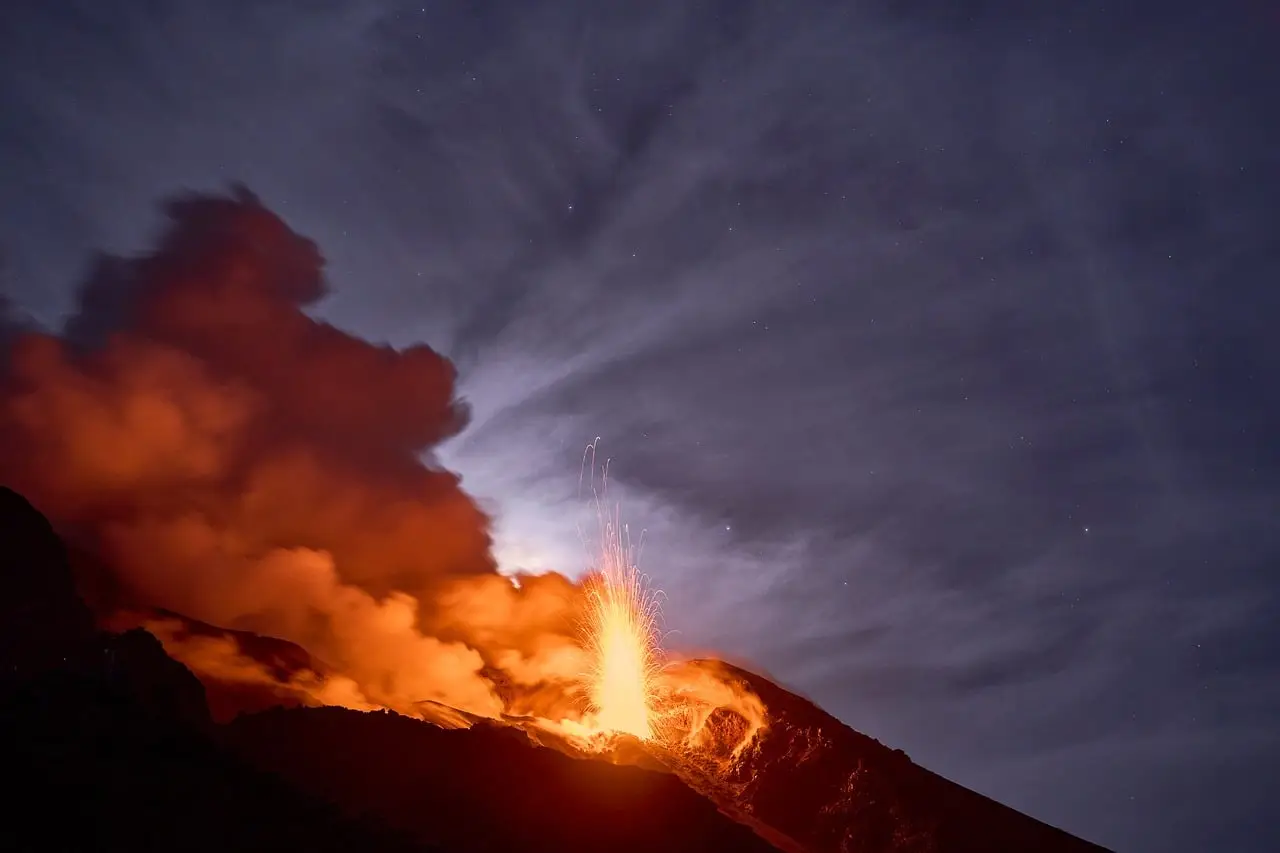
Superheated magma can delay crystal formation for more than eight hours — roughly 24 times longer than conventional magma — and that delay may be what allows some volcanoes to fire lava fountains hundreds of meters into the sky while others merely ooze. That is the central finding of a new study led by the University of Manchester and published in the journal Nature Communications.
For practitioners who model volcanic hazards, the result adds a variable that has long sat outside the standard toolkit: the magma's temperature history, not just its chemical composition or gas pressure.
What did the experiments show?
The research team, an international group, collected volcanic material from the 2021 Tajogaite eruption on La Palma in Spain's Canary Islands. They recreated volcanic conditions in the laboratory and watched crystal formation inside magma samples using advanced X-ray imaging.
The contrast was sharp:
- Magma without superheating began forming crystals within roughly 20 minutes.
- Strongly superheated magma stayed crystal-free for more than eight hours.
That gap matters because crystals behave like thickener in paint. As magma cools, tiny mineral crystals form and grow, and their presence makes the molten material more viscous — literally thicker and harder to move. Take the crystals out of the picture, and the magma stays runny.
In short: heat decides how quickly magma stiffens.
How does superheating work?
Superheating occurs when magma reaches temperatures above the point at which its crystals would normally remain stable. Under normal cooling, microscopic crystal seeds act as anchors that encourage new crystals to develop. Intense heat dissolves those seeds before they can take hold.
Without seeds, crystallization stalls. The magma keeps the fluidity of fresh molten rock for hours instead of minutes, even as it migrates through the crust.
Why does fluid magma produce lava fountains?
The team fed its laboratory measurements into computer models that simulate magma movement beneath volcanoes. The models showed a clear mechanical chain:
- Delayed crystallization keeps magma fluid, so it rises toward the surface faster.
- Faster ascent traps volcanic gases rather than letting them bleed off gradually.
- Trapped gases then propel molten rock violently upward — the lava fountain.
- Conversely, magma that crystallizes early thickens and rises slowly, giving gases time to escape. The result is a gentler eruption with flowing lava rather than a vertical jet.
This is the mechanism the study puts forward to explain a long-standing puzzle: why chemically similar volcanoes can behave so differently, some producing dramatic fountains and others relatively gentle flows.
The explanation is a model-based inference, not a direct observation of a live conduit, and the researchers frame their conclusion accordingly — the experiments and simulations show that delayed crystallization can drive rapid ascent and fountaining.
What changes for hazard assessment?
The study, published in Nature Communications, argues that a volcano's heating history can shape its eruptive behavior. If follow-up work confirms the effect across other volcanic systems, hazard assessments could eventually incorporate magma temperature history as a routine input, alongside the two factors modelers already rely on: chemical composition and gas pressure.
For now, the finding stands as a laboratory-validated clue rather than a forecasting method. The experiments used material from a single eruption — Tajogaite in 2021 — and the modeling results await testing against other volcanoes with different chemistries and histories.
The takeaway in one line: how hot magma got, and how long it stayed that hot, may decide whether a volcano erupts as a fountain or a flow.
via industrytap.com (Source)
More from Marcus Bennett
Show full bio
News editor covering regulation, policy and their impact on general science news at SciBeat.
584 articles
Nearby plates
- Mount Etna's Hidden Plumbing: Two Eruptions, Two Speeds
- Japan's Kikai Supervolcano Is Refilling With Fresh Magma, Study Finds
- Study suggests Earth’s core carbon came from outer solar system
- Deep-Earth Magma Can Store Hidden Oxygen, Study Finds
- Earth's Carbon May Have Arrived Late, From the Outer Solar System